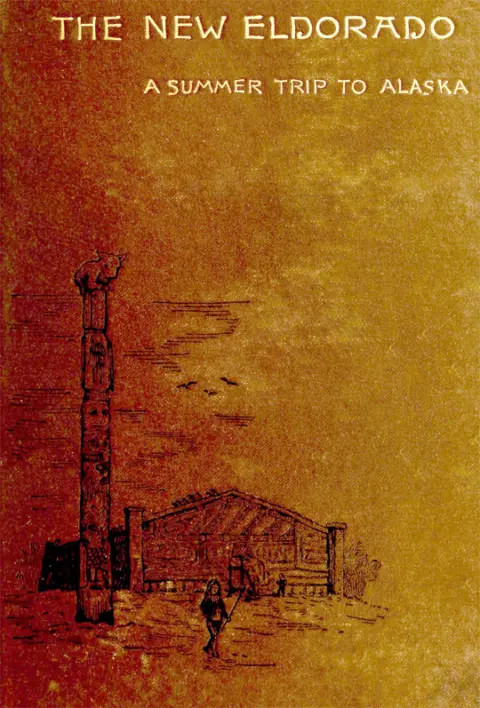
The New Eldorado: A Summer Journey to Alaska
Maturin M. (Maturin Murray) Ballou
THE CLASSIC COLLECTION · 1894
"The Pearl of India" by Maturin M. Ballou is a travelogue written in the late 19th century. The author shares his experiences and observations as he journeys to Ceylon, also known as Sri Lanka, detailing the island's captivating beauty, rich history, and vibrant culture. This work is likely aimed at readers interested in exotic locales, historical insights, and the natural wonders of the region. The opening of the book sets the scene for Ballou's voyage from Asia to Ceylon, describing the awe-inspiring sights and phenomena encountered at sea. He recounts oceanic adventures, such as the phosphorescent waves and dangerous encounters with marine life, as well as the thrill of spotting land after a long journey. The narrative captures the essence of travel, from reflections on the solitude of the sea to the excitement of arrival at the island, culminating in vivid descriptions of the lush landscapes and bustling local life encountered upon landing in Colombo. The use of detailed imagery and personal anecdotes makes the opening a rich prelude to further exploration and commentary on Ceylon's unique characteristics.
Introduction adapted from the source catalogue; source summaries may be automatically generated.
Free to read · English · 81,582 words · No account needed
MAKE TIME FOR A GOOD BOOK
On by default. Untick to stop anonymous reading totals. Each page counts after 10 seconds in view. How this works.
Anonymous counting is on unless you have switched it off.
The betelnut is the product of the areca palm, and resembles a nutmeg in shape and size. A couple of hundred generally form the annual yield of a single tree. Like the cocoanut or our American chestnut, the fruit grows inside of a husk, russet colored, and fibrous in its nature. Farther to the eastward, among the Straits Settlements, the areca palm is known as the Penang-tree because of its predominance in that well-wooded island, where human life exhibits only its most sensuous and lowest form, and where vegetation, fruits, and flowers revel in exuberance.
The banian-tree with its aerial roots is indigenous to Ceylon, flourishing after its peculiar fashion in all parts of the island. At a point on the coast about half-way between Colombo and Galle, there is a grand specimen of this self-producing arboreal giant. The road passes directly through its extensive grove, beneath its dense and welcome shade, which here forms a sort of triumphal arch. The author has seen but one other example of the banian-tree so large and fine in effect; namely, that of world-wide fame in the Botanical Garden just outside of Calcutta, under the thick foliage and branches of which a whole regiment of infantry might comfortably encamp. The age of the banian is incalculable. It multiplies itself so that it may be said in one sense to live forever. Many centuries of age are claimed for this tree in the south of Ceylon.
Speaking of the road between Colombo and Galle, too much praise cannot be bestowed upon these government thoroughfares. Whether on long or short routes, they are admirably and substantially constructed, consequently they are easy to keep in good order. The island has over three thousand miles of made roadways in an area of twenty-five thousand square miles. "The first and most potent means of extending civilization," says a modern pioneer, "is found in roads, the second in roads, the third again in roads." The best thoroughfares in the neighborhood of our New England cities are hardly equal to these. The Ceylon public roads would delight Colonel Pope, of bicycle fame; he who so eloquently and none too earnestly advocates the great importance of good common roads, especially in New England, where we are, when the truth is fairly spoken, sadly deficient in them. The new States of the West and Southwest far excel us in this respect. The road on which we have just embarked, aside from its excellence in point of usefulness (the railway from Colombo to Galle was not completed when the author traveled over the route), is one of ideal beauty, passing through a forest and shore region combined. This turnpike abounds in unique effects and a succession of charming surprises. One is never quite prepared for the natural tableaux which constantly present themselves. An experienced traveler in the low latitudes is apt to anticipate the probabilities when starting forth on a new tropical route, but one must behold in order to properly understand the nature of Ceylon forest scenery. The Colombo and Galle road forms an almost continuous avenue through overarching cocoanut palms, with frequent glimpses of the Indian Ocean on one side and of fresh-water ponds and small lakes on the other, the latter all alive with aquatic birds, such as water-pheasants, plovers, teal, sandlarks, and the like. The "painted snipe," as it is called, is very common, having a chocolate-colored head and a white collar, with back and wings of green, the tail feathers being spotted with yellow like a butterfly's wings. It is a very active bird and is never quiet for a single moment, constantly teetering when upon its feet while seeking for red worms in the sand. A very similar bird is often seen on the salt-water beaches of New England, which resembles this Ceylon example in shape, size, and habits, but not in the texture of its feathers. The American bird also called snipe is of a uniform pale lavender color. It is shy enough on our coast, but its tropical brother is as tame as a pigeon. These places are teeming with blossoms,--pink lilies, bearing broad, floating, heart-shaped leaves whose roots are securely anchored to the bottom. Some of the plants resting so serenely on the glass-like surface have short, delicate white roots, and receive their nutriment only from the air and water, not coming in contact with the earth at all. Others, with insect-inviting petals, close promptly upon the victims allured to their embrace and digest them at leisure, thriving marvelously upon this animal nourishment. Any agency which tends to diminish the myriads of flies and mosquitoes is an assured blessing.
Your reading position is saved on this browser. Take it to another device with a library code. Reading pages adapt to text, rather than matching a printed edition.
Maturin M. (Maturin Murray) Ballou
Maturin M. (Maturin Murray) Ballou
Maturin M. (Maturin Murray) Ballou
Maturin M. (Maturin Murray) Ballou
BEHIND THE BOOK
This eBook is for the use of anyone anywhere in the United States and most other parts of the world at no cost and with almost no restrictions whatsoever. You may copy it, give it away or re-use it under the terms of the Project Gutenberg License included with this eBook or online at www.gutenberg.org. If you are not located in the United States, you will have to check the laws of the country where you are located before using this eBook. Read the source licence.
The original source file, including credits and licence, is retained by this library. Request an original-format copy at no charge. Please include the book title and Project Gutenberg identifier #31923.
KEEP YOUR CURIOSITY GOING
Wilfrid Scawen Blunt
Wilfrid Scawen Blunt

E. W. (Edgar Watson) Howe
Francis Greenleaf Allinson & Anne C. E. (Anne Crosby Emery) Allinson
Cyrenus Cole

John Martineau