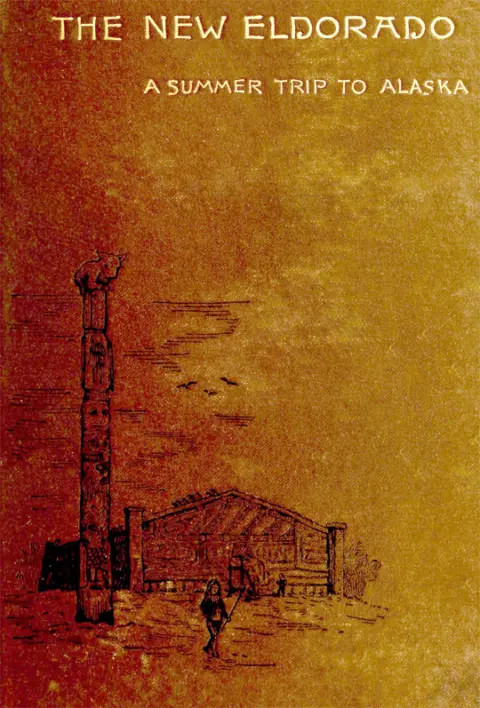
The New Eldorado: A Summer Journey to Alaska
Maturin M. (Maturin Murray) Ballou
THE CLASSIC COLLECTION · 1894
"The Pearl of India" by Maturin M. Ballou is a travelogue written in the late 19th century. The author shares his experiences and observations as he journeys to Ceylon, also known as Sri Lanka, detailing the island's captivating beauty, rich history, and vibrant culture. This work is likely aimed at readers interested in exotic locales, historical insights, and the natural wonders of the region. The opening of the book sets the scene for Ballou's voyage from Asia to Ceylon, describing the awe-inspiring sights and phenomena encountered at sea. He recounts oceanic adventures, such as the phosphorescent waves and dangerous encounters with marine life, as well as the thrill of spotting land after a long journey. The narrative captures the essence of travel, from reflections on the solitude of the sea to the excitement of arrival at the island, culminating in vivid descriptions of the lush landscapes and bustling local life encountered upon landing in Colombo. The use of detailed imagery and personal anecdotes makes the opening a rich prelude to further exploration and commentary on Ceylon's unique characteristics.
Introduction adapted from the source catalogue; source summaries may be automatically generated.
Free to read · English · 81,582 words · No account needed
MAKE TIME FOR A GOOD BOOK
On by default. Untick to stop anonymous reading totals. Each page counts after 10 seconds in view. How this works.
Anonymous counting is on unless you have switched it off.
So far as the flora and fauna of Ceylon are concerned, it resembles the islands of the Malay group lying far to the eastward, much more than it does the land which is situated so near to it at the north. Geologists tell us that the island has for ages past been slowly rising from the ocean level, and we know that well-preserved marine shells are found in masses at a considerable elevation, ten miles inland, both in the north and the south of Ceylon, and especially in the foot-hills of the central mountain, or Kandian range, as it is called, near Ratnapura. When we pause to consider for a moment the possible age of these marine deposits, preconceived and popular ideas of the time which has passed since the creation of the world are utterly nullified. That the process of rising above sea level has been progressing for ages is undoubtedly true, as in the instance of Norway and Sweden, where careful measurements have been recorded, from time to time, during a period of three hundred years, clearly demonstrating that the land of those countries is steadily rising, while the adjacent sea subsides. In some other instances the process is directly reversed, the land obviously, though slowly, sinking, and the ocean rising. This is a well-known operation, not confined to any one portion of the globe. At the ancient town of Pozzuoli, on the shore of the Bay of Naples, there is a solid marble pavement once belonging to a pagan temple, built between two and three thousand years ago. The temple was doubtless originally founded on the dry land, but this indestructible floor is between nine and ten feet below the level of the sea at this writing.
Ceylon is peculiar in its shape, resembling a cone, the smaller end nearest to the continent which lies so close to it. This northern portion of the island is a flat, narrow peninsula with a sandy soil, but which by proper management is made to yield certain crops fairly well. The western and southern coasts are low and densely wooded, having many small bays and picturesque indentations, while the eastern side is characterized by a bold and precipitous shore, quite inaccessible from the sea, yet affording one or two excellent harbors and several indifferent ones. The important and much-praised port of Trincomalee is on this side of the island, where several open roadsteads are commercially available for coasting vessels, so built, like most oriental water-craft, that they can be drawn up on the beach in rough weather. The coast is blockaded on the northwest by numberless rocks, shoals, and sandbanks, impeding navigation, though the island can be circumnavigated, as already indicated, by means of the Paumben Pass, between Ramisseram and the continent. The north and northwest coasts are especially low and flat, undoubtedly formed by ages of sand deposits brought down from the north by the ceaseless currents and lodged upon coral formations as a foundation. In area, Ceylon is more than three times the size of Massachusetts, containing twenty-five thousand square miles. The circuit of the island by water is calculated to be about seven hundred miles. In Pliny's time he made the circumference four times that distance. The latest statistics give it a population of three millions, which is a sparse occupancy for so extensive a territory, and one whose natural resources are sufficient for the support of that number of people many times multiplied. Taken as a whole, the island is perhaps the most thinly inhabited spot in the Orient, though it is the largest and most important of what are known as the crown colonies of the British Empire. Its number of people is annually on the increase, as shown by the English Colonial Blue Book,--an indisputable evidence of material prosperity. The extensive ruins of ancient cities existing in the interior show that there must have been in the past at least thrice the present number of people upon the island, while some authorities place the possible aggregate much higher than we have named, basing their calculation upon the extraordinary size and number of the "buried cities," one of which is reputed to have contained three million inhabitants, and over four hundred thousand organized fighting men, whose weapons were bows, arrows, and spears.
Your reading position is saved on this browser. Take it to another device with a library code. Reading pages adapt to text, rather than matching a printed edition.
Maturin M. (Maturin Murray) Ballou
Maturin M. (Maturin Murray) Ballou
Maturin M. (Maturin Murray) Ballou
Maturin M. (Maturin Murray) Ballou
BEHIND THE BOOK
This eBook is for the use of anyone anywhere in the United States and most other parts of the world at no cost and with almost no restrictions whatsoever. You may copy it, give it away or re-use it under the terms of the Project Gutenberg License included with this eBook or online at www.gutenberg.org. If you are not located in the United States, you will have to check the laws of the country where you are located before using this eBook. Read the source licence.
The original source file, including credits and licence, is retained by this library. Request an original-format copy at no charge. Please include the book title and Project Gutenberg identifier #31923.
KEEP YOUR CURIOSITY GOING
Wilfrid Scawen Blunt
Wilfrid Scawen Blunt

E. W. (Edgar Watson) Howe
Francis Greenleaf Allinson & Anne C. E. (Anne Crosby Emery) Allinson
Cyrenus Cole

John Martineau