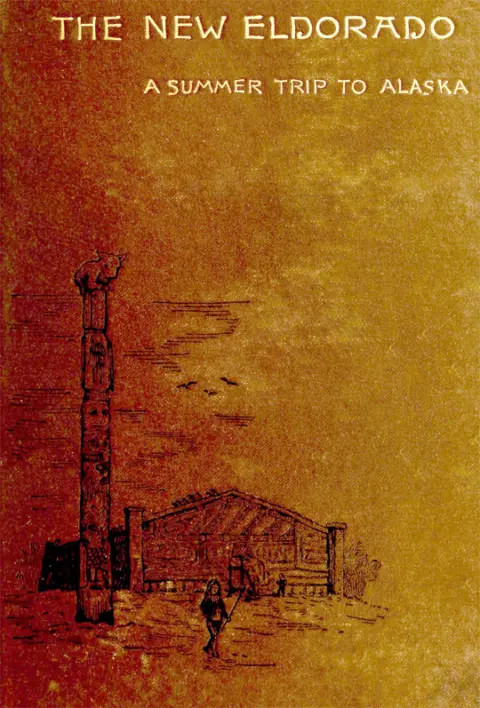
The New Eldorado: A Summer Journey to Alaska
Maturin M. (Maturin Murray) Ballou
THE CLASSIC COLLECTION · 1894
"The Pearl of India" by Maturin M. Ballou is a travelogue written in the late 19th century. The author shares his experiences and observations as he journeys to Ceylon, also known as Sri Lanka, detailing the island's captivating beauty, rich history, and vibrant culture. This work is likely aimed at readers interested in exotic locales, historical insights, and the natural wonders of the region. The opening of the book sets the scene for Ballou's voyage from Asia to Ceylon, describing the awe-inspiring sights and phenomena encountered at sea. He recounts oceanic adventures, such as the phosphorescent waves and dangerous encounters with marine life, as well as the thrill of spotting land after a long journey. The narrative captures the essence of travel, from reflections on the solitude of the sea to the excitement of arrival at the island, culminating in vivid descriptions of the lush landscapes and bustling local life encountered upon landing in Colombo. The use of detailed imagery and personal anecdotes makes the opening a rich prelude to further exploration and commentary on Ceylon's unique characteristics.
Introduction adapted from the source catalogue; source summaries may be automatically generated.
Free to read · English · 81,582 words · No account needed
MAKE TIME FOR A GOOD BOOK
On by default. Untick to stop anonymous reading totals. Each page counts after 10 seconds in view. How this works.
Anonymous counting is on unless you have switched it off.
"How terrible it would be," added the devout Japanese, "if he (the god of fire) were to consume these sacred temples," pointing as he spoke to the unique group of buildings so elaborately ornamented, which contain such priceless hoards of rich bronzes, carved images, and delicate lacquered ware.
The sacred temples of Nikko are in their way quite unequaled in the world, having, with other remarkable attractions, the consecrating influence of great antiquity. The oldest Japanese bronzes are valued at their weight in gold; indeed, that precious metal forms a large percentage of the material of which they are composed. Modern bronze, as compared with that of ten centuries ago, in Japan, is a very different and inexpensive compound.
Any person who has been at sea in a severe storm when there were Chinamen on board the ship has seen the superstitious Mongolians throw bits of "joss-paper" overboard, bearing certain inscriptions and mysterious characters, intended to pacify the water-devil, as they call the spirit of the storm.
A peculiar race of wild people, called Veddahs, inhabit the forest fastness of Bintenne, a district situated southeast from Kandy forty or fifty miles, and a hundred and twenty or thereabouts from Colombo, in a northeast direction. The territory to which these people confine themselves is known as Vedda-ratta, or country of the Veddahs, whither their ancestors retired more than two thousand years ago, when their Singhalese conquerors came to Ceylon from the north. Bintenne, which gives its name to the district, transcends Anuradhapura in antiquity. Long before the Wijayan invasion, it was one of the chief aboriginal cities, and for centuries was the most important place in Ceylon. During the Dutch dominion Bintenne was made a place of note, and is spoken of by them as "the finest city in the island." It is now remote, a circumscribed and secluded district; very few Europeans have ever penetrated any great distance within its borders. Indeed, the density of its jungles forbids access to those who know not its solitary footpaths. The singular people of whom we write are now inconsiderable in number, speaking a language understood only by themselves, and are doubtless descendants of the aborigines of the island, a race who lived here previous to any dates of which we have record. The country which they inhabit is about ninety miles long by half that distance in width, in the southeastern part of the island, and extends towards the sea from the base of the mountain region of the central province, commencing near the base of the Badulla hills. There is abundant evidence connecting these barbarians with the Yakkos, who were the oldest known race in Ceylon. They live mostly upon the game which they kill with bows and arrows. They build no regular habitations, live in caves, grass huts, and the open air, and avoid intercourse with all other tribes, especially the English. They are an undersized people, the men being only five feet in height on an average, and the women still less. Their neglect of any sort of ablution is a marked feature of their habits, while their intellectual capacity is placed, by people who have taken considerable trouble to inform themselves upon the subject, at as low a gauge as possible in human beings. In the matter of cleanliness, the wild animals about them are more civilized than they, their long, tangled, unkempt hair adding to their weird, uncanny appearance. What little intercourse they have with other people is almost entirely by signs, and they seem to be either disinclined or unable to talk intelligently. They are said to be wonderful marksmen with bow and arrow. As they practice constantly from boyhood, this is but natural. With the exception of the knife, the bow and arrow is their only weapon of offense or defense. It is thought that there are not over a couple of thousand Veddahs now in existence, an aggregate which is annually diminished. They are still accustomed to the most primitive ways, producing fire, when it is needed, by rapidly turning a pointed stick in a hole made in perfectly dry wood, their bowstrings acting as a propeller in twirling the stick. This is a sure but laborious way to obtain fire. It is a fact which has been commented upon considerably, and which is perhaps worthy of mention in this connection, that, in many important particulars, these Veddahs are very like the wild native tribes of Australia. This is not only evinced in certain physical resemblances, but also in their hereditary habits, their unwritten tongue, and some other particulars. Much is made of these facts by certain writers on physical geography, who have a theory that in the far past Australia was joined or was adjacent to Ceylon, notwithstanding the wide reach of ocean which now intervenes.
Your reading position is saved on this browser. Take it to another device with a library code. Reading pages adapt to text, rather than matching a printed edition.
Maturin M. (Maturin Murray) Ballou
Maturin M. (Maturin Murray) Ballou
Maturin M. (Maturin Murray) Ballou
Maturin M. (Maturin Murray) Ballou
BEHIND THE BOOK
This eBook is for the use of anyone anywhere in the United States and most other parts of the world at no cost and with almost no restrictions whatsoever. You may copy it, give it away or re-use it under the terms of the Project Gutenberg License included with this eBook or online at www.gutenberg.org. If you are not located in the United States, you will have to check the laws of the country where you are located before using this eBook. Read the source licence.
The original source file, including credits and licence, is retained by this library. Request an original-format copy at no charge. Please include the book title and Project Gutenberg identifier #31923.
KEEP YOUR CURIOSITY GOING
Wilfrid Scawen Blunt
Wilfrid Scawen Blunt

E. W. (Edgar Watson) Howe
Francis Greenleaf Allinson & Anne C. E. (Anne Crosby Emery) Allinson
Cyrenus Cole

John Martineau