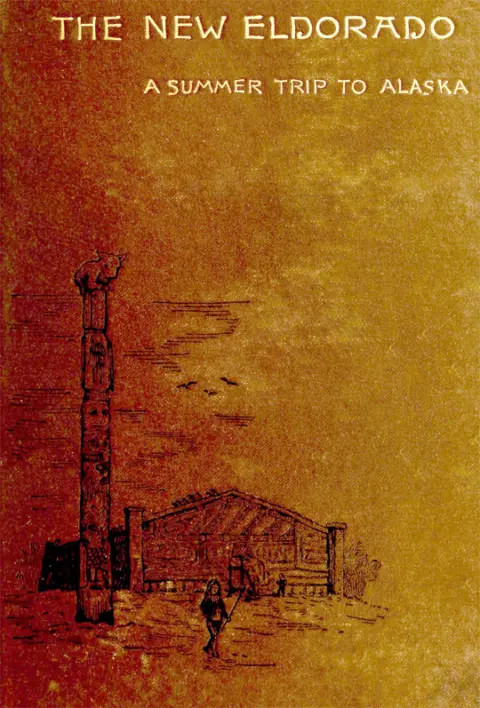
The New Eldorado: A Summer Journey to Alaska
Maturin M. (Maturin Murray) Ballou
THE CLASSIC COLLECTION · 1894
"The Pearl of India" by Maturin M. Ballou is a travelogue written in the late 19th century. The author shares his experiences and observations as he journeys to Ceylon, also known as Sri Lanka, detailing the island's captivating beauty, rich history, and vibrant culture. This work is likely aimed at readers interested in exotic locales, historical insights, and the natural wonders of the region. The opening of the book sets the scene for Ballou's voyage from Asia to Ceylon, describing the awe-inspiring sights and phenomena encountered at sea. He recounts oceanic adventures, such as the phosphorescent waves and dangerous encounters with marine life, as well as the thrill of spotting land after a long journey. The narrative captures the essence of travel, from reflections on the solitude of the sea to the excitement of arrival at the island, culminating in vivid descriptions of the lush landscapes and bustling local life encountered upon landing in Colombo. The use of detailed imagery and personal anecdotes makes the opening a rich prelude to further exploration and commentary on Ceylon's unique characteristics.
Introduction adapted from the source catalogue; source summaries may be automatically generated.
Free to read · English · 81,582 words · No account needed
MAKE TIME FOR A GOOD BOOK
On by default. Untick to stop anonymous reading totals. Each page counts after 10 seconds in view. How this works.
Anonymous counting is on unless you have switched it off.
Here and there one comes upon a Buddhist or Hindu temple, and now we pause before a Mohammedan mosque. Each sect is eminently devout after its own fashion, and all are at liberty to follow the dictates of their own consciences. Two of our party having thoughtlessly entered one of the Hindu sanctuaries without removing their shoes, great indignation was expressed by some natives near at hand, and for a few moments it really appeared as though a downright fight would ensue. However, peace was restored at last by complying with the custom of the place, and promenading daintily through the temple in our stockings. Additional backsheesh was also awarded to the custodian of the shrine to pacify his wounded sensibilities. Before we left the spot, everybody was quite serene. To the author, the most curious part of this experience was that our little party wore their hats through it all, no objection being made. European etiquette demands of one to uncover the head as a mark of respect on special occasions, but the barbaric, or rather the oriental fashion, is to uncover the feet. There are many curious points of difference in symbols of respect. The Tamil covers his head with an ample turban out of deference to those of a higher caste, while the Singhalese proper would not think it respectful to wear anything upon his head in the presence of a superior. A Chinaman lets down his braided pigtail as a mark of respect to those above him in rank, or as a token of reverence in the temple, while a Singhalese twists his braid into a snood at the back of his head, and secures it by a shell comb, for the same purpose.
The display of vegetables and fruit offered for sale on improvised benches or tables outside of the cabins, forming groups vivid in color and novel in shape, is interesting to a stranger. The collection includes pumpkins, sweet potatoes, oranges, pineapples, mangoes, guavas, and bananas, together with zapotas, rose-apples, limes, yams, and many other varieties. They are often arranged upon broad leaves, fresh and green, which impart to them a refreshing air of coolness. Some large, handsome bunches of grapes were observed, for which a high price was asked (thirty cents per pound). These came from the northern part of the island, on the peninsula of Jaffna, where they are raised in small quantities. Ripe oranges in Ceylon have a queer habit of reaching that palatable condition while quite green externally. They are very sweet, having a thin skin and plenty of juice, together with a flavor equal to those of the Indian River district in Florida, and superior to those of California. Prices are very moderate; a large ripe pineapple costs twopence, and half a dozen oranges are sold for the same sum. Statistics show that between nine and ten thousand acres are devoted to the raising of pineapples in Ceylon, where they ripen to great perfection. The little open-air shops are called "caddies," and are always presided over by native women, who, under an air of oriental indifference as to whether you purchase their wares or not, are yet exercised by suppressed eagerness to have you do so. A few of these simple caddies were observed to be prettily decorated with wreaths of myrtle, yellow flowers, and wisps of sweet lemon grass, hung on either side of the fruit, dispensing an exquisite fragrance which dominated all the offensive odors of the locality. This arrangement betrayed a woman's hand, prompted by a certain delicacy of fancy and an eye for natural beauty. There always exists this half-effaced charm within the bosom of the humblest of the sex, whether in Crim Tartary, the Sandwich Islands, or the Parisian boulevards. The surroundings are kaleidoscopic in effect, composed of contrasting races, bronzed men in white turbans, native women very nearly nude, queer physiognomies, busy itinerant salesmen, boisterous children covered only by their copper-colored skins, mingling with native domestic servants in fancy dresses of red and yellow, and bejeweled nurses, sent by their European mistresses to purchase some favorite fruit. The scene is constantly shifting, and the combinations rapidly changing. Every fresh visit to this portion of Colombo reveals some new phases of oriental life, which are often recalled to the mind's eye when one is far away and compassed by very different surroundings.
Your reading position is saved on this browser. Take it to another device with a library code. Reading pages adapt to text, rather than matching a printed edition.
Maturin M. (Maturin Murray) Ballou
Maturin M. (Maturin Murray) Ballou
Maturin M. (Maturin Murray) Ballou
Maturin M. (Maturin Murray) Ballou
BEHIND THE BOOK
This eBook is for the use of anyone anywhere in the United States and most other parts of the world at no cost and with almost no restrictions whatsoever. You may copy it, give it away or re-use it under the terms of the Project Gutenberg License included with this eBook or online at www.gutenberg.org. If you are not located in the United States, you will have to check the laws of the country where you are located before using this eBook. Read the source licence.
The original source file, including credits and licence, is retained by this library. Request an original-format copy at no charge. Please include the book title and Project Gutenberg identifier #31923.
KEEP YOUR CURIOSITY GOING
Wilfrid Scawen Blunt
Wilfrid Scawen Blunt

E. W. (Edgar Watson) Howe
Francis Greenleaf Allinson & Anne C. E. (Anne Crosby Emery) Allinson
Cyrenus Cole

John Martineau