THE CLASSIC COLLECTION✦The garden of resurrectionCLASSIC FREE BOOKS
The garden of resurrection
E. Temple (Ernest Temple) Thurston
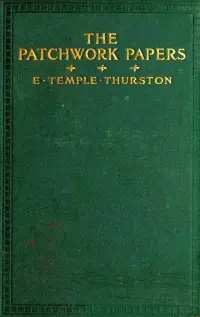
THE CLASSIC COLLECTION · 1910
"The Patchwork Papers" by E. Temple Thurston is a collection of illustrated essays written in the early 20th century. The book explores themes of beauty, memory, and the human experience, weaving together reflections on life through a series of narratives that reveal the author's insights into various characters and situations. Among those introduced are a little old pensioner who creates a patchwork quilt, and Bellwattle, a character with a deep maternal instinct and a love for plants. The opening of the work establishes a tone of introspection and sentimentality as the author reflects on beauty and truth in life. The narrative begins with an encounter with an elderly pensioner, who expresses her desire to create a quilt as a means of leaving behind a lasting memory, emphasizing the themes of connection and remembrance. There is a poignant dialogue between the narrator and the pensioner, revealing her determination to contribute something meaningful, suggesting that our thoughts keep the memory of loved ones alive. This initial chapter sets the stage for further explorations of human emotions and relationships throughout the collection, promising readers a rich tapestry of stories that meld the beautiful with the everyday.
Introduction adapted from the source catalogue; source summaries may be automatically generated.
Free to read · English · 32,084 words · No account needed
MAKE TIME FOR A GOOD BOOK
On by default. Untick to stop anonymous reading totals. Each page counts after 10 seconds in view. How this works.
Anonymous counting is on unless you have switched it off.
I try to conceive a woman in a fit of jealousy sitting down to express her emotions through the medium of the binomial theorem—which I must tell you I know to be a method of expanding X and Y, bracketed to the Nth power, to an infinite series of powers—I try to conceive her doing that, but my conception always fails. Far more readily can I see her inviting to tea the creature who is the cause of her jealousy, and evincing the sweetest friendship for her. Now that is expression, if you like, bracketed, moreover, without any necessity for your binomial theorem, to the Nth power, and expanded to an infinite expression of femininity.
To give you just the simplest example of this matter of the practicality of women in mathematics, I must tell you that Cruikshank and I the other evening were recalling our prowess at Euclid; setting each other problems to prove—well, you know the routine of the propositions of Euclid.
In the midst of darning some socks and, having listened to us in silence for at least an hour, Bellwattle looked up.
“Was Euclid mad?” she asked, quite seriously.
There was something in the nature of a ricochet in that question. It touched not only Euclid, for whom we have infinite respect, but also ourselves, for whom we have more.
“The sanest person that ever lived,” said Cruikshank, shortly.
“Then why did he waste his time inventing all that rubbish? What’s the good of it, anyhow?”
I put away my pencil with which from memory I had just been drawing the diagram for the fourth proposition of the second book.
“It develops,” I answered, “the reasoning power in the human animal—a not unworthy or wholly unnecessary purpose.”
She darned a few stitches in silence.
“Has it ever done any good besides that?” she inquired presently.
“Well,” said Cruikshank, “it teaches you, for example, how, without measuring and purely by the light of reason, to construct an equilateral triangle on a given finite straight line.”
Bellwattle laid down her sock with the knob of wood inside it and she looked at both of us as though we were creatures from another world.
“And what in the name of goodness,” said she, “is an equi—whatever-you-call-it triangle?”
Cruikshank went on with his explanation quite cheerily. On this proposition he was so sure of himself that confidence was actually glowing in his face.
“Well,” said he, “you know what a triangle is, don’t you?”
She nodded her head promisingly.
“One of those things they sometimes play in bands.”
Your reading position is saved on this browser. Take it to another device with a library code. Reading pages adapt to text, rather than matching a printed edition.
E. Temple (Ernest Temple) Thurston
E. Temple (Ernest Temple) Thurston
E. Temple (Ernest Temple) Thurston
BEHIND THE BOOK
This eBook is for the use of anyone anywhere in the United States and most other parts of the world at no cost and with almost no restrictions whatsoever. You may copy it, give it away or re-use it under the terms of the Project Gutenberg License included with this eBook or online at www.gutenberg.org. If you are not located in the United States, you will have to check the laws of the country where you are located before using this eBook. Read the source licence.
The original source file, including credits and licence, is retained by this library. Request an original-format copy at no charge. Please include the book title and Project Gutenberg identifier #62297.
KEEP YOUR CURIOSITY GOING

David Patterson (Spirit) Hatch

David Patterson (Spirit) Hatch

David Patterson (Spirit) Hatch

Ralph Waldo Emerson

Maurice Baring

Oscar Wilde & James McNeill Whistler