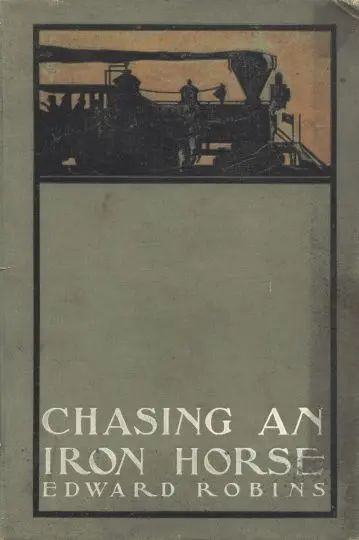
Chasing an Iron Horse; Or, A Boy’s Adventures in the Civil War
Edward Robins
THE CLASSIC COLLECTION · 1898
"The Palmy Days of Nance Oldfield" by Edward Robins is a historical account likely written in the late 19th century. The book chronicles the life of Anne Oldfield, a celebrated comedienne of the early 18th century, tracing her journey from humble beginnings as a seamstress to becoming a prominent figure on the English stage. The narrative captures the culture of the theatrical world during her time, offering insight into the social dynamics and the evolution of drama in England. The opening of the book introduces Anne Oldfield's origins, noting her birth into a family with a royal connection yet plunged into poverty after her father's death. Despite her circumstances, her talent and deep appreciation for theatre emerge early, as she captivates audiences with her voice while performing at the Mitre Tavern. The narrative sets the stage for her eventual rise in the theatre scene, detailing her encounters with influential figures like Captain Farquhar and Sir John Vanbrugh, who encourage her ambitions. Through vivid depictions of her charm and intelligence, the start of the book establishes the foundation for a journey marked by artistic evolution and societal intrigue as Oldfield seeks her place within the competitive world of 18th-century theatre.
Introduction adapted from the source catalogue; source summaries may be automatically generated.
Free to read · English · 75,061 words · No account needed
MAKE TIME FOR A GOOD BOOK
On by default. Untick to stop anonymous reading totals. Each page counts after 10 seconds in view. How this works.
Anonymous counting is on unless you have switched it off.
[Footnote A: Addison's comment about these two favourite comedians shows that then, as now, eccentricity in dress formed a popular species of stage humour.]
[Footnote B: Sir George Etherege, in his comedy of "The Comical
Revenge, or Love in a Tub."]
(From the "Spectator")
No. 338. FRIDAY, MARCH 28, 1712.
"Nil fuit unquam
Sic dispar sibi."
HOR. SAT. III. 1-1-18.
"Made up of nought but inconsistencies."
I find the tragedy of the "Distressed Mother" is published to-day. The author of the prologue,[A] I suppose pleads an old excuse I have read somewhere, of "being dull with design;" and the gentleman who writ the epilogue[B] has, to my knowledge, so much of greater moment to value himself upon, that he will easily forgive me for publishing the exceptions made against gaiety at the end of serious entertainments in the following letter: I should be more unwilling to pardon him, than anybody, a practice which cannot have any ill consequence, but from the abilities of the person who is guilty of it.
[Footnote A: Steele.]
[Footnote B: Addison credited Budgell with the epilogue.]
"MR. SPECTATOR,--I had the happiness the other night of sitting very near you, and your worthy friend Sir Roger, at the acting of the new tragedy, which you have in a late paper or two so justly recommended. I was highly pleased with the advantageous situation fortune had given me in placing me so near two gentlemen, from one of which I was sure to hear such reflections on the several incidents of the play as pure nature suggested; and from the other, such as flowed from the exactest art and judgment; though I must confess that my curiosity led me so much to observe the knight's reflections that I was not so well at leisure to improve myself by yours. Nature, I found, played her part in the knight pretty well, till at the last concluding lines she entirely forsook him. You must know, Sir, that it is always my custom, when I have been well entertained at a new tragedy, to make my retreat before the facetious epilogue enters; not but that those pieces are often very well writ, but having paid down my half-crown, and made a fair purchase of as much of the pleasing melancholy as the poet's art can afford me, or my own nature admit of, I am willing to carry some of it home with me; and cannot endure to be at once tricked out of all, though by the wittiest dexterity in the world. However, I kept my seat the other night, in hopes of finding my own sentiments of this matter favoured by your friend's; when, to my great surprise, I found the knight, entering with equal pleasure into both parts, and as much satisfied with Mrs. Oldfield's gaiety, as he had been before with Andromache's greatness. Whether this were no more than an effect of the knight's peculiar humanity, pleased to find at last, that, after all the tragical doings, everything was safe and well, I do not know. But for my own part, I must confess I was so dissatisfied, that I was sorry the poet had saved Andromache, and could heartily have wished that he had left her stone-dead upon the stage. For you cannot imagine, Mr. Spectator, the mischief she was reserved to do me. I found my soul, during the action, gradually worked up to the highest pitch; and felt the exalted passion which all generous minds conceive at the sight of virtue in distress. The impression, believe me, Sir, was so strong upon me, that I am persuaded, if I had been let alone in it, I could at an extremity have ventured to defend yourself and Sir Roger against half a score of the fiercest Mohocks; but the ludicrous epilogue in the close extinguished all my ardour, and made me look upon all such noble achievements as downright silly and romantic. What the rest of the audience felt, I cannot so well tell. For myself I must declare, that at the end of the play I found my soul uniform, and all of a piece; but at the end of the epilogue, it was so jumbled together and divided between jest and earnest, that, if you will forgive me an extravagant fancy, I will here set it down. I could not but fancy, if my soul had at that moment quitted my body, and descended to the poetical shades in the posture it was then in, what a strange figure it would have made among them. They would not have known what to have made of my motley spectre, half comic and half tragic, all over resembling a ridiculous face, that, at the same time, laughs on one side, and cries on the other. The only defence, I think, I have ever heard made for this, as it seems to me the most unnatural tack of the comic tail to the tragic head, is this, that the minds of the audience must be refreshed, and gentlemen and ladies not sent away to their own homes with too dismal and melancholy thoughts about them: for who knows the consequence of this? We are much obliged indeed to poets for the great tenderness they express for the safety of our persons, and heartily thank them for it. But if that be all, pray, good Sir, assure them, that we are none of us like to come to any great harm; and that, let them do their best, we shall, in all probability, live out the length of our days, and frequent the theatres more than ever. What makes me more desirous to have some reformation of this matter is, because of an ill consequence or two attending it: for a great many of our church musicians being related to the theatre, they have, in imitation of these epilogues, introduced in their farewell voluntaries, a sort of music quite foreign to the design of church-services, to the great prejudice of well-disposed people. Those fingering gentlemen should be informed, that they ought to suit their airs to the place and business; and that the musician is obliged to keep to the text as much as the preacher. For want of this, I have found by experience a great deal of mischief. For when the preacher has often, with great piety, and art enough, handled his subject, and the judicious clerk has with the utmost diligence called out two staves proper to the discourse, and I have found in myself, and in the rest of the pew, good thoughts and dispositions, they have been all in a moment dissipated by a merry jig from the organ loft. One knows not what further ill effects the epilogues I have been speaking of may in time produce: but this I am credibly informed of, that Paul Lorrain[A] has resolved upon a very sudden reformation in his tragical dramas; and that, at the next monthly performance, he designs, instead of a penitential psalm, to dismiss his audience with an excellent new ballad of his own composing. Pray, Sir, do what you can to put a stop to these growing evils, and you will very much oblige your humble servant,
Your reading position is saved on this browser. Take it to another device with a library code. Reading pages adapt to text, rather than matching a printed edition.
BEHIND THE BOOK
This eBook is for the use of anyone anywhere in the United States and most other parts of the world at no cost and with almost no restrictions whatsoever. You may copy it, give it away or re-use it under the terms of the Project Gutenberg License included with this eBook or online at www.gutenberg.org. If you are not located in the United States, you will have to check the laws of the country where you are located before using this eBook. Read the source licence.
The original source file, including credits and licence, is retained by this library. Request an original-format copy at no charge. Please include the book title and Project Gutenberg identifier #11717.
KEEP YOUR CURIOSITY GOING
Cécile Tormay

Moritz Busch
John L. Ransom
Frances Wright
Cécile Tormay

Mabel Potter Daggett