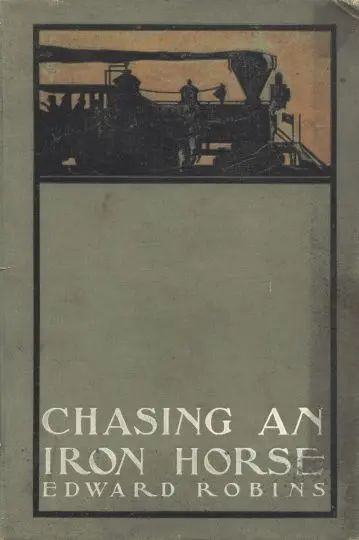
Chasing an Iron Horse; Or, A Boy’s Adventures in the Civil War
Edward Robins
THE CLASSIC COLLECTION · 1898
"The Palmy Days of Nance Oldfield" by Edward Robins is a historical account likely written in the late 19th century. The book chronicles the life of Anne Oldfield, a celebrated comedienne of the early 18th century, tracing her journey from humble beginnings as a seamstress to becoming a prominent figure on the English stage. The narrative captures the culture of the theatrical world during her time, offering insight into the social dynamics and the evolution of drama in England. The opening of the book introduces Anne Oldfield's origins, noting her birth into a family with a royal connection yet plunged into poverty after her father's death. Despite her circumstances, her talent and deep appreciation for theatre emerge early, as she captivates audiences with her voice while performing at the Mitre Tavern. The narrative sets the stage for her eventual rise in the theatre scene, detailing her encounters with influential figures like Captain Farquhar and Sir John Vanbrugh, who encourage her ambitions. Through vivid depictions of her charm and intelligence, the start of the book establishes the foundation for a journey marked by artistic evolution and societal intrigue as Oldfield seeks her place within the competitive world of 18th-century theatre.
Introduction adapted from the source catalogue; source summaries may be automatically generated.
Free to read · English · 75,061 words · No account needed
MAKE TIME FOR A GOOD BOOK
On by default. Untick to stop anonymous reading totals. Each page counts after 10 seconds in view. How this works.
Anonymous counting is on unless you have switched it off.
"Lady T. My lord, you grow scurrilous; you'll make me hate you. I'll have you to know I keep company with the politest people in town, and the assemblies I frequent are full of such.
"Lord T. So are the churches--now and then.
"Lady T. My friends frequent them, too, as well as the assemblies.
"Lord T. Yes; and would do it oftener if a groom of the chambers there were allowed to furnish cards to the company.
"Lady T. I see what you drive at all this while. You would lay an imputation on my fame to cover your own avarice! I might take any pleasures, I find, that were not expensive.
"Lord T. Have a care, madam; don't let me think you only value your chastity to make me reproachable for not indulging you in everything else that's vicious. I, madam, have a reputation, too, to guard that's dear to me as yours. The follies of an ungoverned wife may make the wisest man uneasy; but 'tis his own fault if ever they make him contemptible.
"Lady T. My lord, you make a woman mad!
"Lord T. You'd make a man a fool.
"Lady T. If heaven has made you otherwise, that won't be in my power.
"Lord T. Whatever may be in your inclination, madam, I'll prevent you making me a beggar, at least.
"Lady T. A beggar! Croesus, I'm out of patience. I won't come home
till four to-morrow morning.
"Lord T. That may be, madam; but I'll order the doors to be locked at
twelve.
"Lady T. Then I won't come home till to-morrow night.
"Lord T. Then, madam, you shall never come home again." [Exit Lord
Townley.
In the end, of course, Lady Townley is converted to the pleasures of domesticity, and ends the comedy by saying:
"So visible the bliss, so plain the way,
How was it possible my sense could stray?
But now, a convert to this truth I come,
That married happiness is never found from home."
Perhaps when Oldfield delivered these virtuous lines, she thought to herself that happiness, even of the unmarried kind, was never very far away from home. But she forgot sentiment when she came back to give the breezy epilogue:
"Methinks I hear some powder'd critics say
Damn it, this wife reform'd has spoil'd the play!
The coxcombs should have drawn her more in fashion,
Have gratify'd her softer inclination,
Have tipt her a gallant, and clinch'd the provocation.
But there our bard stops short: for 'twere uncivil
T'have made a modern belle all o'er a devil!
He hop'd in honor of the sex, the age
Would bear one mended woman--on the stage."
Your reading position is saved on this browser. Take it to another device with a library code. Reading pages adapt to text, rather than matching a printed edition.
BEHIND THE BOOK
This eBook is for the use of anyone anywhere in the United States and most other parts of the world at no cost and with almost no restrictions whatsoever. You may copy it, give it away or re-use it under the terms of the Project Gutenberg License included with this eBook or online at www.gutenberg.org. If you are not located in the United States, you will have to check the laws of the country where you are located before using this eBook. Read the source licence.
The original source file, including credits and licence, is retained by this library. Request an original-format copy at no charge. Please include the book title and Project Gutenberg identifier #11717.
KEEP YOUR CURIOSITY GOING
Cécile Tormay

Moritz Busch
John L. Ransom
Frances Wright
Cécile Tormay

Mabel Potter Daggett