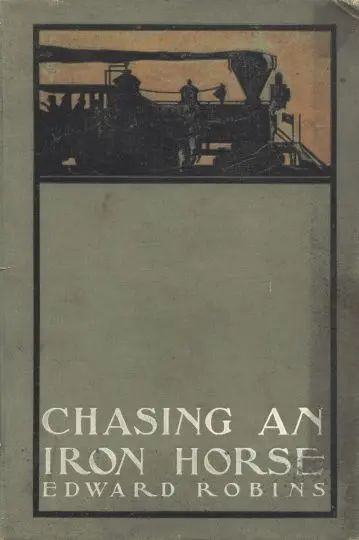
Chasing an Iron Horse; Or, A Boy’s Adventures in the Civil War
Edward Robins
THE CLASSIC COLLECTION · 1898
"The Palmy Days of Nance Oldfield" by Edward Robins is a historical account likely written in the late 19th century. The book chronicles the life of Anne Oldfield, a celebrated comedienne of the early 18th century, tracing her journey from humble beginnings as a seamstress to becoming a prominent figure on the English stage. The narrative captures the culture of the theatrical world during her time, offering insight into the social dynamics and the evolution of drama in England. The opening of the book introduces Anne Oldfield's origins, noting her birth into a family with a royal connection yet plunged into poverty after her father's death. Despite her circumstances, her talent and deep appreciation for theatre emerge early, as she captivates audiences with her voice while performing at the Mitre Tavern. The narrative sets the stage for her eventual rise in the theatre scene, detailing her encounters with influential figures like Captain Farquhar and Sir John Vanbrugh, who encourage her ambitions. Through vivid depictions of her charm and intelligence, the start of the book establishes the foundation for a journey marked by artistic evolution and societal intrigue as Oldfield seeks her place within the competitive world of 18th-century theatre.
Introduction adapted from the source catalogue; source summaries may be automatically generated.
Free to read · English · 75,061 words · No account needed
MAKE TIME FOR A GOOD BOOK
On by default. Untick to stop anonymous reading totals. Each page counts after 10 seconds in view. How this works.
Anonymous counting is on unless you have switched it off.
Lady Townley is nothing more or less than a glorified, matured edition of Lady Betty Modish, and, therefore, a very charming woman. Charming, at least, on the boards of a theatre, if not upon the floor of a real drawing-room. For she has a love of pleasure which can hardly be called domestic, and her unfortunate husband, who would see more of her, is tempted to ask, in the very first scene of the play: "Why did I marry?" "While she admits no lover," Lord Townley soliloquises [for my lady is at least virtuous] "she thinks it a greater merit still, in her chastity, not to care for her husband; and while she herself is solacing in one continual round of cards and good company, he, poor wretch, is left at large to take care of his own contentment. 'Tis time, indeed, some care were taken, and speedily there shall be. Yet let me not be rash. Perhaps this disappointment of my heart may make me too impatient; and some tempers, when reproach'd, grow more untractable."
And when Lady Townley, all graces and ribbons and laces, enters on the scene my lord meekly asks:
"Going out so soon after dinner, madam?"
"Lady T. Lord, my Lord, what can I possibly do at home?
"Lord T. What does my sister, Lady Grace, do at home?
"Lady T. Why, that is to me amazing! Have you ever any pleasure at
home?
"Lord T. It might be in your power, madam, I confess, to make it a little more comfortable to me.
"Lady T. Comfortable! and so, my good lord, you would really have a woman of my rank and spirit, stay at home to comfort her husband! Lord! what notions of life some men have!
"Lord T. Don't you think, madam, some ladies notions are full as
extravagant?"
"Lady T. Yes, my lord, when tame doves live cooped within the pen of your precepts, I do think 'em prodigious indeed!
"Lord T. And when they fly wild about this town, madam, pray what must the world think of 'em then?
"Lady T. Oh! this world is not so ill bred as to quarrel with any
woman for liking it.
"Lord T. Nor am I, madam, a husband so well bred as to bear my wife's being so fond of it; in short, the life you lead, madam--
"Lady T. Is, to me, the pleasantest life in the world.
"Lord T. I should not dispute your taste, madam, if a woman had a right to please nobody but herself.
"Lady T. Why, whom would you have her please?
"Lord T. Sometimes her husband.
Your reading position is saved on this browser. Take it to another device with a library code. Reading pages adapt to text, rather than matching a printed edition.
BEHIND THE BOOK
This eBook is for the use of anyone anywhere in the United States and most other parts of the world at no cost and with almost no restrictions whatsoever. You may copy it, give it away or re-use it under the terms of the Project Gutenberg License included with this eBook or online at www.gutenberg.org. If you are not located in the United States, you will have to check the laws of the country where you are located before using this eBook. Read the source licence.
The original source file, including credits and licence, is retained by this library. Request an original-format copy at no charge. Please include the book title and Project Gutenberg identifier #11717.
KEEP YOUR CURIOSITY GOING
Cécile Tormay

Moritz Busch
John L. Ransom
Frances Wright
Cécile Tormay

Mabel Potter Daggett