
The Writing of News A Handbook with Chapters on Newspaper Correspondence and Copy Reading
Charles G. (Charles Griffith) Ross
THE CLASSIC COLLECTION · 1901
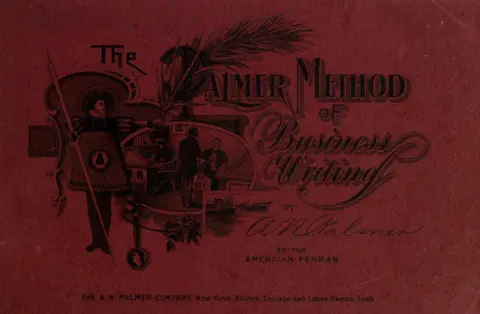
"The Palmer Method of Business Writing" by A. N. Palmer is a self-help guide on penmanship written in the early 20th century. It provides a systematic approach to mastering practical writing skills, aimed primarily at young learners in both public and private educational settings, as well as individuals studying at home. The book emphasizes the cultivation of rapid, legible, and natural handwriting, focusing on techniques that promote ease, endurance, and individual style, contrasting sharply with traditional copy-book methods. The opening of the text introduces the reader to the foundational philosophy of the Palmer Method, which asserts that good handwriting can be achieved through proper physical techniques and consistent practice. Palmer critiques traditional education methods, positing that they stifle creativity and result in ineffective handwriting skills. He provides detailed instructions on posture, arm movement, and the importance of muscle memory, underscoring the necessity of practicing in a relaxed manner without mechanical constraints. The text sets the stage for a series of progressively challenging lessons that aim to develop both the technical ability and artistic expression necessary for effective business writing.
Introduction adapted from the source catalogue; source summaries may be automatically generated.
Free to read · English · 22,207 words · No account needed
MAKE TIME FOR A GOOD BOOK
On by default. Untick to stop anonymous reading totals. Each page counts after 10 seconds in view. How this works.
Anonymous counting is on unless you have switched it off.
Through the adoption of the Palmer Method figures, made small and well within the spaces, the New England Telephone Co. has reduced errors of its employes to a minimum, and saved thousands of dollars a year.
Figures should be made small; students sometimes think that large figures are necessarily plainer, but such is not the case. Examine carefully the diagram. At the left are figures that are absolutely plain; one could not be mistaken for another, and yet their extreme size in the small spaces makes them difficult to read. At the right are the same figures, no more perfect, but not so large. Please note carefully that these, surrounded by white paper, and much smaller, are more legible, even at a distance, than the large figures at the left.
Students who have practiced in copy-books almost invariably make figures three or four times too large. Our models are large enough for ordinary use. If occasion demands, it will be easy to make them larger. One-eighth of an inch is perhaps high enough for ordinary figures, while in some places it will be an advantage to make them even smaller.
In making figure one, draw the hand toward you with a quick light motion, sliding on the third and fourth fingers. Uniformity in the height and slant are the two important points to observe.
The development and application of a lateral oval motion will aid in the construction of figure two. In making it in class drill a count of three should be used, thus—one, two, three, one, two, three, etc., or dot, two, three.
Notice the exercise preceding figure three in lesson sixty-five. The motion used in that exercise will produce a good figure if properly applied. One, two, three, or dot, two, three, is the count used. A count of three is used in figures four and five also, but for figures six, seven, and nine, use a count of two.
Several lessons should be given to drilling on the figures singly before grouping them, but as soon as the forms are mastered and the student can make them at a fair rate of speed, it is best to drill in miscellaneous order somewhat as follows: 1, 0, 2, 6, 9, 8, 5, 4, 3, 0, 9, 6, 7, 2, 2, 8, 9, 3, 5, 6, 9, 1, 5, 8, 6, 9, 5, 4, 6, 9, 3, 7, 8, etc. No particular order is necessary, but the aim should be to repeat one as often as another.
=Drill 77=
=Drill 78=
It is truly interesting to watch the development and improvement in figure practice in a class where the work is well and systematically done. Two weeks should be devoted to this practice and there should be frequent reviews.
Your reading position is saved on this browser. Take it to another device with a library code. Reading pages adapt to text, rather than matching a printed edition.
BEHIND THE BOOK
This eBook is for the use of anyone anywhere in the United States and most other parts of the world at no cost and with almost no restrictions whatsoever. You may copy it, give it away or re-use it under the terms of the Project Gutenberg License included with this eBook or online at www.gutenberg.org. If you are not located in the United States, you will have to check the laws of the country where you are located before using this eBook. Read the source licence.
The original source file, including credits and licence, is retained by this library. Request an original-format copy at no charge. Please include the book title and Project Gutenberg identifier #66476.
KEEP YOUR CURIOSITY GOING
Charles G. (Charles Griffith) Ross
Hannah Webster Foster

Emily Lawless
Edwin Hamlin Carr

Charles De Lano Hine
Andrew Ure