
The Writing of News A Handbook with Chapters on Newspaper Correspondence and Copy Reading
Charles G. (Charles Griffith) Ross
THE CLASSIC COLLECTION · 1901
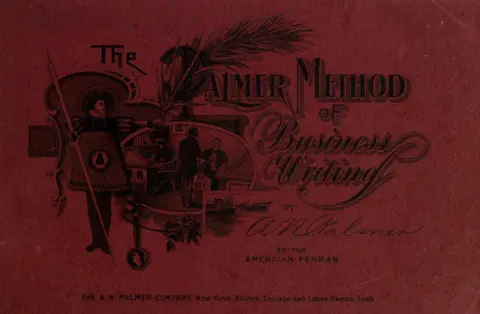
"The Palmer Method of Business Writing" by A. N. Palmer is a self-help guide on penmanship written in the early 20th century. It provides a systematic approach to mastering practical writing skills, aimed primarily at young learners in both public and private educational settings, as well as individuals studying at home. The book emphasizes the cultivation of rapid, legible, and natural handwriting, focusing on techniques that promote ease, endurance, and individual style, contrasting sharply with traditional copy-book methods. The opening of the text introduces the reader to the foundational philosophy of the Palmer Method, which asserts that good handwriting can be achieved through proper physical techniques and consistent practice. Palmer critiques traditional education methods, positing that they stifle creativity and result in ineffective handwriting skills. He provides detailed instructions on posture, arm movement, and the importance of muscle memory, underscoring the necessity of practicing in a relaxed manner without mechanical constraints. The text sets the stage for a series of progressively challenging lessons that aim to develop both the technical ability and artistic expression necessary for effective business writing.
Introduction adapted from the source catalogue; source summaries may be automatically generated.
Free to read · English · 22,207 words · No account needed
MAKE TIME FOR A GOOD BOOK
On by default. Untick to stop anonymous reading totals. Each page counts after 10 seconds in view. How this works.
Anonymous counting is on unless you have switched it off.
In developing light, uniform motion in class penmanship practice, counting is important. It makes the work more interesting, tones down the movement of the naturally nervous pupil, acts as a constant spur to the habitually slow boy or girl, and keeps the indolent student busy. In the oblique straight line and the oval exercises given in drill one, the downward strokes only should be counted. The other parts of the drills, being what are termed connective lines, are not counted.
Speed is so important in the development of good writing that it should receive close attention in all practice work until correct speed has become a habit. Too much speed is just as bad as too little. Correct speed forces a light, firm line; too little speed results in shaky tremulous lines; while excessive speed means irregular letter formation. If you develop a light, firm, elastic motion, and the proper degree of speed in straight line and oval making, you will find the work of the following lessons comparatively easy.
=The straight line and oval exercises in drills one, two, and three should be made at a speed of two hundred downward strokes to a minute; one hundred in one-half a minute; and then move the paper.=
The most convenient count for continuous straight line or oval exercises as given in drill two is 1, 2, 3, 4, 5, 6, 7, 8, 9, 10—1, 2, 3, 4, 5, 6, 7, 8, 9, 20—1, 2, 3, 4, 5, 6, 7, 8, 9, 30—1, 2, 3, 4, 5, 6, 7, 8, 9, 40—1, 2, 3, 4, 5, 6, 7, 8, 9, 50, continuing until two hundred has been reached. Until correct speed habits have been developed, the second hand of a watch should be used as a guide.
=A few minutes in the right way are worth more than hours of practice in the wrong way.=
=Drill 2=
Begin this lesson with a review of position and movement, without the penholder. At least five minutes should be devoted to energetic practice of the straight line and oval drills in this way.
Do you see the dotted lines at the left in drill two? They are to show you the general direction in which the pen moves in making the downward strokes.
Slant needs no special study, but will take care of itself if the instructions have been studied and heeded. Especially is this true in relation to the position at the desk, the position of the paper and arms on the desk, the relation of each to the other, and the changing of the paper with the left hand, to keep it in the right position in regard to the desk, body, and arms. See diagrams—page eighteen.
Your reading position is saved on this browser. Take it to another device with a library code. Reading pages adapt to text, rather than matching a printed edition.
BEHIND THE BOOK
This eBook is for the use of anyone anywhere in the United States and most other parts of the world at no cost and with almost no restrictions whatsoever. You may copy it, give it away or re-use it under the terms of the Project Gutenberg License included with this eBook or online at www.gutenberg.org. If you are not located in the United States, you will have to check the laws of the country where you are located before using this eBook. Read the source licence.
The original source file, including credits and licence, is retained by this library. Request an original-format copy at no charge. Please include the book title and Project Gutenberg identifier #66476.
KEEP YOUR CURIOSITY GOING
Charles G. (Charles Griffith) Ross
Hannah Webster Foster

Emily Lawless
Edwin Hamlin Carr

Charles De Lano Hine
Andrew Ure