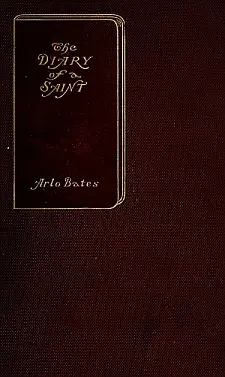
The Diary of a Saint
Arlo Bates
THE CLASSIC COLLECTION · 1884
"The Pagans" by Arlo Bates is a novel likely composed during the late 19th century. This work delves into the paradoxes of love, art, and societal expectations, focusing on characters who embody the struggles between personal desires and conventional norms. The narrative centers on Arthur Fenton, a young artist preparing for marriage, and his complex interactions with Helen, a talented sculptor, as they navigate their contrasting views on love and commitment. The opening of "The Pagans" sets the stage within an artistic atmosphere, showcasing a conversation between Arthur Fenton and Helen Greyson in her tastefully arranged sitting room. As Fenton prepares for his impending marriage to Edith Caldwell, the dialogue explores themes of disillusionment and societal conformity, with Fenton expressing cynicism about the institution of marriage. Helen's observations reflect a blend of admiration and critical insight into Fenton's character, hinting at deeper feelings beneath their seemingly platonic relationship. The exchange is rich in wit and philosophical undercurrents, establishing both characters' artistic aspirations and emotional complexities as they engage with their personal and relational dilemmas.
Introduction adapted from the source catalogue; source summaries may be automatically generated.
Free to read · English · 59,653 words · No account needed
MAKE TIME FOR A GOOD BOOK
On by default. Untick to stop anonymous reading totals. Each page counts after 10 seconds in view. How this works.
Anonymous counting is on unless you have switched it off.
"But, Helen, have I ever pretended to believe in marriage? Marriage is a crime! Think of the wretched folly of those who talk of the holiness of love's being protected by the sanctities of marriage. If love is holy, let it have way; if it is not, all the sacraments priests can devise cannot sanctify it."
"Then why, Arthur, do you marry at all?"
"Because marriage is a necessary evil as society is at present
constituted."
"But," Helen said slowly, "you who pretend to have so little regard for
society--"
"Ah, there it is," he interrupted. "Man is gregarious by instinct; he must do as his fellows do. He must submit to the most absurd convenances of his fellowmen, as one sheep jumps where another did though the bar be taken away. If he were strong enough to stand alone he might take conventions by the throat and be a god!"
His outburst was too vehement and sudden not to come from some underlying current of deep feeling, rather than from the present conversation. He had risen while speaking, his head thrown back, his eyes sparkling. His companion regarded him with admiration, not unmixed, however, with amusement.
"And you," she said, "choose to call yourself a man without
enthusiasms."
"Yes," replied he, smiling and regaining his seat, "I am a man without
enthusiasms."
"That is the cleverest thing you ever said," Helen continued, musingly. "And so we understand you intend to be ruled by conventionality and marry?"
"Precisely; it would be unjust to Edith to even talk to her of my
views."
"I should hope so!" exclaimed his hostess. "But you will at least have her to yourself, and that pays for every thing."
"Oh, peutêtre!" Fenton returned dubiously, perfectly well aware that the remark had been made to elicit comment, yet too fond of talking to resist temptation and leave it unanswered, "peutêtre, though I never believed in the desert-island theory. It is more in your line; you still have faith in it."
"Oh, I do," she rejoined quickly; "and so would you if you were in
love. You'd be content to be on a rock in the mid ocean if she were
there."
"Love on a desert island," returned the young man, smiling significantly; "Oh, le premier jour, c'est bon; le deuxième jour, ce n'est pas si bon; le troisième jour--mon Dieu, mais comment on s'ennuie!"
"No, no, no," Helen broke in impetuously. "Good, always! Always,
always, or never!"
Fenton threw back his head and burst into a shout of laughter.
"'Twere errant folly to presume,
Love's flame could burn and not consume,"
Your reading position is saved on this browser. Take it to another device with a library code. Reading pages adapt to text, rather than matching a printed edition.
Arlo Bates
Arlo Bates
Arlo Bates
Arlo Bates
BEHIND THE BOOK
This eBook is for the use of anyone anywhere in the United States and most other parts of the world at no cost and with almost no restrictions whatsoever. You may copy it, give it away or re-use it under the terms of the Project Gutenberg License included with this eBook or online at www.gutenberg.org. If you are not located in the United States, you will have to check the laws of the country where you are located before using this eBook. Read the source licence.
The original source file, including credits and licence, is retained by this library. Request an original-format copy at no charge. Please include the book title and Project Gutenberg identifier #8671.
KEEP YOUR CURIOSITY GOING
Coulson Kernahan

Maurice Baring
Frances Wright
Cécile Tormay

Frederic Jesup Stimson

W. H. P. (William Henry Pope) Jarvis