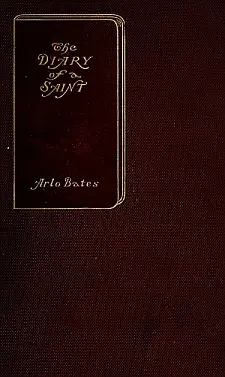
The Diary of a Saint
Arlo Bates
THE CLASSIC COLLECTION · 1884
"The Pagans" by Arlo Bates is a novel likely composed during the late 19th century. This work delves into the paradoxes of love, art, and societal expectations, focusing on characters who embody the struggles between personal desires and conventional norms. The narrative centers on Arthur Fenton, a young artist preparing for marriage, and his complex interactions with Helen, a talented sculptor, as they navigate their contrasting views on love and commitment. The opening of "The Pagans" sets the stage within an artistic atmosphere, showcasing a conversation between Arthur Fenton and Helen Greyson in her tastefully arranged sitting room. As Fenton prepares for his impending marriage to Edith Caldwell, the dialogue explores themes of disillusionment and societal conformity, with Fenton expressing cynicism about the institution of marriage. Helen's observations reflect a blend of admiration and critical insight into Fenton's character, hinting at deeper feelings beneath their seemingly platonic relationship. The exchange is rich in wit and philosophical undercurrents, establishing both characters' artistic aspirations and emotional complexities as they engage with their personal and relational dilemmas.
Introduction adapted from the source catalogue; source summaries may be automatically generated.
Free to read · English · 59,653 words · No account needed
MAKE TIME FOR A GOOD BOOK
On by default. Untick to stop anonymous reading totals. Each page counts after 10 seconds in view. How this works.
Anonymous counting is on unless you have switched it off.
"How extravagant you were in your vial," she said, involuntarily
lifting it to her nostrils.
"Don't!" Dr. Ashton exclaimed, leaning forward suddenly.
"Is it so deadly as that!" she asked in some dismay, holding it off.
"It is simply pure prussic acid," he replied. "But it might be loosely
stopped."
She examined carefully the minute writing engraved upon the glass.
"'Death foils the gods,'" she read. "Is it one of your own wickednesses, Will?" "I don't know. By the way, we might send it to Mrs. Fenton now as a souvenir of the two desirable acquaintances she has lost."
"What a brood of vipers she must think us, Will. I think it is pathetic, probably; but I cannot help being amused. It is rather an odd sensation to find that instead of being the harmless, insignificant body I have always supposed, I am really a hardened and abandoned reprobate."
"Oh, I've always known it, but I did not tell you for fear of
destroying your peace of mind."
"I'm afraid," sighed Helen, rather absently, "that--if you don't mind the slang--Arthur has an elephant on his hands."
"Yes," assented the other, "himself."
She laughed musically, toying with the little cut-glass vial.
"How familiarity takes away the dread of any thing," she remarked. "We become accustomed to any thing; and, while I dare say it is the shallowest of sophistry, that ought to be an argument in favor of the theory that vice and fearfulness are alike only strangeness."
"That is rather a sophistical bit of logic; so perfectly so that it ought to be theology. Excuse me, but could you let me have a morsel of cheese."
"There does not seem to be any for you to have," she said, glancing
over the table.
"Isn't there," returned he, as carelessly as if he had not noted that fact. "It is of no consequence."
"Oh, I can easily get it; I suppose Hannah forgot it."
She restored the vial to its place, laying the closed case by her plate, and left the room. The instant the door closed behind her, Dr. Ashton reached across the table, possessed himself of the vial, returning the case to its former position. His wife turned just outside the door, and came back with a meaning smile to take up the empty case and lock it again in the cabinet.
"I cannot trust you," she remarked with a smile; "you are too eager to
foil the gods."
He smiled in return, holding his wine-glass up to the light.
"There is more where that came from," he said. "You forget my
profession."
Your reading position is saved on this browser. Take it to another device with a library code. Reading pages adapt to text, rather than matching a printed edition.
Arlo Bates
Arlo Bates
Arlo Bates
Arlo Bates
BEHIND THE BOOK
This eBook is for the use of anyone anywhere in the United States and most other parts of the world at no cost and with almost no restrictions whatsoever. You may copy it, give it away or re-use it under the terms of the Project Gutenberg License included with this eBook or online at www.gutenberg.org. If you are not located in the United States, you will have to check the laws of the country where you are located before using this eBook. Read the source licence.
The original source file, including credits and licence, is retained by this library. Request an original-format copy at no charge. Please include the book title and Project Gutenberg identifier #8671.
KEEP YOUR CURIOSITY GOING
Coulson Kernahan

Maurice Baring
Frances Wright
Cécile Tormay

Frederic Jesup Stimson

W. H. P. (William Henry Pope) Jarvis