
Lucia in London
E. F. (Edward Frederic) Benson
THE CLASSIC COLLECTION · 1909
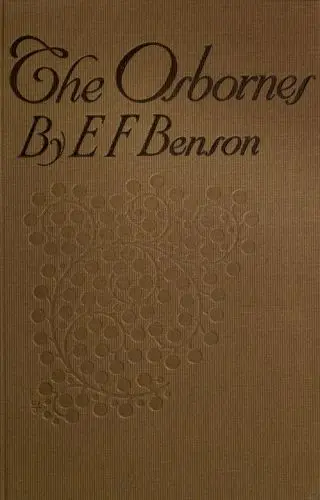
"The Osbornes" by E. F. Benson is a novel written in the early 20th century. It explores themes of social ambition and the upper middle class through the experiences of the Osborne family, who have recently risen to prominence and seek acceptance within London's elite society. The story features various characters central to the Osborne's social endeavors, particularly Mrs. Osborne, who orchestrates extravagant events to secure their status. The beginning of the novel introduces readers to Mr. and Mrs. Osborne, showcasing their lavish new home in Park Lane, where a grand fancy-dress ball is being prepared. The narration provides an in-depth look at their efforts to establish themselves among London's high society, highlighting Mrs. Osborne's relentless pursuit of recognition and the interplay of family dynamics. Details about their decorative choices, memories associated with their rise in status, and their interactions with their sons, Claude and Percy, are woven throughout, setting the stage for upcoming social encounters and personal relationships, particularly concerning Claude's potential romance with Dora West. The opening establishes a rich backdrop of character intentions and social commentary that invites readers to delve deeper into this intricate world.
Introduction adapted from the source catalogue; source summaries may be automatically generated.
Free to read · English · 101,701 words · No account needed
MAKE TIME FOR A GOOD BOOK
On by default. Untick to stop anonymous reading totals. Each page counts after 10 seconds in view. How this works.
Anonymous counting is on unless you have switched it off.
“Just exactly whatever you like so long as we do it by ourselves. I haven’t seen you all morning.”
“I know; it’s been beastly,” said she, “but May’s a dear, you know, and she wanted to talk about Harry, and I rather wanted to talk about you, so we both talked together, and I can’t remember a word she said.”
Claude was lying face downward on the grass, nursing his match, and Dora was looking at the short hair on the back of his neck. Then quickly and suddenly she looked up.
“Oh, Jim, you cheated,” she cried. “I saw you move that ball with your foot. What a brute he is! He always cheats at croquet, and is always found out. I don’t cheat: I only lose my temper. Claude, dear, keep an eye on him. Or perhaps you cheat too, do you? Oh, what a heavenly day. Do let’s go on the lake after you’ve finished your game. You shall row and steer, and I shall encourage you.”
Dora passed over the fact of Jim’s cheating as she passed over the other numerous topics of her conversation, things to be alluded to and left behind, and Claude, sitting up again when he had got a light, made no comment whatever to it. Jim continued to play calmly and correctly, and at the end of his break came toward them, leaving an unpromising position.
“You talk more rot in a short space of time than anyone I ever saw,” he remarked. “What with shooting at running pheasants and saying I cheat, you make my head whirl.”
“Oh, but you did, I saw you,” said Dora calmly. “Why not grant it?”
She paused a moment as Claude aimed, and then continued:
“Oh, Claude, what bad luck! Or did it hit it? I almost thought I saw it tremble, and in a minute I shall be sure of it.”
“I thought it hit,” said Jim.
“No, I’m sure it didn’t,” said Claude. “Full inch between them.”
The game was over in a couple of turns after this, but Dora, finding it hot on her grassy bank, had gone down to sit in the boat and wait for Claude. At the conclusion of the game he produced a sovereign and handed it to Jim.
“You gave me a good thrashing,” he said, “couldn’t get in but that
once.”
“Thanks. Yes, you had bad luck all through. I say.... You’re satisfied that Dora was talking nonsense?”
“About what?”
“When she said I cheated. Of course I did nothing of the kind.”
Your reading position is saved on this browser. Take it to another device with a library code. Reading pages adapt to text, rather than matching a printed edition.
E. F. (Edward Frederic) Benson

E. F. (Edward Frederic) Benson

E. F. (Edward Frederic) Benson

E. F. (Edward Frederic) Benson
BEHIND THE BOOK
This eBook is for the use of anyone anywhere in the United States and most other parts of the world at no cost and with almost no restrictions whatsoever. You may copy it, give it away or re-use it under the terms of the Project Gutenberg License included with this eBook or online at www.gutenberg.org. If you are not located in the United States, you will have to check the laws of the country where you are located before using this eBook. Read the source licence.
The original source file, including credits and licence, is retained by this library. Request an original-format copy at no charge. Please include the book title and Project Gutenberg identifier #58884.
KEEP YOUR CURIOSITY GOING
Coulson Kernahan

Maurice Baring
Frances Wright
Cécile Tormay

Frederic Jesup Stimson

W. H. P. (William Henry Pope) Jarvis