
Lucia in London
E. F. (Edward Frederic) Benson
THE CLASSIC COLLECTION · 1909
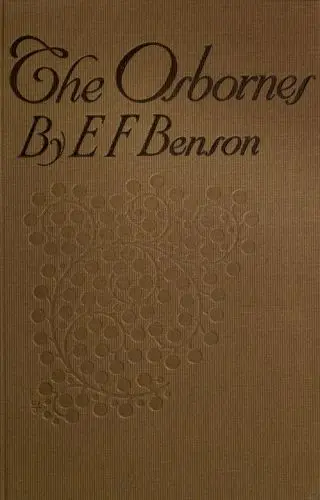
"The Osbornes" by E. F. Benson is a novel written in the early 20th century. It explores themes of social ambition and the upper middle class through the experiences of the Osborne family, who have recently risen to prominence and seek acceptance within London's elite society. The story features various characters central to the Osborne's social endeavors, particularly Mrs. Osborne, who orchestrates extravagant events to secure their status. The beginning of the novel introduces readers to Mr. and Mrs. Osborne, showcasing their lavish new home in Park Lane, where a grand fancy-dress ball is being prepared. The narration provides an in-depth look at their efforts to establish themselves among London's high society, highlighting Mrs. Osborne's relentless pursuit of recognition and the interplay of family dynamics. Details about their decorative choices, memories associated with their rise in status, and their interactions with their sons, Claude and Percy, are woven throughout, setting the stage for upcoming social encounters and personal relationships, particularly concerning Claude's potential romance with Dora West. The opening establishes a rich backdrop of character intentions and social commentary that invites readers to delve deeper into this intricate world.
Introduction adapted from the source catalogue; source summaries may be automatically generated.
Free to read · English · 101,701 words · No account needed
MAKE TIME FOR A GOOD BOOK
On by default. Untick to stop anonymous reading totals. Each page counts after 10 seconds in view. How this works.
Anonymous counting is on unless you have switched it off.
He looked up, and saw that Jim did not speak because he could not. His face was horribly white, and his lips were twitching. And at the sight of him, helpless, and, whatever he had done, suffering horribly, a far greater warmth of pity came over Claude than he had felt hitherto. All his kindness was challenged. And the prompting of the moment was not a mistaken one.
“Oh, I say, old chap,” he said, and stopped short.
For Jim broke. During all those two hideous days he had nerved himself up to encounter abuse, disgust, any form of righteous wrath and contempt. He knew well that Claude had spared him not for his own sake, but for Dora’s, and in this confession he was going to make, he was prepared to be treated as he deserved, though Claude had spared him public disgrace. But what he had not nerved himself up to encounter was kindness, such as that which rang in those few words. And once more, but now not with hysterical laughter, but with the weeping of exhaustion and shame and misery, he buried his head in that same sofa cushion.
Claude felt helpless, awkward, brutal. But it was no use doing anything yet: there was no reaching Jim till that violence had abated, and he sat there waiting, just crossing over once to the door, and bolting it for fear Parker should come in. And at length he laid his hand on Jim’s shoulder.
“It’s knocked you about awfully,” he said. “I can see that, I’m awfully sorry. You must have had a hellish two days. You needn’t tell me, you know.”
Jim pulled himself together, and raised his head.
“That’s just what I must do,” he said. “I forged your cheque.”
“Well, well,” said Claude.
But Jim had got the thing said, and now he went on with suppressed and
bitter vehemence.
“I’ve always been a swindler, I think,” he said. “I’m rotten: that’s what the matter with me. I’ve cheated all my life. I can’t even play games without cheating. I cheated you at croquet once, and won a sovereign. Dora saw.”
Again Claude’s instinct, not his reason, prompted him and not amiss. It only told him he was sorry for Jim, and could a little reassure him over this.
“But she didn’t know we were playing for money,” said he quickly. “In fact, I told her we were not.”
“So it’s twice that you have spared me. Her, rather,” said Jim.
Claude accepted the correction. It was an obvious one to him no less
than to Jim.
Your reading position is saved on this browser. Take it to another device with a library code. Reading pages adapt to text, rather than matching a printed edition.
E. F. (Edward Frederic) Benson

E. F. (Edward Frederic) Benson

E. F. (Edward Frederic) Benson

E. F. (Edward Frederic) Benson
BEHIND THE BOOK
This eBook is for the use of anyone anywhere in the United States and most other parts of the world at no cost and with almost no restrictions whatsoever. You may copy it, give it away or re-use it under the terms of the Project Gutenberg License included with this eBook or online at www.gutenberg.org. If you are not located in the United States, you will have to check the laws of the country where you are located before using this eBook. Read the source licence.
The original source file, including credits and licence, is retained by this library. Request an original-format copy at no charge. Please include the book title and Project Gutenberg identifier #58884.
KEEP YOUR CURIOSITY GOING
Coulson Kernahan

Maurice Baring
Frances Wright
Cécile Tormay

Frederic Jesup Stimson

W. H. P. (William Henry Pope) Jarvis