
Lucia in London
E. F. (Edward Frederic) Benson
THE CLASSIC COLLECTION · 1909
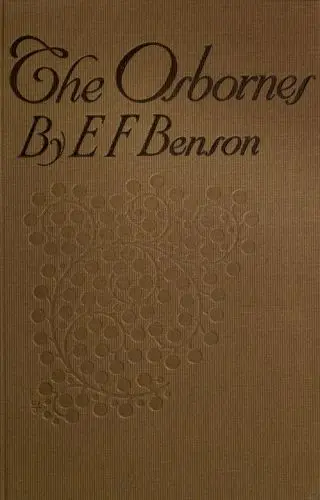
"The Osbornes" by E. F. Benson is a novel written in the early 20th century. It explores themes of social ambition and the upper middle class through the experiences of the Osborne family, who have recently risen to prominence and seek acceptance within London's elite society. The story features various characters central to the Osborne's social endeavors, particularly Mrs. Osborne, who orchestrates extravagant events to secure their status. The beginning of the novel introduces readers to Mr. and Mrs. Osborne, showcasing their lavish new home in Park Lane, where a grand fancy-dress ball is being prepared. The narration provides an in-depth look at their efforts to establish themselves among London's high society, highlighting Mrs. Osborne's relentless pursuit of recognition and the interplay of family dynamics. Details about their decorative choices, memories associated with their rise in status, and their interactions with their sons, Claude and Percy, are woven throughout, setting the stage for upcoming social encounters and personal relationships, particularly concerning Claude's potential romance with Dora West. The opening establishes a rich backdrop of character intentions and social commentary that invites readers to delve deeper into this intricate world.
Introduction adapted from the source catalogue; source summaries may be automatically generated.
Free to read · English · 101,701 words · No account needed
MAKE TIME FOR A GOOD BOOK
On by default. Untick to stop anonymous reading totals. Each page counts after 10 seconds in view. How this works.
Anonymous counting is on unless you have switched it off.
They talked long, “contriving,” as Lady Osborne had said, the sole point of the contrivance being that her husband should enjoy his day or two at Grote, and have everything to his liking, and not fret about her. Once and again and again once, Dora tried to lead the conversation back to Lady Osborne herself, to get from her some inkling of what her indisposition might be, what its symptoms were, with a view of encouraging her to face the doctor with equanimity, for this was clearly an ordeal she dreaded. And on Dora’s third attempt she put an end to further questions.
“I think, dearie, we’ll not talk about that,” she said, “because, as I told you, I’m such a coward as never was, and the more I think about it, the more coward I shall be when I get to the doctor’s door. It was just the same with me about my teeth before I lost them all: if one had to come out, I had such a shrinking from a bit of pain, that if I thought about it, I knew I shouldn’t go to the dentist at all. So I used to busy myself with other things, and plan a treat, maybe, for the working folk, or an extra good dinner for Mr. O., or a surprise for Per or Claude; and it’s a similar to that what I’ll do now, if you don’t mind. And I assure you I’m so bothered over the thought of you and Dad being at Grote without me that I’ve little desire to think about anything else. Thirty-five years it is last May, my dear, since we took each other for better or worse, and it’s always been better, and not a night since then, I assure you, have we not slept under the same roof, and in the same room save when I had a cold and feared to give it him. And he’s got to depend on me, Gold bless him, and knows that I shall see he has a biscuit or two on a plate by his bedside and a glass of milk, against he wakes the night. Servants are never to be trusted, my dear, though I’m sure it’s a shame to say it, when ours are so attentive. But he’s got a new valet just of late, and if you could peep in at my lord’s bedroom door when you went up to bed, and see as all was prepared, and that his slippers was put where he can see them in his dressing room, else he’ll walk to bed in his bare feet and step on a pin or a tack someday, which I always dread for him. And if he comes in hot, as he’s taken to do in this weather from his walk, just you behave as if you was me, and say to him, ‘Mr. O., you go and change your vest and your socks, else I don’t pour out your cup of tea,’ and knowing as you’ll do that will take a load off my mind, and I shall go to the doctor this afternoon, knowing as you are looking after him as if I was there, as comfortable as if I was going to have a cheque cashed for me. And, my dear, if you’d sit next him in church, and just nudge him if he attempts to follow the lesson without putting his glasses on. It’s small print in his Bible, and never another one will he let me give him, just because it was that one he used to read out of to me when we were in Cornwall on our wedding trip, and sometimes no church within distance. But be sure he changes his underwear, my dear, when he comes in, for he catches cold easy, and his skin acts so well that it’s as if he’d had a bath. And give him plenty of milk in his coffee at breakfast, not that he likes it, but he will have the coffee made so strong that it’s enough to rasp the coats of the stomach, as they say, unless you drown it in milk. And you’ll cheer him up, I know, my dear, if he gets anxious, and just say to him ‘Stuff and nonsense, Dad, Mrs. O.’s had a bit of an upset, same as you have times without number, and she’s always nervous about herself, and has gone to see the doctor, and as like as not will come down to-morrow afternoon with a couple of pills in her pocket, and ready to be laughed at to your heart’s content.’ That’s what I want you to say, my dear, though you’ll put it in your own words, and much better I’m sure. But to-day it’s as if I feel I couldn’t go and look after my friends, now that I know you’ll take my place, for when there’s a multitude in the house, sometimes the mistress can’t get to bed till it maybe is one o’clock or worse, and I want a good long night. I shall try to see Sir Henry as soon as may be, and after that I don’t doubt I shall just get to bed and sleep the clock round. I’m so tired, my dear, and there’s something---- Well, I make no doubt that before many hours are out, we shall all be laughing together over my silliness, and Mr. O. will be asking if I have taken enough phosphorus jelly, or what not. Lor’, he’ll never let me hear the last of it!”
Your reading position is saved on this browser. Take it to another device with a library code. Reading pages adapt to text, rather than matching a printed edition.
E. F. (Edward Frederic) Benson

E. F. (Edward Frederic) Benson

E. F. (Edward Frederic) Benson

E. F. (Edward Frederic) Benson
BEHIND THE BOOK
This eBook is for the use of anyone anywhere in the United States and most other parts of the world at no cost and with almost no restrictions whatsoever. You may copy it, give it away or re-use it under the terms of the Project Gutenberg License included with this eBook or online at www.gutenberg.org. If you are not located in the United States, you will have to check the laws of the country where you are located before using this eBook. Read the source licence.
The original source file, including credits and licence, is retained by this library. Request an original-format copy at no charge. Please include the book title and Project Gutenberg identifier #58884.
KEEP YOUR CURIOSITY GOING
Coulson Kernahan

Maurice Baring
Frances Wright
Cécile Tormay

Frederic Jesup Stimson

W. H. P. (William Henry Pope) Jarvis