
The Speculations of John Steele
Robert Barr
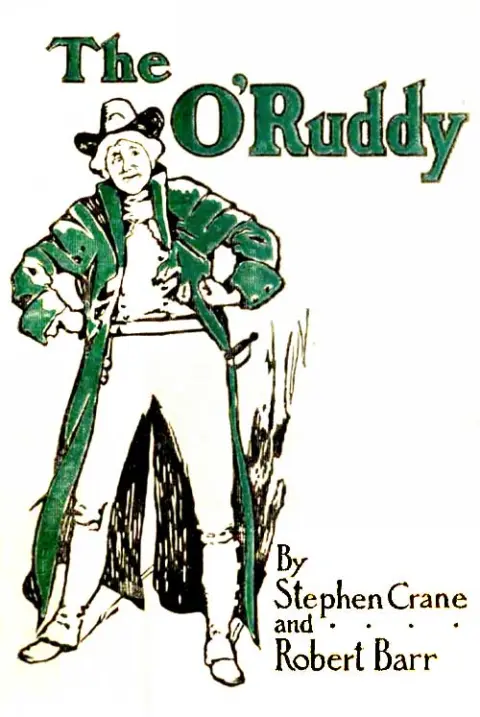
THE CLASSIC COLLECTION · 1903
"The O'Ruddy: A Romance" by Stephen Crane and Robert Barr is a novel written in the early 20th century. The book follows Tom O'Ruddy, a young man from Ireland who embarks on a journey to deliver important papers to the Earl of Westport, his father’s old comrade. Along the way, O'Ruddy encounters friendship, duels, and unexpected adventures, revealing the contrasts between his Irish background and the English society he enters. At the start of the story, O'Ruddy recounts the legacy of his family, which was once prominent in Ireland but has fallen into obscurity. After the death of his father, O'Ruddy sets off to fulfill his late father's last request to return some papers to the Earl. His humorous encounters begin in Bristol, where he makes a splash at a local inn, challenging a Colonel’s dishonorable remarks about his father and inadvertently setting the stage for a duel. These initial misadventures highlight O'Ruddy's fiery spirit and charm as he navigates the unfamiliar terrain of English gentry, foreshadowing the tumultuous events that will follow.
Introduction adapted from the source catalogue; source summaries may be automatically generated.
Free to read · English · 96,900 words · No account needed
MAKE TIME FOR A GOOD BOOK
On by default. Untick to stop anonymous reading totals. Each page counts after 10 seconds in view. How this works.
Anonymous counting is on unless you have switched it off.
There were loud cries of "Order! Order! Order!" The wrathful Fancher was pulled down into his chair by soothful friends and neighbours, to whom he gesticulated and cried out during the uproar.
I looked toward old Fullbil, expecting to see him disturbed, or annoyed, or angry. On the contrary he seemed pleased, as a little boy who had somehow created a row.
"The excellent Fancher," said he, "the excellent Fancher is wroth. Let us proceed, gentlemen, to more friendly topics. You, now, Doctor Chord, with what new thing in chemics are you ready to astound us?"
The speech was addressed to a little man near me, who instantly blushed crimson, mopping his brow in much agitation, and looked at the table, unable for the moment to raise his eyes or speak a word.
"One of the greatest scientists of the time," said my friend in my
ear.
"Sir," faltered the little man in his bashfulness, "that part of the discourse which related to the flying of kites has interested me greatly, and I am ready to contend that kites fly, not, as many say, through the influence of a demon or spirit which inhabits the materials, but through the pressure of the wind itself."
Fancher, now himself again, said:
"I wish to ask the learned doctor whether he refers to Chinese kites?"
The little man hurriedly replied that he had not Chinese kites in his
mind at all.
"Very good, then," said the great critic. "Very good."
"But, sir," said Fullbil to little Chord, "how is it that kites may fly without the aid of demons or spirits, if they are made by man? For it is known, sir, that man may not move in the air without the aid of some devilish agency, and it is also known that he may not send aloft things formed of the gross materials of the earth. How, then, can these kites fly virtuously?"
There was a general murmur of approbation of Fullbil's speech, and the little doctor cast down his eyes and blushed again, speechless.
It was a triumph for Fullbil, and he received the congratulations of his friends with his faint vain smile implying that it was really nothing, you know, and that he could have done it much better if he had thought that anybody was likely to heed it.
The little Doctor Chord was so downtrodden that for the remainder of the evening he hardly dared to raise his eyes from the table, but I was glad to see him apply himself industriously to the punch.
Your reading position is saved on this browser. Take it to another device with a library code. Reading pages adapt to text, rather than matching a printed edition.
Robert Barr

Robert Barr

Robert Barr

Robert Barr
BEHIND THE BOOK
This eBook is for the use of anyone anywhere in the United States and most other parts of the world at no cost and with almost no restrictions whatsoever. You may copy it, give it away or re-use it under the terms of the Project Gutenberg License included with this eBook or online at www.gutenberg.org. If you are not located in the United States, you will have to check the laws of the country where you are located before using this eBook. Read the source licence.
The original source file, including credits and licence, is retained by this library. Request an original-format copy at no charge. Please include the book title and Project Gutenberg identifier #29573.
KEEP YOUR CURIOSITY GOING
Coulson Kernahan

Maurice Baring
Frances Wright
Cécile Tormay

Frederic Jesup Stimson

W. H. P. (William Henry Pope) Jarvis