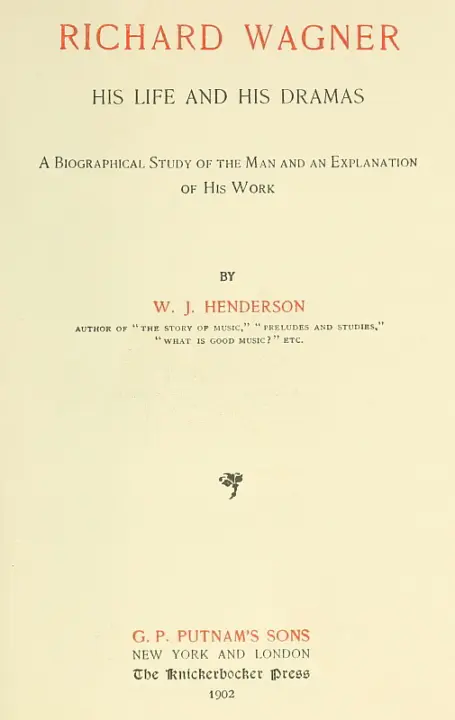
Richard Wagner His Life and His Dramas A Biographical Study of the Man and an Explanation of His Work
W. J. (William James) Henderson
THE CLASSIC COLLECTION · 1899
"The Orchestra and Orchestral Music" by W. J. Henderson is a non-fiction publication written in the late 19th century. This work serves as an informative guide for music lovers, providing insights into the structure and function of modern orchestras and the various instruments that comprise them. It addresses the characteristics of individual instruments and conveys how they contribute to the overall orchestral sound, aiming to enhance the reader's understanding of orchestral performances. The opening of the text establishes its intent by clarifying that it is not a technical manual for musicians but rather a resource for amateurs seeking to deepen their appreciation of orchestral music. Henderson introduces the modern orchestra, detailing instrumental families such as strings, woodwinds, and brass, and discusses their unique tonal qualities and functions. The author emphasizes the evolution of orchestral music, introduces the role of the conductor in shaping performances, and hints at a historical perspective that traces developments from early composers to contemporary orchestrators.
Introduction adapted from the source catalogue; source summaries may be automatically generated.
Free to read · English · 42,204 words · No account needed
MAKE TIME FOR A GOOD BOOK
On by default. Untick to stop anonymous reading totals. Each page counts after 10 seconds in view. How this works.
Anonymous counting is on unless you have switched it off.
It is believed that three horns were employed in the symphonic orchestra for the first time in this work. Mozart used four in “Idomeneo” (1781). The Fourth Symphony, B flat (1807), is a smaller work, and its orchestra is the same as that of the First and Second, except that only one flute is required and the ’cello is named. The great Fifth Symphony, C minor (1808), is scored for 1 piccolo, 2 flutes, 2 oboes, 2 clarinets, 2 bassoons, contra-bassoon, 2 horns, 2 trumpets, 3 trombones, drums, and strings. Sir George Grove notes that “the piccolo, trombones, and contra-fagotto are employed in the finale only, and make their appearance here for the first time in the symphonies. The contra-fagotto was first known to Beethoven in his youth at Bonn, where the Elector’s orchestra contained one. He has employed it also in ‘Fidelio,’ in the Ninth Symphony, and elsewhere.”
The Sixth Symphony, known as the “Pastoral” (1808), is scored for 1 piccolo, 2 flutes, 2 oboes, 2 clarinets, 2 bassoons, 2 horns, 2 trumpets, 2 trombones, drums, and strings. The piccolo and trombones were used for special descriptive effects in this work, and when he came to write the great Seventh Symphony (1813), Beethoven employed the same array of instruments as he had in his First and Second symphonies. The same orchestra sufficed for the Eighth Symphony (1814), but the Titanic Ninth (1824) demanded a larger instrumental body. The score calls for 1 piccolo, 2 flutes, 2 oboes, 2 clarinets, 2 bassoons, 1 contra-bassoon, 4 horns, 2 trumpets, 3 trombones, tympani, triangle, cymbals, bass drum, and strings. Four horns are here used for the first time in the symphonic orchestra, and their introduction completed the development of the classical body of instruments.
When the romantic writers began to advance along the path opened by Beethoven and to seek for broader and more influential emotional expression, they introduced one or two more instruments for special effects. The English horn was known to Bach in its primitive form of oboe da caccia. It was used by Gluck in his “Orfeo” and “Telemacho,” but, as Berlioz notes, without apparent appreciation of its tone-quality. In its modern form it was introduced into the orchestra by Rossini in “William Tell” (1829), and Meyerbeer in “Robert le Diable” (1831). Modern symphonic writers use it freely. Its employment in their music is probably due to the demonstration of its utility by the eminent French composer, Hector Berlioz (1803-69), who had a truly wonderful insight into the powers of all orchestral instruments, and who laid down the principles of the post-Beethovenian style of orchestral writing. We find Schubert, Schumann, Mendelssohn, and other immediate followers of Beethoven using precisely the same orchestra, sometimes with two horns and sometimes with four, and seldom without trombones, throughout an entire work. Berlioz, however, began at once to give variety to the instrumental body. For instance, so small a work as his arrangement for orchestra of Weber’s “Invitation à la Valse” is scored for 1 piccolo, 1 flute, 2 oboes, 2 clarinets, 4 bassoons, 4 horns, 1 cornet, 1 trumpet, 3 trombones, 2 harps, tympani, and strings. The harp, as we have noted, had been used in the opera, but Berlioz was the first to explore its possibilities. Many of Berlioz’s other advances in the use of orchestral instruments were owing to the introduction, in 1832, of the system of boring and keying wind-instruments invented by Theobald Boehm. This system vastly increased the agility of these instruments and improved their intonation.
Your reading position is saved on this browser. Take it to another device with a library code. Reading pages adapt to text, rather than matching a printed edition.
W. J. (William James) Henderson
W. J. (William James) Henderson
BEHIND THE BOOK
This eBook is for the use of anyone anywhere in the United States and most other parts of the world at no cost and with almost no restrictions whatsoever. You may copy it, give it away or re-use it under the terms of the Project Gutenberg License included with this eBook or online at www.gutenberg.org. If you are not located in the United States, you will have to check the laws of the country where you are located before using this eBook. Read the source licence.
The original source file, including credits and licence, is retained by this library. Request an original-format copy at no charge. Please include the book title and Project Gutenberg identifier #71345.
KEEP YOUR CURIOSITY GOING

Charles G. (Charles Griffith) Ross
Hannah Webster Foster

Emily Lawless
Edwin Hamlin Carr

Charles De Lano Hine
Andrew Ure