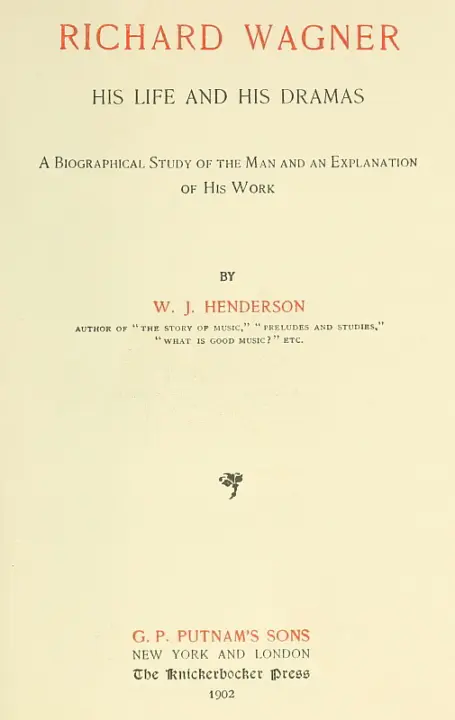
Richard Wagner His Life and His Dramas A Biographical Study of the Man and an Explanation of His Work
W. J. (William James) Henderson
THE CLASSIC COLLECTION · 1899
"The Orchestra and Orchestral Music" by W. J. Henderson is a non-fiction publication written in the late 19th century. This work serves as an informative guide for music lovers, providing insights into the structure and function of modern orchestras and the various instruments that comprise them. It addresses the characteristics of individual instruments and conveys how they contribute to the overall orchestral sound, aiming to enhance the reader's understanding of orchestral performances. The opening of the text establishes its intent by clarifying that it is not a technical manual for musicians but rather a resource for amateurs seeking to deepen their appreciation of orchestral music. Henderson introduces the modern orchestra, detailing instrumental families such as strings, woodwinds, and brass, and discusses their unique tonal qualities and functions. The author emphasizes the evolution of orchestral music, introduces the role of the conductor in shaping performances, and hints at a historical perspective that traces developments from early composers to contemporary orchestrators.
Introduction adapted from the source catalogue; source summaries may be automatically generated.
Free to read · English · 42,204 words · No account needed
MAKE TIME FOR A GOOD BOOK
On by default. Untick to stop anonymous reading totals. Each page counts after 10 seconds in view. How this works.
Anonymous counting is on unless you have switched it off.
Abbreviations in scores, 47
Aria da capo, suggestion to orchestral composers, 220
Bach’s orchestra, 195
Balance of tone, 65;
how obtained, 115
Bass clarinet, compass and character, 28;
introduction of, 209
Bass drum, 111
Bassoon, compass and character, 24
Baton, use of, 148 et seq.;
need of, 154
“Battery,” 108 et seq.
Beethoven’s symphonies, 226 et seq.
Bells, 111
Berlioz, 67, 68;
his orchestra, 208
Boston Symphony Orchestra, 50, 212
Bowing, 9;
marks for, 138
Brass, 4;
methods of using, 97 et seq.;
Bach’s and Handel’s plans, 98;
Haydn’s, 99;
Mozart’s, 100;
employed unsupported, 105;
Wagner learns from Gluck and Mozart, 107
Carillon, 112
Castanets, 111
Clarinet, compass and character, 26;
how to read its music, 52;
methods of using, 86 et seq.
Classic music, character of, 222
Classicists, modern, 231
Clefs, 55 et seq.
Colorists, 231
Conductor, development of, 147 et seq.;
interpreting, 156;
Wagner’s influence on, 161;
functions of, 164;
in detail, 167;
choice of tempo, 169;
work besides choice of tempo, 174
Conductors, famous, 158 et seq.
Contra-bass clarinet, 96
Contra-bassoon, 95
Contrast, 65;
how obtained, 119
Cornet, 23
Cyclic forms, 220
Cymbals, 111
Directions, composers’, to be obeyed, 139
Double-bass, compass and character, 17
Drum, bass, 111;
snare, 111
English Horn, compass and character, 23
Flexibility in orchestral playing, 134
Flute, compass and character, 19;
uses of, 81 et seq.;
introduction of, 190
Forms, development of musical, 220;
Beethoven’s innovations, 227;
Schumann’s, 228
Glissando, 41
Gong, 111
Gossec, developer of orchestral technics, 158
Habeneck, interpreting conductor, 160
Handel’s orchestra, 196
Harmonics, 7, 8
Harmony, dispersal of, 64
Harp, 39;
pedals, 40;
methods of using, 39 et seq.
Harpsichord, used in conducting, 149 et seq.;
method of use, 150;
used in symphonic conducting, 155
Haydn’s orchestra, 200
Horn, compass and character, 30;
how to read its music, 54;
methods of using, 97 et seq.;
stopped tones, 100;
valves, 100;
Rossini’s horn style, 100;
in “Eroica” symphony, 101;
four horns, how used, 101, 102
Horn, English, 23;
introduction into orchestra, 208
Instrumentation, models, 68
Instruments, list of, in orchestra, 4;
names in four languages, 46
Leader of orchestra, 154
Legno, col, 10
Legrenzi’s orchestra, 192
Liszt, inventor of symphonic poem, 230
Lully’s orchestra, 192
Mendelssohn, model for string writing, 76
Metronome, 172
Meyerbeer, 39, 40, 41
Middle voices, 135
Monteverde, Claudio, founder of modern orchestra, 186
Mozart, tone-coloring, and string plan, 75, 76;
his orchestra, 204
Music, orchestral, development of, 217 et seq.;
polyphonic, 218;
classic, 220;
character of, 222 et seq.;
what to expect in classic, 224;
Beethoven’s, 226 et seq.;
romantic, 228
Nicode, divided strings in “Das Meer,” 77
Oboe, compass and character, 20;
uses of, 81 et seq.
Ophicleide, 210
Orchestra, defined, 3;
Beethoven’s, 4, 206;
instruments in, 4;
how used, 61;
compass, 61;
dynamic range, 62;
constitution of, 142;
development of, 181 et seq.;
in Middle Ages, 183;
Peri’s and Cavaliere’s, 185, 186;
Monteverde’s, 186;
Scarlatti’s, 190;
Lully’s, 192;
Legrenzi’s, 192;
Bach’s, 195;
Handel’s, 196;
in early part of eighteenth century, 193, 198;
Gossec’s, 200;
Haydn’s, 200;
Dresden court orchestra, 203;
Mozart’s, 204;
Berlioz’s, 208;
Wagner’s, 210, 211;
Boston Symphony’s number, 212;
festival, 213
Orchestral music, development of, 217 et seq.
Orchestras, famous, 140 et seq., 202
Orchestration, general principles of, 61;
requirements of, 63;
models in, 67, 68;
Bach’s polyphonic, 82;
qualities of good, 113 et seq.;
pianists’ mistakes, 115;
Bach’s, 120;
effect of clarinet in, 120;
Handel’s, 121;
romantic, 122;
innovations of Monteverde, 188;
Corelli’s contributions to, 193
Overture, classic form, 200
Your reading position is saved on this browser. Take it to another device with a library code. Reading pages adapt to text, rather than matching a printed edition.
W. J. (William James) Henderson
W. J. (William James) Henderson
BEHIND THE BOOK
This eBook is for the use of anyone anywhere in the United States and most other parts of the world at no cost and with almost no restrictions whatsoever. You may copy it, give it away or re-use it under the terms of the Project Gutenberg License included with this eBook or online at www.gutenberg.org. If you are not located in the United States, you will have to check the laws of the country where you are located before using this eBook. Read the source licence.
The original source file, including credits and licence, is retained by this library. Request an original-format copy at no charge. Please include the book title and Project Gutenberg identifier #71345.
KEEP YOUR CURIOSITY GOING

Charles G. (Charles Griffith) Ross
Hannah Webster Foster

Emily Lawless
Edwin Hamlin Carr

Charles De Lano Hine
Andrew Ure