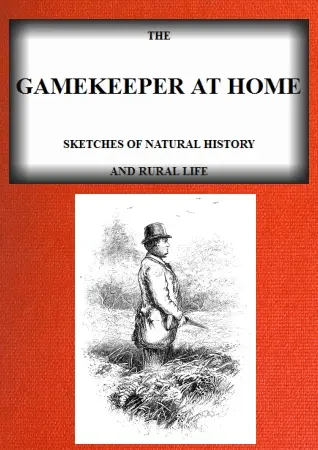
The Gamekeeper at Home: Sketches of natural history and rural life (Illustrated)
Richard Jefferies
THE CLASSIC COLLECTION · 1885
"The Open Air" by Richard Jefferies is a collection of essays written during the late 19th century. The book explores themes of nature, the beauty of the countryside, and the connection between humans and the natural world. Through engaging prose, Jefferies encapsulates the essence of rural life and the tranquility found in open spaces, making a compelling case for the rejuvenating power of nature. At the start of "The Open Air," the narrative introduces a character named St. Guido, a young boy who embodies the spirit of exploration and wonder in nature. As he runs through fields of wheat and encounters various creatures, he experiences magical moments of connection with the environment. The scene unfolds as Guido observes the beauty of cornflowers and engages with humble-bees, while also reflecting on the whispers of nature around him. The narrative is rich with pastoral imagery, inviting readers into a vivid world that celebrates the simplicity and profundity of being outdoors. This opening sets the tone for Jefferies' contemplative exploration of life's deeper meanings as observed through the lens of a child's innocent curiosity.
Introduction adapted from the source catalogue; source summaries may be automatically generated.
Free to read · English · 74,861 words · No account needed
MAKE TIME FOR A GOOD BOOK
On by default. Untick to stop anonymous reading totals. Each page counts after 10 seconds in view. How this works.
Anonymous counting is on unless you have switched it off.
Looking at the soil as we walk, where it is exposed by the roots of a fallen tree, or where there is an old gravel pit, the question occurs whether forests, managed as they are in old countries, ever really increase the fertility of the earth? That decaying vegetation produces a fine mould cannot be disputed; but it seems here that there is no more decaying vegetation than is required for the support of the trees themselves. The leaves that fall--the million million leaves--blown to and fro, at last disappear, absorbed into the ground. So with quantities of the lesser twigs and branches; but these together do not supply more material to the soil than is annually abstracted by the extensive roots of trees, of bushes, and by the fern. If timber is felled, it is removed, and the bark and boughs with it; the stump, too, is grubbed and split for firewood. If a tree dies it is presently sawn off and cut up for some secondary use or other. The great branches which occasionally fall are some one's perquisite. When the thickets are thinned out, the fagots are carted away, and much of the fern is also removed. How, then, can there be any accumulation of fertilising material? Rather the reverse; it is, if anything, taken away, and the soil must be less rich now than it was in bygone centuries. Left to itself the process would be the reverse, every tree as it fell slowly enriching the spot where it mouldered, and all the bulk of the timber converted into fertile earth. It was in this way that the American forests laid the foundation of the inexhaustible wheat-lands there. But the modern management of a forest tends in the opposite direction--too much is removed; for if it is wished to improve a soil by the growth of timber, something must be left in it besides the mere roots. The leaves, even, are not all left; they have a value for gardening purposes: though, of course, the few cartloads collected make no appreciable difference. There is always something going on in the forest; and more men are employed than would be supposed. In the winter the selected elms are thrown and the ash poles cut; in the spring the oak timber comes down and is barked; in the autumn the fern is cut. Splitting up wood goes on nearly all the year round, so that you may always hear the axe. No charcoal-burning is practised, but the mere maintenance of the fences, as, for instance, round the pheasant enclosures, gives much to do. Deer need attention in winter, like cattle; the game has its watchers; and ferreting lasts for months. So that the forest is not altogether useless from the point of view of work. But in so many hundred acres of trees these labourers are lost to sight, and do not in the least detract from its wild appearance. Indeed, the occasional ring of the axe or the smoke rising from the woodman's fire accentuates the fact that it is a forest. The oaks keep a circle round their base and stand at a majestic distance from each other, so that the wind and the sunshine enter, and their precincts are sweet and pleasant. The elms gather together, rubbing their branches in the gale till the bark is worn off and the boughs die; the shadow is deep under them, and moist, favourable to rank grass and coarse mushrooms. Beneath the ashes, after the first frost, the air is full of the bitterness of their blackened leaves, which have all come down at once. By the beeches there is little underwood, and the hollows are filled ankle-deep with their leaves. From the pines comes a fragrant odour, and thus the character of each group dominates the surrounding ground. The shade is too much for many flowers, which prefer the nooks of hedgerows. If there is no scope for the use of "express" rifles, this southern forest really is a forest and not an open hillside. It is a forest of trees, and there are no woodlands so beautiful and enjoyable as these, where it is possible to be lost a while without fear of serious consequences; where you can walk without stepping up to the waist in a decayed tree-trunk, or floundering in a bog; where neither venomous snake not torturing mosquito causes constant apprehensions and constant irritation. To the eye there is nothing but beauty; to the imagination pleasant pageants of old time; to the ear the soothing cadence of the leaves as the gentle breeze goes over. The beeches rear their Gothic architecture, the oaks are planted firm like castles, unassailable. Quick squirrels climb and dart hither and thither, deer cross the distant glade, and, occasionally, a hawk passes like thought.
Your reading position is saved on this browser. Take it to another device with a library code. Reading pages adapt to text, rather than matching a printed edition.
Richard Jefferies
Richard Jefferies
Richard Jefferies
Richard Jefferies
BEHIND THE BOOK
This eBook is for the use of anyone anywhere in the United States and most other parts of the world at no cost and with almost no restrictions whatsoever. You may copy it, give it away or re-use it under the terms of the Project Gutenberg License included with this eBook or online at www.gutenberg.org. If you are not located in the United States, you will have to check the laws of the country where you are located before using this eBook. Read the source licence.
The original source file, including credits and licence, is retained by this library. Request an original-format copy at no charge. Please include the book title and Project Gutenberg identifier #6981.
KEEP YOUR CURIOSITY GOING
Wilfrid Scawen Blunt
Wilfrid Scawen Blunt

E. W. (Edgar Watson) Howe

David Patterson (Spirit) Hatch

David Patterson (Spirit) Hatch

David Patterson (Spirit) Hatch