
Last letters from the living dead man
David Patterson (Spirit) Hatch
THE CLASSIC COLLECTION · 1906
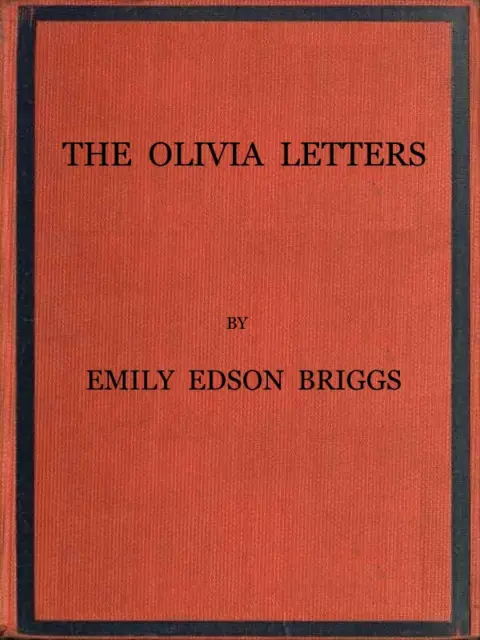
"The Olivia Letters" by Emily Edson Briggs is a collection of historical correspondence written in the early 20th century. This work presents a unique portrayal of Washington, D.C. over a span of forty years, recounting events and experiences through the letters of a newspaper correspondent named Olivia. The central theme revolves around political and social life during and after the Civil War, with insights into key historical figures and events. At the start of the narrative, the author introduces Olivia's reflections on the architectural beauty of the National Capitol, highlighting the grandeur of its dome as a symbol of national pride. Through her observations, the reader is drawn into the post-war atmosphere of Washington, where the return to peace is juxtaposed with the lingering memories of conflict. Olivia's voice captures the essence of contemporary society and politics—she shares her detailed impressions of life in the Capitol, the societal dynamics surrounding influential figures, and her poignant encounters with soldiers and politicians alike. This opening sets the tone for a richly detailed exploration of an era filled with transformation and introspection.
Introduction adapted from the source catalogue; source summaries may be automatically generated.
Free to read · English · 137,842 words · No account needed
MAKE TIME FOR A GOOD BOOK
On by default. Untick to stop anonymous reading totals. Each page counts after 10 seconds in view. How this works.
Anonymous counting is on unless you have switched it off.
A new music reaches the ear of Washington. It is the voice of the workingmen, with brass instruments in their hands, saluting their new leader. All hail! Senator Sprague of Rhode Island. The man who touches the pulse of the invalid with an earnest desire to do the patient good is called a kind physician. The man who feels the feverish pulse of a suffering nation, sees the people rise in their awful majesty, and immensity, echoes, “Here! Here!”
Senator Sprague has been studying the rise and decline of nations. He reminds us that there is a vicious something which underlies the basis of modern as well as ancient society, a nameless horror which picks the bones of a nation just as Victor Hugo’s devil-fish finishes the last delicate morsel of what was once a man. It is the same to the nation that the destructive worm is to the ship. It is the accumulation of tubercular deposits in the national tissues. The fatal seed of dissolution is already planted, and the harvest, when garnered, will be safely packed away in the frightful storehouse of death. With blanched face, in the distance, we shrink from the leprous patient, but upon closer examination we find the “sick man” is old Uncle Sam, and his old war wounds are still unhealed, though in a healthy condition, and none give him any trouble to-day except the sabre cut of Finance. In the early part of the last winter General Butler laid his hand on this tremendous wound. The nation quivered with hope and expectation, but Uncle Sam said, “Hands off, my brave general; don’t you see just so much of my substance has been shot away? If a lobster loses one of its claws, will any patent medicine make it grow again? Leave the lobster to the care of the kindly elements, and a new member, precisely like the old one, makes its appearance, beautifully, by degrees. The humblest reptile can teach the wisest man important wisdom.” When just so much substance has been destroyed by fire and sword, is it not the folly of madness to try to replace it by “financial policy”? Is there no other way to make a dollar except to dig the metal out of the bowels of the earth, take it to the mint, and give it a legitimate birth? The smallest child can understand the great “financial problem” as it exists to-day. Did General Butler enlighten us on the subject? We owe just so many gold dollars. As a lawyer he pointed out the way in which we could avoid a partial payment of our honest debts. The people said to General Butler, “We like your sagacity as lawyer, but we still believe that time is the best cure for all.” General Butler then subsided on the finance question. A new champion has arisen to point out a greener path over which to journey, as we march heavy ladened. It is the youthful millionaire, Senator Sprague. His bill before the Senate can be summed up in exactly three words: “Make more greenbacks.” This is the way to make money plenty? Why not? If Senator Sprague wants ten thousand yards of calico, he manufactures it. If the workingman wants more money, he is advised to manufacture the same. It is a great deal easier to print a paper dollar than to earn the gold the paper is expected to represent. But Senator Sprague was born into the manufacturing business, and, as it has been of such vast importance to him, is it a wonder that he advises the same employment to others when he has reaped riches and honor, whilst he is yet a growing man? Senator Sprague would also make the Government a kind of “Grand Lama”--a huge autocrat doing business for himself, just like Astor, Vanderbilt and Stewart. He would have him loan money; also, make him liable to sue and be sued. To be sure, this would extinguish all millionaire upstarts. So far so good; but would it not also add fresh fuel to the fires of corruption? What is the whisky ring but a set of dishonest officials, acting in the name of the Government, covering their plunder with the garments of Uncle Sam? Instead of diminishing the power to rob the people, Senator Sprague advocates an additional supply of the grand army officials. The flock of to-day may be compared to a cloud of locusts. “No!” say our legislators. Only a lunatic attempts to extinguish a fire by throwing on more fuel. A good government should be like the azure vault of heaven, resting on all alike, protecting the poor man in his cabin, the rich man in his palace, if he has honestly acquired his wealth. It should fall upon the honorable citizen like a web woven by fairy fingers; upon the criminal, whether powerful or weak, like the lariat flung by the unerring hand of the Indian hunter of the pampas. Senator Sprague and the workingmen who endorse him propose to take from the Government this most holy inheritance bequeathed us by our Revolutionary ancestors, baptized anew by the precious blood of three hundred thousand lives, and set it up in all the great cities of the Union, as the golden calf was set up in the wilderness, and the people, instead of being told to bow the knee, are advised to borrow. How will this help the poor man who has no security to give; or is the great national broker expected to lend without any security at all? No one disputes the fact that a great harassing debt annoys the people. It might have been much less. With sorrow we remember the millions that were flung into the sea by the incompetency of the late Navy Department; but with this folly our creditors have nothing to do. It is for us to say that we will pay to the last farthing. Shall we allow speculators in the name of Uncle Sam to use the people’s money and take the risk of being benefited in the end? Never! No, never! It is proven beyond a doubt that if the tax on whisky and tobacco could be honestly collected and turned over to the Treasury Department it would liquidate every penny of the interest of the public debt; other taxes would then gradually consume the principal. But if we are in haste, as we ought to be, to pay our debts, let the noble women of this country say, “No more of our gold shall drift seaward to bring us back jewels, silks, and knick-knacks.” Let the graceful, elegant wife of Senator Sprague be content with a wardrobe which vies in costliness with that of an European princess. Thirty silk walking dresses, all made to fit the same exquisite image, were within hearing of the workingmen’s serenade.
Your reading position is saved on this browser. Take it to another device with a library code. Reading pages adapt to text, rather than matching a printed edition.
BEHIND THE BOOK
This eBook is for the use of anyone anywhere in the United States and most other parts of the world at no cost and with almost no restrictions whatsoever. You may copy it, give it away or re-use it under the terms of the Project Gutenberg License included with this eBook or online at www.gutenberg.org. If you are not located in the United States, you will have to check the laws of the country where you are located before using this eBook. Read the source licence.
The original source file, including credits and licence, is retained by this library. Request an original-format copy at no charge. Please include the book title and Project Gutenberg identifier #58604.
KEEP YOUR CURIOSITY GOING
David Patterson (Spirit) Hatch

David Patterson (Spirit) Hatch

David Patterson (Spirit) Hatch
Cécile Tormay

Moritz Busch
John L. Ransom