
Last letters from the living dead man
David Patterson (Spirit) Hatch
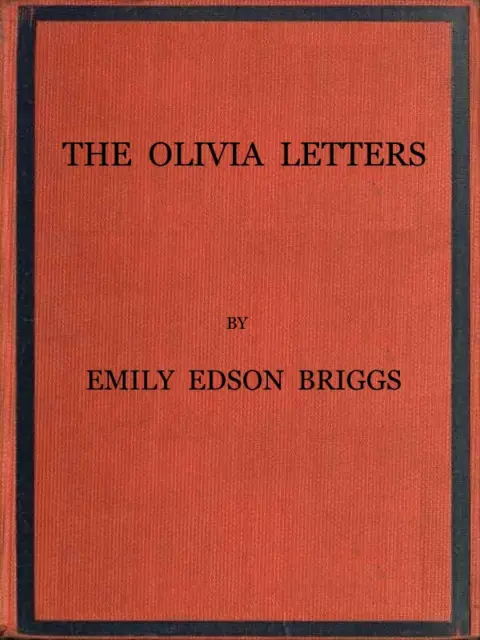
THE CLASSIC COLLECTION · 1906
"The Olivia Letters" by Emily Edson Briggs is a collection of historical correspondence written in the early 20th century. This work presents a unique portrayal of Washington, D.C. over a span of forty years, recounting events and experiences through the letters of a newspaper correspondent named Olivia. The central theme revolves around political and social life during and after the Civil War, with insights into key historical figures and events. At the start of the narrative, the author introduces Olivia's reflections on the architectural beauty of the National Capitol, highlighting the grandeur of its dome as a symbol of national pride. Through her observations, the reader is drawn into the post-war atmosphere of Washington, where the return to peace is juxtaposed with the lingering memories of conflict. Olivia's voice captures the essence of contemporary society and politics—she shares her detailed impressions of life in the Capitol, the societal dynamics surrounding influential figures, and her poignant encounters with soldiers and politicians alike. This opening sets the tone for a richly detailed exploration of an era filled with transformation and introspection.
Introduction adapted from the source catalogue; source summaries may be automatically generated.
Free to read · English · 137,842 words · No account needed
MAKE TIME FOR A GOOD BOOK
On by default. Untick to stop anonymous reading totals. Each page counts after 10 seconds in view. How this works.
Anonymous counting is on unless you have switched it off.
A long residence in Washington proves the sad fact that “court life” at the capital of a Republic is precisely the same as in a monarchy, except in the change of its duration. As the time to accomplish results is so very brief the odious process becomes more patent and less care is taken to hide all the art and skill practiced by the parasites who surround the Executive and who change his nature in a very brief time unless, like “Old Hickory” or Abraham Lincoln, he cannot be veneered by his surroundings because the identity is too strong. When a citizen enters the White House as the political head of the nation he never hears another familiar word. From the august Secretary of State to the scullion in the kitchen, it is “Mr. President.” Not only the inclination downward of the head with the bending muscles of the knees, but even the voices of the old friends become humble in tone and deferential in spirit. Cringing servants in the shape of Congressmen--in fact, all other mortals who have favors to crave--creep and crawl before the face of majesty. By and by the strong and designing of either sex elbow all the rest away, and form a cordon around the Executive, coloring all in the shape of everything which reaches his ears and eyes until he is no longer himself and is as blind as a bat hung to the walls of the Mammoth Cave.
In proof of the above assertion the writer will give the readers of The Times a description of the last day at the White House before the attempt was made upon President Garfield’s life. It was Friday, the last “Cabinet day” in the annals of this administration. It was the first day of July, hot and sultry beyond description. The breeze which swept through the open doors of the mansion came like the breath from an open oven. The spray from the fountain turned into vapor in its ascending flight and reminded the beholder of boiling geysers in a volcanic plain. Inside the White House a crowd had congregated to improve the opportunity of the last chance before the President should depart on his summer tour. Both branches of Congress, Army and Navy, governors of States and Territories, with the odds and ends of humanity all unknown to fame, were collected in an indescribable, whirling kaleidoscope. At times the stairs leading to the “throne room” would be turned into a cataract, but instead of animalcules in the water it was humanity in the air. The stairs once free from the descending mass would be instantly filled with the same kind of material in an upward flight, to remain until hope was dead, and the first result would be enacted again. It was understood that the President would see the people between the hours of 10 and 12, although it was “Cabinet day.” But, alas, the “people” meant the Cabinet officers, for not content with seeing their chief at the 12 o’clock council, it appeared that each had a little private business of his own. At 10 o’clock, or rather five minutes after, the coupe of the Treasury Department deposited Secretary Windom, apparently fresh from the hands of his laundress, faultlessly attired in thinnest of summer covering, on the Executive porch. The fragrance of a perfumed bath still clung to his handsome person and nothing could be compared to it but heaven’s own dew clinging to a morning-glory. With mischief dancing in his hazel eyes and a wave of his fragrant hand to the little woman whose duty it is to press his official name between leaves of lavender, he disappeared. Then came Lincoln--“Bob” the people call him, not tall like his late father, but stalwart of limb and broad of shoulder, a strong, handsome face, which lights up with the same expression which we all remember who had the honor of standing in the presence of Abraham Lincoln. A moment and he is gone. And now comes Postmaster-General James, looking neither to the right nor the left, with his eyes bent, as usual, in one direction. Built on the narrow-gauge plan, long, slim, shallow and slender, ophidian and dazzling, one listens for the death-dealing rattle. Cold chills begin to creep along the great nerve centers. He glides up the stairs. Thank heaven, he has gone. A moment later and a prominent governor says: “Garfield never knows what that man is bringing about.” Stand aside! He’s little, but how he can sting! It is MacVeigh--a Scottish chief. The tartan plaid, bare legs and pibroch are invisible. Round, dense and compact as a bullet, with the characteristics of Scotland which mark him as surely as the furze that each season adorns the heather. American-born generations may stand between him and his ancestors, but he is no more changed than an English walnut would be transplanted to the Western continent.
Your reading position is saved on this browser. Take it to another device with a library code. Reading pages adapt to text, rather than matching a printed edition.
BEHIND THE BOOK
This eBook is for the use of anyone anywhere in the United States and most other parts of the world at no cost and with almost no restrictions whatsoever. You may copy it, give it away or re-use it under the terms of the Project Gutenberg License included with this eBook or online at www.gutenberg.org. If you are not located in the United States, you will have to check the laws of the country where you are located before using this eBook. Read the source licence.
The original source file, including credits and licence, is retained by this library. Request an original-format copy at no charge. Please include the book title and Project Gutenberg identifier #58604.
KEEP YOUR CURIOSITY GOING
David Patterson (Spirit) Hatch

David Patterson (Spirit) Hatch

David Patterson (Spirit) Hatch
Cécile Tormay

Moritz Busch
John L. Ransom