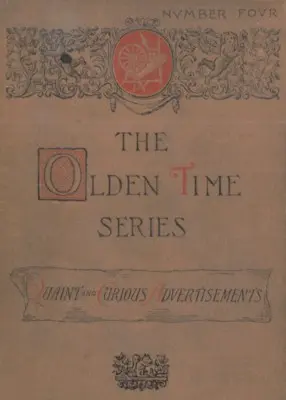
The Olden Time Series, Vol. 4: Quaint and Curious Advertisements Gleanings Chiefly from Old Newspapers of Boston and Salem, Massachusetts
Henry M. (Henry Mason) Brooks
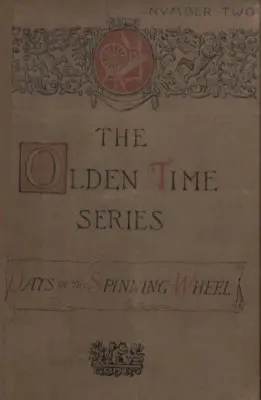
THE CLASSIC COLLECTION · 1885
"The Olden Time Series: Vol. 2: The Days of the Spinning-Wheel in New England" by Henry M. Brooks is a historical account written in the late 19th century. The book explores the quaint customs and lifestyles of New England during the period when spinning wheels were commonplace in households, serving as a symbol of industry and domesticity. Brooks compiles anecdotes from old newspapers and personal reminiscences to provide readers with a vivid portrayal of daily life and societal values during that era. At the start of the book, the author reflects on the nostalgia that accompanies antique items, particularly the spinning wheel, which has become a sought-after artifact in modern times. He sets the scene by contrasting the simplicity and frugality of life in early America before the Revolutionary War with contemporary trends, noting the shift from spinning wheels to modern pianos and the decline in musical appreciation. Through observations and anecdotes collected from historical documents, Brooks dives into various aspects of life, including fashion, economic conditions, and social customs, illustrating how the inhabitants viewed their past with both reverence and critique.
Introduction adapted from the source catalogue; source summaries may be automatically generated.
Free to read · English · 18,978 words · No account needed
MAKE TIME FOR A GOOD BOOK
On by default. Untick to stop anonymous reading totals. Each page counts after 10 seconds in view. How this works.
Anonymous counting is on unless you have switched it off.
The public are respectfully desired, in case of any discovery of a child, or children so lost or strayed, to bring them immediately to the subscriber at No. 71, Newbury street.--By an attention to this regulation, Parents and friends may have their anxiety relieved by applying as above.
SAMUEL ADAMS, Town-Cryer.
Constitutional Telegraph, Aug. 8, 1800.
Masonic notice from Paul Revere and others, from the "Boston Post-Boy."
NOTICE is hereby given to the Brethren of the Antient and Honorable Society of FREE AND ACCEPTED MASONS, That the Feast of St. JOHN the BAPTIST will be Celebrated by the Brethren of St. ANDREW'S Lodge, (duly authoriz'd, constituted and appointed to be held at Boston, by the Right Honorable, JOHN LORD ABERDOUR, Grand Master of Scotland) on Thursday the 24th Instant, at the Royal-Exchange Tavern in King-Street, Tickets to be had of
JOSEPH WEBB, jun.
Boston, June 14, 1762. PHILLIP LEWIS,
PAUL REVERE.
The house of Copley, the celebrated painter, is thus advertised:--
To be LET, and entered on immediately,
THAT elegant, convenient, and most pleasantly situated DWELLING-HOUSE, with a large Garden, and other Land about it, (near his Excellency the Governour's) belonging to Mr. COPLEY; well known to be completely accommodated for a genteel family. Inquire of CHARLES PELHAM, (at the late Dwelling-House of Mrs. PELHAM, at New-Boston) he being impowered to let it.
May 16, 1789.
Massachusetts Centinel.
Antique luxuries.
WANTED, the following, viz. Fifteen Pair of WOOD DUCKS, Four Pair of WILD GEESE, Three Pair of FLYING SQUIRRELS, Three Dozen of the smallest Size Terrapeins or fresh Water TURTLES, for which a good PRICE will be given, or for any Part of them.----Enquire of the Printer.
Essex Gazette, Feb. 21, 1771.
We do not see much in the papers about spinning-wheels until after the War of the Revolution; then there seemed to be what may be called a revival of domestic industry. In 1786 the ladies of Hartford, Conn., formed an Economical Association. They say that they are "fully sensible that our calamities are in a great measure occasioned by the luxury and extravagance of individuals, and are of opinion that it is a duty they owe their country as well as their families to retrench as far as possible all unnecessary expenses." Their articles of agreement were signed, on the 6th of November, 1786, by more than a hundred ladies belonging to the first families in the city. By these articles they engage "not to purchase for next six months any Gauze, Ribbons, Lace, Feathers, Beaver-Hats, Silks, Muslins, and Chintzes, except only for weddings and mourning;" also to "dress their persons in the plainest manner and encourage industry, frugality, and neatness, giving all due preference to the manufactures of their own country." To this they add that "when they receive visits and make entertainments, it will be their study to avoid unnecessary expense, especially on foreign articles." On June 17 of that year the President of Harvard College addressed a letter to the "Massachusetts Gazette" which is interesting in this connection. This letter we copy to show how economy entered into everything, even a "liberal education." It will moreover be of interest because of the attempt made to regulate the students' dress.
Your reading position is saved on this browser. Take it to another device with a library code. Reading pages adapt to text, rather than matching a printed edition.
Henry M. (Henry Mason) Brooks
Lorin Low Dame & Henry M. (Henry Mason) Brooks
Henry M. (Henry Mason) Brooks
Henry M. (Henry Mason) Brooks
BEHIND THE BOOK
This eBook is for the use of anyone anywhere in the United States and most other parts of the world at no cost and with almost no restrictions whatsoever. You may copy it, give it away or re-use it under the terms of the Project Gutenberg License included with this eBook or online at www.gutenberg.org. If you are not located in the United States, you will have to check the laws of the country where you are located before using this eBook. Read the source licence.
The original source file, including credits and licence, is retained by this library. Request an original-format copy at no charge. Please include the book title and Project Gutenberg identifier #22405.
KEEP YOUR CURIOSITY GOING
Cécile Tormay

Moritz Busch
John L. Ransom
Frances Wright
Cécile Tormay

Mabel Potter Daggett