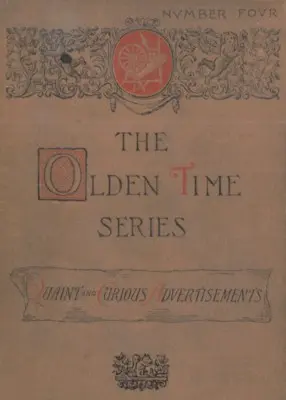
The Olden Time Series, Vol. 4: Quaint and Curious Advertisements Gleanings Chiefly from Old Newspapers of Boston and Salem, Massachusetts
Henry M. (Henry Mason) Brooks
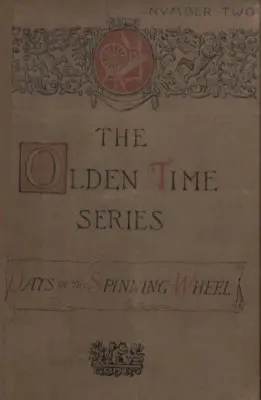
THE CLASSIC COLLECTION · 1885
"The Olden Time Series: Vol. 2: The Days of the Spinning-Wheel in New England" by Henry M. Brooks is a historical account written in the late 19th century. The book explores the quaint customs and lifestyles of New England during the period when spinning wheels were commonplace in households, serving as a symbol of industry and domesticity. Brooks compiles anecdotes from old newspapers and personal reminiscences to provide readers with a vivid portrayal of daily life and societal values during that era. At the start of the book, the author reflects on the nostalgia that accompanies antique items, particularly the spinning wheel, which has become a sought-after artifact in modern times. He sets the scene by contrasting the simplicity and frugality of life in early America before the Revolutionary War with contemporary trends, noting the shift from spinning wheels to modern pianos and the decline in musical appreciation. Through observations and anecdotes collected from historical documents, Brooks dives into various aspects of life, including fashion, economic conditions, and social customs, illustrating how the inhabitants viewed their past with both reverence and critique.
Introduction adapted from the source catalogue; source summaries may be automatically generated.
Free to read · English · 18,978 words · No account needed
MAKE TIME FOR A GOOD BOOK
On by default. Untick to stop anonymous reading totals. Each page counts after 10 seconds in view. How this works.
Anonymous counting is on unless you have switched it off.
By His Excellency's Command,
A. OLIVER, Secr'y.
GOD Save the KING.
Fire-works to be "play'd off," Aug. 13, 1759. From the "Boston Gazette."
The Publick REJOICINGS in Town this Day, on Account of the Success of His Majesty's Arms in the Reduction of Ticonderoga, Niagara and Crown-Point, by the Troops under the Command of the victorious General AMHERST, are now beginning--A great Number of People have been employ'd in making Fire-Works, &c. which will be play'd off this Evening, when there will be a handsome illumination.
The "Post-Boy" of November 15 of that year prints the following:--
NEW-YORK, November 15.
The Ships Manchester and Edward, that arrived here lately from London, brought over no less than 206 Chests of Green and Bohea Teas, for the different Merchants of this City.
Since our last two Vessels arrived here from Ireland, with about 2000 Firkins of choice Irish Butter, which we hope will bring down the Price of that Article.
We get an idea of men's clothing in 1767 from the following:--
WHEREAS in the Time of Divine Service Yesterday, the House of the Subscriber was broke open, and the following Things stolen from thence, viz. a Chocolate-colour Coat and Jacket trim'd with Brass Buttons, a cloth-colour'd cut-velvet Jacket with white Buttons, a pair Wash-Leather Breeches with white Buttons, five Silver Tea-Spoons, and one large ditto, mark'd G.P. Whoever shall apprehend the Thief or Thieves, so that he or they may be convicted, shall have FOUR DOLLARS Reward, paid by
Concord, September 14, 1767.
Lectures were not common in the last century. It was not until within fifty or sixty years ago, when Lyceums began to be established, that the lecture system became developed.
We find that in 1769 a Mr. Douglass lectured in Boston, according to an advertisement in the "Chronicle," August 17th.
The well-known Colonel David Mason of the Revolution, who was a prominent figure among the patriots at Leslie's Retreat at the North Bridge in Salem in February, 1775, was one of the earliest, if not the very first, to lecture in Salem upon a scientific subject. In the "Essex Gazette," Jan. 15, 1771, we find his advertisement:--
No longer than next Week, will
Continue to be exhibited, every Evening
in which the Air is dry, (Saturday and Sunday
excepted)
A Course of Experiments in that instructive and entertaining Branch of Natural PHILOSOPHY, called
=Electricity=,
To be accompanied with Methodical Lectures on the Nature and Properties of that WONDERFUL ELEMENT,
By David Mason,
At his Dwelling-House near the North Bridge.
The Course to consist of two Lectures,
At a Pistareen each Lecture.
Your reading position is saved on this browser. Take it to another device with a library code. Reading pages adapt to text, rather than matching a printed edition.
Henry M. (Henry Mason) Brooks
Lorin Low Dame & Henry M. (Henry Mason) Brooks
Henry M. (Henry Mason) Brooks
Henry M. (Henry Mason) Brooks
BEHIND THE BOOK
This eBook is for the use of anyone anywhere in the United States and most other parts of the world at no cost and with almost no restrictions whatsoever. You may copy it, give it away or re-use it under the terms of the Project Gutenberg License included with this eBook or online at www.gutenberg.org. If you are not located in the United States, you will have to check the laws of the country where you are located before using this eBook. Read the source licence.
The original source file, including credits and licence, is retained by this library. Request an original-format copy at no charge. Please include the book title and Project Gutenberg identifier #22405.
KEEP YOUR CURIOSITY GOING
Cécile Tormay

Moritz Busch
John L. Ransom
Frances Wright
Cécile Tormay

Mabel Potter Daggett