THE CLASSIC COLLECTION✦Irish NationalityCLASSIC FREE BOOKS
Irish Nationality
Alice Stopford Green
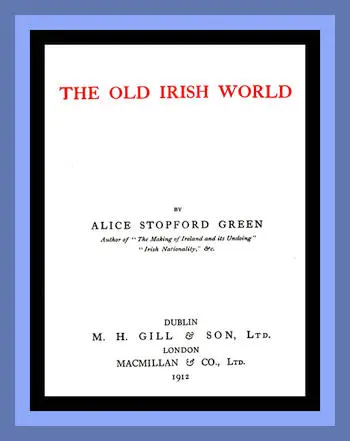
THE CLASSIC COLLECTION · 1912
"The Old Irish World" by Alice Stopford Green is a historical account written in the early 20th century. This work combines lectures and papers that explore Ireland's historical narrative, culture, and civilization, particularly in the context of overcoming English colonial perspectives that have shaped its history. The book emphasizes the importance of understanding Ireland's unique historical identity and its rich cultural contributions. At the start of the book, the author expresses gratitude to friends who encouraged her to publish lectures on Irish history. She highlights the historical challenge of studying Irish civilization, pointing out how traditional narratives often undermine the richness of Ireland's past. Stopford Green critiques the way history has been presented in England, asserting that Irish history has been marginalized and misrepresented. She stresses the urgent need for the Irish people to reclaim their narrative and to study their history not merely as a fragment of English history but as a significant narrative that deserves recognition and respect.
Introduction adapted from the source catalogue; source summaries may be automatically generated.
Free to read · English · 50,372 words · No account needed
MAKE TIME FOR A GOOD BOOK
On by default. Untick to stop anonymous reading totals. Each page counts after 10 seconds in view. How this works.
Anonymous counting is on unless you have switched it off.
For thirty-seven years Calvagh now led his people’s fight against “the English manner of government,” in other words, the destruction of the Irish. He seized more lords and officers, won more wealth, and recovered more Irish territory than any lord in Leinster. At this time the Desmonds, out of favour under Lancastrian kings, had withdrawn to Munster to build up their dominion in the south, while the Ormonds and their cousins and rivals the Talbots fought for power. Passing strangers appeared in Dublin Castle; but with occasional interruptions the actual authority swung back, now to Ormond and his half-brother the prior of Kilmainham, now to Talbot and his brother the Archbishop of Dublin, till each family had held the chief control many times. The Talbots stood for pure English rule, and excelled in severity alike towards colonists and natives. They used for their wars and their rewards Irish taxes, coyn and livery; but at Westminster they represented Ormond’s iniquity in levying the like taxes, and his faint and wavering sympathies for his countrymen, as treason of the darkest hue; his favouring his Irish friends, keeping Irish soldiers for his following, letting lands slip into Irish hands, making Irishmen knights of the shire; with a few additions thrown in of his sloth, violence, and corruption--“courses ruinous and destructive” to the English. In the midst of this discord Calvagh seems to have leaned to Ormond. His wife, apparently by a friendly arrangement, was given tribute from an Ormond lordship in Kildare. He himself held Talbot’s cousin Thomas to ransom in his prison at Killeigh: he took “blackrent” or tribute from the English of Meath.
Meanwhile both Ulster and Offaly were set aflame by the coming of a new Mortimer Viceroy (1423) Edmund, son of Roger of the Irish dress. When he landed with an English army O’Neill and O’Donnell had already marched over Louth and Meath (1423), compelling the English to give hostages and guarantees for their pledge that they would be under tribute for ever. Edmund called O’Neill and some of the leaders to his Trim Castle, and made arrangements with him; but they had scarcely left when he died of plague (1424), and Talbot, then Lord Chief Justice, pursued the chiefs and carried them prisoners to Dublin, demanding hostages and ransom. Calvagh on his side raided Meath, where he seized the Marshal of the English army, the Seneschal of the Viceroy’s manor, and other squires. But it was now the turn of Ormond, who had lately come to Ireland bringing a host of Saxons, and adding great strength to the English wars; and Talbot made terms with Calvagh before the appointment of the new viceroy. But the peace was brief. Calvagh entered into alliance with the princes of Ulster. He married his daughter Finola to O’Donnell, “harrasser and destroyer of the English.” And when O’Neill with O’Donnell marched a great army to Mullingar (1431), and on the Moat where O’Melaghlin had in old times ruled and judged Leinster, gathered the chiefs to take his wages and acknowledge him leader for the war, Calvagh joined his host in the ravaging of Westmeath till the English paid a heavy price for the sparing of their country. Later, when his son-in-law O’Donnell was captured and imprisoned in Dublin Castle (1434), then sent to England (1435), and finally to the Isle of Man (1439) to die there in prison, Calvagh marched, year after year, through Meath to avenge his captivity. The Justiciary or Deputy himself was taken prisoner by Calvagh’s son, and kept some time till the English of Dublin ransomed him. In the feuds of the barons he found allies. The son of MacFheorais, chief of the Berminghams and heir of “the treacherous baron,” suffered “an abuse” in the great court of Trim, the Governor’s castle. For as he entered the court (1443) under the safeguard of Ormond, the son of Barnewell, Treasurer of Meath, beat a Caimin--namely, a stroke of his finger on the nose of Bermingham’s son. On which he stole out of the town, and went towards O’Connor Faly, and they joined together, and it is hard to know that ever was such abuse better revenged than the said Caimin. They burned and preyed Meath and obtained their full demands--that Calvagh should have his duties from the English during his life as Lord of his territory, and that the Clan-Feorais should have all their hostages freely restored; and not only that but they obtained in this “war of Caimin” all conditions such as they demanded for holding peaceable quiet with the English. Ever more formidable, Calvagh now led his kerns to Moyclare beyond Maynooth and to Tara itself (1446). Talbot, made Earl of Shrewsbury, was called back from the French wars. He re-built Castle Carberry, the castle of the old massacre, to defend Meath against Berminghams and O’Connors, caused Calvagh to make peace, to ransom his son taken in the wars, and deliver many beeves for the royal kitchen; and made a statute (1447) that English and Irish should no more be confounded together by their dress, but that every Englishman who did not shave in the English manner once at least in two weeks, should be treated as an Irish enemy--a statute which survived till the reign of Charles I. His last characteristic outrage was the treacherous capture of Felim O’Reilly who had gone to Trim at his own invitation, and the like deceitful seizing of the Savadges. Talbot seems to have been distinguished for his violated pledges among the crowd of English officials whose broken faith became a byword. “Thy safe-guarding,” said the poet, “I confide to God; to Mary’s sweet and only Son; that He may shelter thee from Anglo-word of Englishmen, and from the gentiles’ act of violence.” The prisoners all died in Trim Castle, disappointing the Viceroy of his ransom. After which Talbot disappeared for the last time to France (1447), followed by the curses of the Irish--“the learned say there came not from the time of Herod anyone so wicked in evil deeds.” In his stead came Richard Plantagenet, Duke of York, heir to the English crown, and to all the earldoms and lordships of the Mortimers.
Your reading position is saved on this browser. Take it to another device with a library code. Reading pages adapt to text, rather than matching a printed edition.
BEHIND THE BOOK
This eBook is for the use of anyone anywhere in the United States and most other parts of the world at no cost and with almost no restrictions whatsoever. You may copy it, give it away or re-use it under the terms of the Project Gutenberg License included with this eBook or online at www.gutenberg.org. If you are not located in the United States, you will have to check the laws of the country where you are located before using this eBook. Read the source licence.
The original source file, including credits and licence, is retained by this library. Request an original-format copy at no charge. Please include the book title and Project Gutenberg identifier #53159.
KEEP YOUR CURIOSITY GOING
Cécile Tormay

Moritz Busch
John L. Ransom
Frances Wright
Cécile Tormay

Mabel Potter Daggett