THE CLASSIC COLLECTION✦Irish NationalityCLASSIC FREE BOOKS
Irish Nationality
Alice Stopford Green
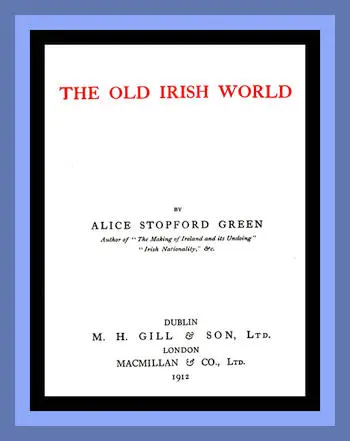
THE CLASSIC COLLECTION · 1912
"The Old Irish World" by Alice Stopford Green is a historical account written in the early 20th century. This work combines lectures and papers that explore Ireland's historical narrative, culture, and civilization, particularly in the context of overcoming English colonial perspectives that have shaped its history. The book emphasizes the importance of understanding Ireland's unique historical identity and its rich cultural contributions. At the start of the book, the author expresses gratitude to friends who encouraged her to publish lectures on Irish history. She highlights the historical challenge of studying Irish civilization, pointing out how traditional narratives often undermine the richness of Ireland's past. Stopford Green critiques the way history has been presented in England, asserting that Irish history has been marginalized and misrepresented. She stresses the urgent need for the Irish people to reclaim their narrative and to study their history not merely as a fragment of English history but as a significant narrative that deserves recognition and respect.
Introduction adapted from the source catalogue; source summaries may be automatically generated.
Free to read · English · 50,372 words · No account needed
MAKE TIME FOR A GOOD BOOK
On by default. Untick to stop anonymous reading totals. Each page counts after 10 seconds in view. How this works.
Anonymous counting is on unless you have switched it off.
In the long task of giving its true balance to the history of Ireland, by the discovery of all the facts, and the adjudging of their place, controversy will be lively. Every Irishman for certain will be ready for a battle of wits. But let us keep our intelligence perfectly clear on one point. We shall hear a great deal of “impartiality” and a “judicial mind.” Here we must make no mistake. Impartiality of intellect need not mean insensibility of heart. Let us suppose that the intellect should have no pre-possession at all, not even in favour of English civilization, nor of the idol of the market-place, “the Wealth of Nations”--its delicate balance should drop now on this side, now on that, without a shadow of prejudice or a hint of obstinacy, abhorrent of convention, with never a predilection. But impartiality of the heart--that is another matter. Who will pretend to comprehend human life who has no great affection of the soul? The generous heart knows no balancing hesitation between the man who deserts his country and the man who defends it; he alone can interpret the hero in whose soul some answering passion flames; and I suppose that the understanding of a commonwealth will best come to him who is most responsive to a variety of human emotions. I think we could do with a change of partialities in Ireland--fewer orthodox predilections of the head, if it might be so, and some illumination from the heart.
A new examination of Irish history is indeed of the utmost importance to our people. The leading reviews, text-books, and histories in England with one accord have presented Ireland to the English people under the “savage” aspect, and their statements have been too frequently accepted. Hear the common opinion as Tennyson put it: “Kelts are all made furious fools.... They live in a horrible island, and have no history of their own worth the least notice. Could not anyone blow up that horrible island with dynamite and carry it off in pieces--a long way off?” The same gloomy picture is still spread before England. Mr. Fletcher, a Fellow of All Souls, records that “it was quite common to bleed a cow for a refreshing drink of blood,” and that “there were no exports save the said cow-skins,” though with these the Irish apparently managed to buy “red seas of claret.” Shane O’Neill was killed “by his own people whom he was plundering!” Degradation was universal, as we learn from a sentence absolutely amazing in its colossal and unscrupulous ignorance--“though his name had once been FitzNigel or de Burgh, it gradually became O’Neill or O’Bourke!” Mr. Rudyard Kipling joins Mr. Fletcher in declaring that Irish history “was all broken heads and stolen cows, as it had been for a thousand years,” and that Irishmen had no interest or care for their religion till they discovered a use for it as a warcry against England. Accounts of Ireland equally contrary to fact and common sense serve in political controversy. English politicians assert on platforms that Irishmen of themselves had never any national life or duty at all, that the first gleam of true patriotism was taught them by England since the Union, that Ireland had no conception of a Parliament till England gave it to her people, when the boon was so misused and misunderstood by an incompetent race (the English in Ireland, be it remembered) that in the higher interests of man it had to be withdrawn. As for the desire of self-government, “some people said it was a matter of historical sentiment. The humour of it was that there never was a real Irish kingdom at all. The Parliament which it was sought to restore to Ireland was given to it by England. The historical sentiment and loyalty which Mr. John Redmond was talking was the greatest humbug that was ever preached.” There are others who argue, Dr. Mahaffy among them, that practically there is not any more a Celtic race in Ireland, but one so mixed in blood that it no longer, if it ever did, contains the materials of a nation. The Celtic people, to their honour, have never denied a national brotherhood to Danes, Normans, English, or Palatines, who loyally entered into the Irish commonwealth. But as to political theories of the vanishing of the race, we have only to examine them by known facts, and turn to the Report of the Registrar-General in 1909 for proof that in the mingling of peoples the Celtic is still the predominant element over all the rest; and if this proof is conclusive, even in the register of merely Irish names, how enormous would be its increased weight if we could reckon in Celtic families the change from Irish names which has gone on ceaselessly since the thirteenth century, and is still constantly occurring at this moment--a change which, however lamentable, cannot alter the blood and the inheritance.
Your reading position is saved on this browser. Take it to another device with a library code. Reading pages adapt to text, rather than matching a printed edition.
BEHIND THE BOOK
This eBook is for the use of anyone anywhere in the United States and most other parts of the world at no cost and with almost no restrictions whatsoever. You may copy it, give it away or re-use it under the terms of the Project Gutenberg License included with this eBook or online at www.gutenberg.org. If you are not located in the United States, you will have to check the laws of the country where you are located before using this eBook. Read the source licence.
The original source file, including credits and licence, is retained by this library. Request an original-format copy at no charge. Please include the book title and Project Gutenberg identifier #53159.
KEEP YOUR CURIOSITY GOING
Cécile Tormay

Moritz Busch
John L. Ransom
Frances Wright
Cécile Tormay

Mabel Potter Daggett