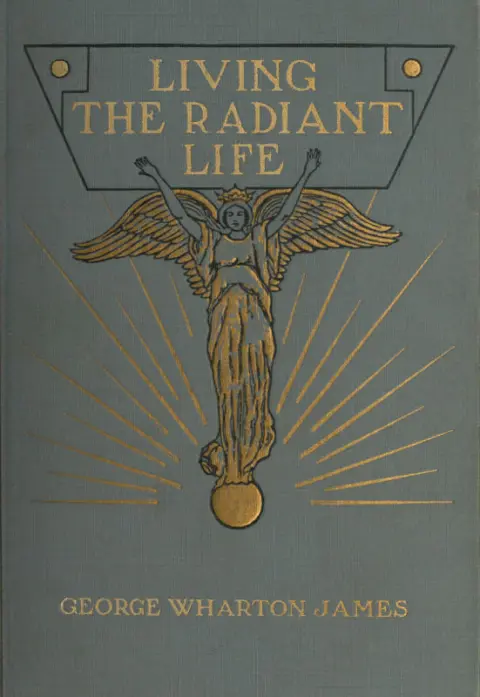
Living the Radiant Life: A Personal Narrative
George Wharton James
THE CLASSIC COLLECTION · 1913
"The Old Franciscan Missions of California" by George Wharton James is a historical account written during the early 20th century. The book delves into the rich tapestry of California's early missions, highlighting the lives and work of the Franciscan missionaries, particularly focused on the significant contributions of figures like Padre Junipero Serra. Through this exploration, James aims to shed light on the spiritual and cultural interactions between the missionaries and the indigenous peoples of California. The opening portion of the book sets the stage for discussing the historical context of the missions, emphasizing the misperception that California's missions were the only early establishments of their kind in the region. James begins by recounting the broader history of Spanish exploration and the founding of missions in other territories, particularly in Mexico. He details the transition from Jesuit to Franciscan control over the missions in Lower California before explaining the significant mission-building efforts in Alta California. The narrative provides insights into the motivations driving the missionaries and highlights the challenges they faced, as well as their dedication to the spiritual guidance and education of the native population. Overall, this section engages readers with a deep sense of historical inquiry and a reverence for the past endeavors of the Franciscan fathers.
Introduction adapted from the source catalogue; source summaries may be automatically generated.
Free to read · English · 65,358 words · No account needed
MAKE TIME FOR A GOOD BOOK
On by default. Untick to stop anonymous reading totals. Each page counts after 10 seconds in view. How this works.
Anonymous counting is on unless you have switched it off.
On the strength of reports that he heard, Governor Argüello recalled the Monterey troops; but this appeared to be a mistake, for, immediately, Guerra of Santa Barbara sent eighty men over to San Emigdio, where, on April 9 and 11, severe conflicts took place, with four Indians killed, and wounded on both sides. A wind and dust storm arising, the troops returned to Santa Barbara.
In May the governor again took action, sending Captain Portilla with a force of 130 men. The prefect Sarría and Padre Ripoll went along to make as peaceable terms as possible, and a message which Sarría sent on ahead doubtless led the insurgents to sue for peace. They said they were heartily sorry for their actions and were anxious to return to Mission life, but hesitated about laying down their arms for fear of summary punishment. The gentiles still fomented trouble by working on the fears of the neophytes, but owing to Argüello's granting a general pardon, they were finally, in June, induced to return, and the revolt was at an end.
After these troubles, however, the Mission declined rapidly in prosperity. Though the buildings under Padre Ripoll were in excellent condition, and the manufacturing industries were well kept up, everything else suffered.
In 1817 a girls' school for whites was started at the presidio of Santa Barbara, but nothing further is known of it. Several years later a school was opened, and Diego Fernandez received $15 a month as its teacher. But Governor Echeandía ordered that, as not a single scholar attended, this expense be discontinued; yet he required the comandante to compel parents to send their children to school.
In 1833 Presidente Duran, discussing with Governor Figueroa the question of secularization, deprecated too sudden action, and suggested a partial and experimental change at some of the oldest Missions, Santa Barbara among the number.
When the decree from Mexico, came, however, this was one of the first ten Missions to be affected thereby. Anastasio Carrillo was appointed comisionado, and acted from September, 1833. His inventory in March, 1834, showed credits, $14,953; buildings, $22,936; furniture, tools, goods in storehouse, vineyards, orchards, corrals, and animals, $19,590; church, $16,000; sacristy, $1500; church ornaments, etc., $4576; library, $152; ranches, $30,961; total, $113,960, with a debt to be deducted of $1000.
The statistics from 1786 to 1834, the whole period of the Mission's history, show that there were 5679 baptisms, 1524 marriages, 4046 deaths. The largest population was 1792 in 1803. The largest number of cattle was 5200 in 1809, of sheep, 11,066 in 1804.
Your reading position is saved on this browser. Take it to another device with a library code. Reading pages adapt to text, rather than matching a printed edition.
George Wharton James

George Wharton James

George Wharton James
George Wharton James
BEHIND THE BOOK
This eBook is for the use of anyone anywhere in the United States and most other parts of the world at no cost and with almost no restrictions whatsoever. You may copy it, give it away or re-use it under the terms of the Project Gutenberg License included with this eBook or online at www.gutenberg.org. If you are not located in the United States, you will have to check the laws of the country where you are located before using this eBook. Read the source licence.
The original source file, including credits and licence, is retained by this library. Request an original-format copy at no charge. Please include the book title and Project Gutenberg identifier #13854.
KEEP YOUR CURIOSITY GOING
Cécile Tormay

Moritz Busch
John L. Ransom
Frances Wright
Cécile Tormay

Mabel Potter Daggett