
My study windows
James Russell Lowell
THE CLASSIC COLLECTION · 1892
"The Old English Dramatists" by James Russell Lowell is a critical work that appears to have been written in the late 19th century. This examination consists of lectures focusing on the prominent figures of English drama during the Elizabethan era, notably Christopher Marlowe, John Webster, and others who shaped the landscape of early English theatre. Lowell aims to explore the qualities, significance, and legacy of these playwrights, highlighting their contributions to drama and literature that still resonate today. The opening of the work provides a reflective introduction to Lowell's thoughts on lecturing and the challenges of distilling thoughts into a structured presentation. He recalls his own experiences lecturing thirty-two years prior and his long-standing affinity for Old English dramatists. Lowell expresses his understanding of the historical context and the literary evolution leading to the period of the dramatists he intends to discuss, contrasting their works with those of Shakespeare. He discusses the development of language and how it helped elevate the dramatic arts, setting the stage for a deep dive into a rich tapestry of literary criticism and exploration of these writers.
Introduction adapted from the source catalogue; source summaries may be automatically generated.
Free to read · English · 35,993 words · No account needed
MAKE TIME FOR A GOOD BOOK
On by default. Untick to stop anonymous reading totals. Each page counts after 10 seconds in view. How this works.
Anonymous counting is on unless you have switched it off.
There are, properly speaking, no characters in the plays of Marlowe--but personages and interlocutors. We do not get to know them, but only to know what they do and say. The nearest approach to a character is Barabas, in “The Jew of Malta,” and he is but the incarnation of the popular hatred of the Jew. There is really nothing human in him. He seems a bugaboo rather than a man. Here is his own account of himself:--
“As for myself, I walk abroad o’ nights,
And kill sick people groaning under walls;
Sometimes I go about and poison wells;
And now and then, to cherish Christian thieves,
I am content to lose some of my crowns,
That I may, walking in my gallery,
See ’em go pinioned by my door along;
Being young, I studied physic, and began
To practise first upon the Italian;
There I enriched the priests with burials,
And always kept the sexton’s arms in ure
With digging graves and ringing dead men’s knells;
And, after that, was I an engineer,
And in the wars ’twixt France and Germany,
Under pretence of helping Charles the Fifth,
Slew friend and enemy with my stratagems.
Then, after that, was I an usurer,
And with extorting, cozening, forfeiting,
And tricks belonging unto brokery,
I filled the jails with bankrupts in a year.
And with young orphans planted hospitals;
And every moon made some or other mad,
And now and then one hang himself for grief,
Pinning upon his breast a long great scroll
How I with interest tormented him.
But mark how I am blest for plaguing them--
I have as much coin as will buy the town.”
Here is nothing left for sympathy. This is the mere lunacy of distempered imagination. It is shocking, and not terrible. Shakespeare makes no such mistake with Shylock. His passions are those of a man, though of a man depraved by oppression and contumely; and he shows sentiment, as when he says of the ring that Jessica had given for a monkey: “It was my turquoise. I had it of Leah when I was a bachelor.” And yet, observe the profound humor with which Shakespeare makes him think first of its dearness as a precious stone and then as a keepsake. In letting him exact his pound of flesh, he but follows the story as he found it in Giraldi Cinthio, and is careful to let us know that this Jew had good reason, or thought he had, to hate Christians. At the end, I think he meant us to pity Shylock, and we do pity him. And with what a smiling background of love and poetry does he give relief to the sombre figure of the Jew! In Marlowe’s play there is no respite. And yet it comes nearer to having a connected plot, in which one event draws on another, than any other of his plays. I do not think Milman right in saying that the interest falls off after the first two acts. I find enough to carry me on to the end, where the defiant death of Barabas in a caldron of boiling oil he had arranged for another victim does something to make a man of him. But there is no controlling reason in the piece. Nothing happens because it must, but because the author wills it so. The conception of life is purely arbitrary, and as far from nature as that of an imaginative child. It is curious, however, that here, too, Marlowe should have pointed the way to Shakespeare. But there is no resemblance between the Jew of Malta and the Jew of Venice, except that both have daughters whom they love. Nor is the analogy close even here. The love which Barabas professes for his child fails to humanize him to us, because it does not prevent him from making her the abhorrent instrument of his wanton malice in the death of her lover, and because we cannot believe him capable of loving anything but gold and vengeance. There is always something extravagant in the imagination of Marlowe, but here it is the extravagance of absurdity. Generally he gives us an impression of power, of vastness, though it be the vastness of chaos, where elemental forces hurtle blindly one against the other. But they are elemental forces, and not mere stage properties. Even Tamburlaine, if we see in him--as Marlowe, I think, meant that we should see--the embodiment of brute force, without reason and without conscience, ceases to be a blusterer, and becomes, indeed, as he asserts himself, the scourge of God. There is an exultation of strength in this play that seems to add a cubit to our stature. Marlowe had found the way that leads to style, and helped others to find it, but he never arrived there. He had not self-denial enough. He can refuse nothing to his fancy. He fails of his effect by over-emphasis, heaping upon a slender thought a burthen of expression too heavy for it to carry. But it is not with fagots, but with priceless Oriental stuffs, that he breaks their backs.
Your reading position is saved on this browser. Take it to another device with a library code. Reading pages adapt to text, rather than matching a printed edition.
James Russell Lowell
James Russell Lowell

James Russell Lowell
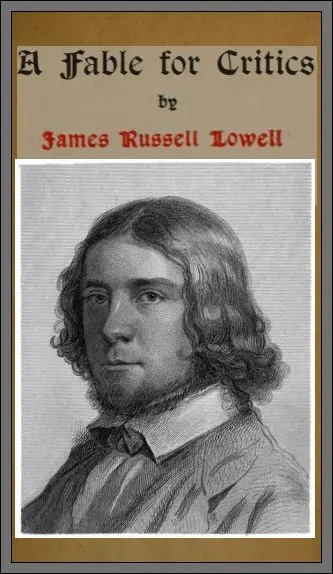
James Russell Lowell
BEHIND THE BOOK
This eBook is for the use of anyone anywhere in the United States and most other parts of the world at no cost and with almost no restrictions whatsoever. You may copy it, give it away or re-use it under the terms of the Project Gutenberg License included with this eBook or online at www.gutenberg.org. If you are not located in the United States, you will have to check the laws of the country where you are located before using this eBook. Read the source licence.
The original source file, including credits and licence, is retained by this library. Request an original-format copy at no charge. Please include the book title and Project Gutenberg identifier #72335.
KEEP YOUR CURIOSITY GOING

David Patterson (Spirit) Hatch

David Patterson (Spirit) Hatch

David Patterson (Spirit) Hatch
Cécile Tormay

Moritz Busch
John L. Ransom