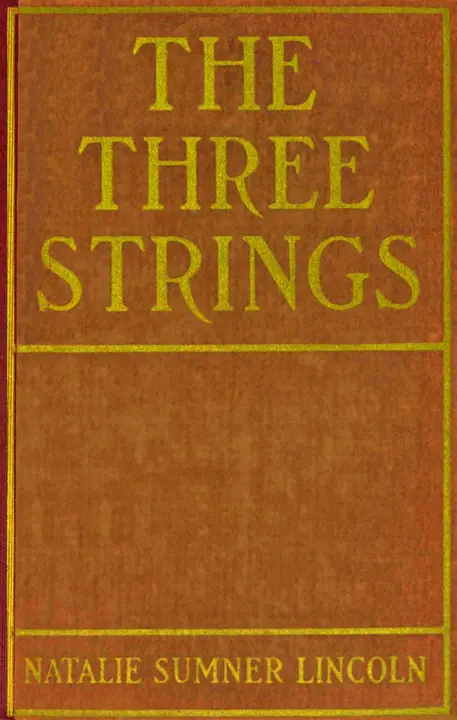
The three strings
Natalie Sumner Lincoln
THE CLASSIC COLLECTION · 1915
"The Official Chaperon" by Natalie Sumner Lincoln is a novel written in the early 20th century. The story revolves around Marjorie Langdon, who becomes the official chaperon for Janet Fordyce, the daughter of a wealthy family in Washington, D.C. The narrative explores themes of social expectations, romance, and the complexities of relationships within high society during this era. At the start of the novel, we are introduced to various characters as they navigate life in Washington. The story opens aboard a Pullman sleeper, where a traveler, later revealed to be Duncan Fordyce, observes the bustling life of Washington as he arrives in the city. The narrative quickly shifts focus to Marjorie, who is dealing with her dismissal from Admiral Lawrence due to a missing codicil and her financial struggles. As she enters her new role as a chaperon for Janet, the reader is drawn into the social dynamics, tensions, and romantic entanglements that unfold, setting the stage for a captivating exploration of love and intrigue.
Introduction adapted from the source catalogue; source summaries may be automatically generated.
Free to read · English · 74,204 words · No account needed
MAKE TIME FOR A GOOD BOOK
On by default. Untick to stop anonymous reading totals. Each page counts after 10 seconds in view. How this works.
Anonymous counting is on unless you have switched it off.
Once in the crowded dining-room on the ground floor of the New Willard, Marjorie thanked a kindly Providence which ordained that the tables were too small to accommodate the Calhoun-Cooper party and her own, and she saw them depart to another quarter of the room with inward joy. Barnard, silently resenting that he was the fifth spoke in the wheel, left them, and joined another group of friends, and Duncan, contemplating his sister and Tom already deep in conversation, gave his undivided attention to Marjorie. They were none of them conscious of the tardiness of the service, or the flight of time, and Tom gave voice to genuine regret as they finally rose from the table and made their way to the lift.
“Why do good times have to end?” he grumbled. “I don’t know when I have enjoyed myself so much.”
“It has been fun,” agreed Janet softly, secretly longing to linger beside the distinguished-looking young officer. “Shall we see you at dinner tomorrow?”
“You bet!” he whispered, with emphasis.
“Go ahead, Janet,” Duncan’s strong arm propelled his sister forward. “Don’t you see the lift is waiting?”
As Marjorie and Tom started to follow them some new arrivals pushed rudely between, and an instant later, the packed elevator shot upward.
“Never mind, we’ll catch the next one,” said Tom consolingly, as he darted to the second shaft. “It’s coming down now.” They waited impatiently for the passengers in the elevator to step out in the square hall, then entered and found they had the lift to themselves. The elevator boy was about to release the lever, when the starter tapped on the glass partition, and throwing open the door, permitted Representative J. Calhoun-Cooper to step inside.
“Good evening, sir,” said Marjorie cordially.
“Oh, how do you do,” replied Calhoun-Cooper, somewhat taken aback on recognizing his companions. He barely nodded to Tom, whose greeting was equally curt; and Marjorie, becoming aware of the apparently strained relations between the two men, broke the awkward silence.
“I am afraid you are too late to see the ball at its height,” she said.
“I couldn’t get here any earlier,” answered Calhoun-Cooper. “Have you seen my wife and daughter this evening?”
“Yes; they finished supper before we did, and have already gone back to
the ballroom.”
Calhoun-Cooper, who had been watching Marjorie with peculiar
intentness, wheeled on Tom.
“My congratulations, Captain,” he said sardonically. “You executed my commission with commendable quickness.”
“I don’t catch your meaning, sir,” retorted Tom frigidly.
Your reading position is saved on this browser. Take it to another device with a library code. Reading pages adapt to text, rather than matching a printed edition.
Natalie Sumner Lincoln
Natalie Sumner Lincoln
Natalie Sumner Lincoln
Natalie Sumner Lincoln
BEHIND THE BOOK
This eBook is for the use of anyone anywhere in the United States and most other parts of the world at no cost and with almost no restrictions whatsoever. You may copy it, give it away or re-use it under the terms of the Project Gutenberg License included with this eBook or online at www.gutenberg.org. If you are not located in the United States, you will have to check the laws of the country where you are located before using this eBook. Read the source licence.
The original source file, including credits and licence, is retained by this library. Request an original-format copy at no charge. Please include the book title and Project Gutenberg identifier #69388.
KEEP YOUR CURIOSITY GOING
Coulson Kernahan

Maurice Baring
Frances Wright
Cécile Tormay

Frederic Jesup Stimson

W. H. P. (William Henry Pope) Jarvis