The Vegetable Lamb of Tartary: A Curious Fable of the Cotton Plant. To Which Is Added a Sketch of the History of Cotton and the Cotton Trade
Henry Lee

THE CLASSIC COLLECTION · 1875
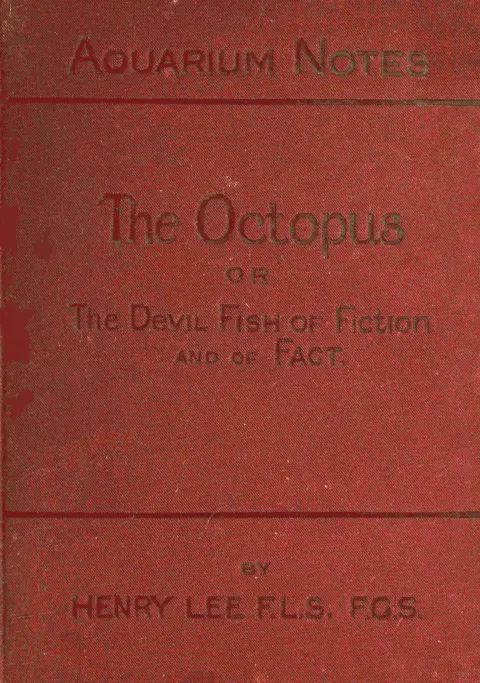
"The Octopus; or, The 'Devil-Fish' of Fiction and of Fact" by Henry Lee is a scientific publication written in the late 19th century. The work serves as an observational study of the octopus, providing insights into its behavior, anatomy, and significance in both natural history and popular culture. Throughout the book, Lee contrasts scientific knowledge with fictional representations, particularly drawing comparisons to Victor Hugo's portrayal of the creature. The opening portion of the text introduces the reader to Lee's role as a naturalist at the Brighton Aquarium, where he reflects on his observations of octopuses. He shares anecdotes about the public's fascination with the "devil-fish" and recounts a notable incident involving an octopus that was tragically consumed by a dogfish, sparking significant media attention. Following this, he outlines the book's aim to merge his previous writings and new observations, establishing a foundation for his scientific analysis of the octopus in relation to its mythical narratives and characteristics.
Introduction adapted from the source catalogue; source summaries may be automatically generated.
Free to read · English · 38,810 words · No account needed
MAKE TIME FOR A GOOD BOOK
On by default. Untick to stop anonymous reading totals. Each page counts after 10 seconds in view. How this works.
Anonymous counting is on unless you have switched it off.
Plato, the comic poet, mentioning in his “Phaon” the banquet of Philoxenus the Leucadian, says:—
“Good-sized polypus in season,
Should be boiled—to roast them’s treason,
But if early, and not big,
Roast them; boiled ar’n’t worth a fig.”
Alexis, in his “Pseudypobolemæus,” writes:—
Take the stiff feelers of the polypus, And with them you shall find some modest liver And cutlets of wild goats, which you shall eat.
The eggs of the octopus and sepia were also regarded as dainties. Hegemon of Thasos thus refers to them in his “Philuma:”—
Go quickly! buy me of that polypus,
And fry the roe, and give it us to eat.
But to fry octopus was not, by some, considered good cooking. Nicostratus of Philetærus says, in the “Antyllus:”—
I never again will venture to eat cuttle-fish which has been
dressed in a frying-pan.
They ate heartily at breakfast in those times, it seems, for Epicharmus tells us in “The Sirens:”—
In the morning early, at the break of day,
We roasted plump anchovies,
Cutlets of well-fed pork and polypi;
And then we drank sweet wine.
Philoxenus, the poet of Cythera, is reported to have been a very greedy man. He wished that he had a throat three cubits long, that he might drink as long as possible, and that his food might all at once delight him. Machon, the comic poet, relates how his fondness for well-cooked octopus and his insatiate gluttony caused his death:—
They say Philoxenus, the ancient poet
Of Dithyrambics, was so wonderfully
Attached to fish, that once at Syracuse
He bought a polypus two cubits long,
Then dress’d it, and then ate it up himself,
All but the head—and afterwards fell sick,
Seized with a sharp attack of indigestion.
Then when some doctor came to him to see him
Who saw that he was greatly out of order;
“If,” said the doctor, “you have any business
Not well arranged, do not delay to settle it,
For you will die before six hours are over!”
Philoxenus replied, “All my affairs,
O Doctor, are well ended and arranged
Long, long ago; but now, since deadly fate
Calls me away, who can’t be disobeyed,
That I may go below with all my goods,
Bring me the relics of that polypus!”
We learn something of the most approved methods of cooking the “cuttle-fishes” and “squids” from the following passages. Sotades, in his play entitled “The Shut-up Women,” introduces a cook, who makes a speech in which these molluscs are mentioned:—
Your reading position is saved on this browser. Take it to another device with a library code. Reading pages adapt to text, rather than matching a printed edition.
Henry Lee
BEHIND THE BOOK
This eBook is for the use of anyone anywhere in the United States and most other parts of the world at no cost and with almost no restrictions whatsoever. You may copy it, give it away or re-use it under the terms of the Project Gutenberg License included with this eBook or online at www.gutenberg.org. If you are not located in the United States, you will have to check the laws of the country where you are located before using this eBook. Read the source licence.
The original source file, including credits and licence, is retained by this library. Request an original-format copy at no charge. Please include the book title and Project Gutenberg identifier #72133.
KEEP YOUR CURIOSITY GOING

Maurice Baring
Francis Greenleaf Allinson & Anne C. E. (Anne Crosby Emery) Allinson

John Muir

Asa Gray
Asa Gray

Florence Nightingale



