
First course in biology
L. H. (Liberty Hyde) Bailey & Walter Moore Coleman
THE CLASSIC COLLECTION · 1891
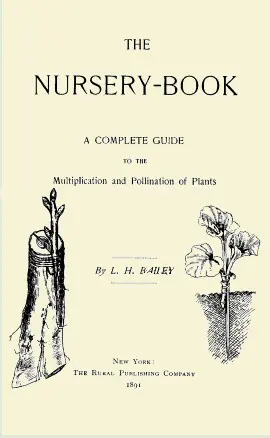
"The Nursery-Book: A Complete Guide to the Multiplication and Pollination of Plants" by L. H. Bailey is a scientific publication written in the late 19th century. The book serves as a comprehensive handbook on various methods of plant propagation, offering detailed techniques for multiplication and pollination. It is likely of interest to horticulturists, gardeners, and those involved in botany, as it covers practical applications of growing plants through seeds, cuttings, grafting, and other methods. At the start of the book, the author introduces the purpose of the guide, detailed explanations of plant propagation methods, and the necessity of proper techniques, such as moisture and temperature regulation during seed germination. The opening section outlines essential requirements for growing plants, including how to prepare seeds and the significance of moisture and temperature, illustrating methods with practical advice and illustrations. The author emphasizes that this guide does not delve into the ultimate effects of these methods but focuses on the processes themselves.
Introduction adapted from the source catalogue; source summaries may be automatically generated.
Free to read · English · 83,421 words · No account needed
MAKE TIME FOR A GOOD BOOK
On by default. Untick to stop anonymous reading totals. Each page counts after 10 seconds in view. How this works.
Anonymous counting is on unless you have switched it off.
Seeds sometimes. Also by divisions and layers. Cuttings of green-wood are commonly used, made in summer for hardy species or in early spring for tender ones. Cuttings of ripened wood may be taken in fall, and stored until spring in a rather dry place. The variegated sorts do better if grafted upon strong stocks.
=Hicoria=, Carya (Hickory, Pecan, etc.). Juglandeæ.
Increased chiefly by seeds, which should be stratified; also by root-sprouts. Seeds are sometimes planted at intervals in the field where the trees are to stand; but this practice is not to be recommended. The hickory can be grafted. Best results are obtained by veneer or splice-grafting in winter, on potted stocks. Cleft-grafting can be employed out-doors. Saddle-grafting upon young twigs is sometimes used. See also Pecan.
=Hippeastrum= (Equestrian Star). Amaryllideæ.
Seeds may be sown as soon as ripe in well-drained pots or pans of sandy loam, slightly covered, and placed in a temperature of about 65°. For increasing by divisions--which is the usual way--the old bulbs should be taken from the pots and carefully separated, with the least possible injury to the roots. This should be done when the plants are at rest, and the offsets should be placed singly in pots. Keep the bulb about two-thirds above the level of the soil, dispose the roots evenly, and plunge in bottom heat, in a position exposed to the light.
=Hippomane=, Mancinella. Euphorbiaceæ.
Propagated by cuttings, placed in sand under glass.
=Hippophaë= (Sallow Thorn, Sea Buckthorn). Elæagnaceæ.
May be increased by seeds, suckers, layers, and cuttings of
the roots.
=Hoffmannia=, Higginsia. Rubiaceæ.
Insert cuttings in sandy soil under cover, in bottom heat.
=Hog Plum.= See Spondias.
=Holbœllia.= Berberideæ.
In spring, cuttings may be made of half-ripened shoots.
=Holly.= See Ilex.
=Hollyhock= (Althæa). Malvaceæ.
Seeds should be sown as soon as ripe--in summer--in pots or pans, and placed in a slight bottom heat or in the open air. In either case, place the seedlings in 3-inch pots, and winter in a cold-frame. Dividing the roots, after flowering is over, by separating the crown, so as to preserve one or more buds and as many roots as possible to each piece. Cuttings of young shoots three inches long, taken off close to the old root at nearly the same time, should be placed singly in small pots of light, sandy soil and kept close, and shaded in a cold-frame until rooted. If cuttings are made during winter, a gentle bottom heat must be given. Also grafted (see page 88). See also Althæa.
=Honesty.= See Lunaria.
=Honey-Locust.= See Gleditschia.
=Honeysuckle.= See Lonicera.
=Hop.= See Humulus.
=Hop Hornbeam.= See Ostrya.
=Horehound= (Marrubium vulgare). Labiatæ.
Seeds, in early spring. Division.
=Horkelia.= See Potentilla.
Your reading position is saved on this browser. Take it to another device with a library code. Reading pages adapt to text, rather than matching a printed edition.
L. H. (Liberty Hyde) Bailey & Walter Moore Coleman

L. H. (Liberty Hyde) Bailey

L. H. (Liberty Hyde) Bailey

L. H. (Liberty Hyde) Bailey
BEHIND THE BOOK
This eBook is for the use of anyone anywhere in the United States and most other parts of the world at no cost and with almost no restrictions whatsoever. You may copy it, give it away or re-use it under the terms of the Project Gutenberg License included with this eBook or online at www.gutenberg.org. If you are not located in the United States, you will have to check the laws of the country where you are located before using this eBook. Read the source licence.
The original source file, including credits and licence, is retained by this library. Request an original-format copy at no charge. Please include the book title and Project Gutenberg identifier #47955.
KEEP YOUR CURIOSITY GOING

John Muir

Asa Gray
Asa Gray

Florence Nightingale
Elizabeth Robins Pennell
Denison Olmsted