THE CLASSIC COLLECTION✦Salve Venetia, gleanings from Venetian history; vol. IICLASSIC FREE BOOKS
Salve Venetia, gleanings from Venetian history; vol. II
F. Marion (Francis Marion) Crawford
THE CLASSIC COLLECTION · 1893
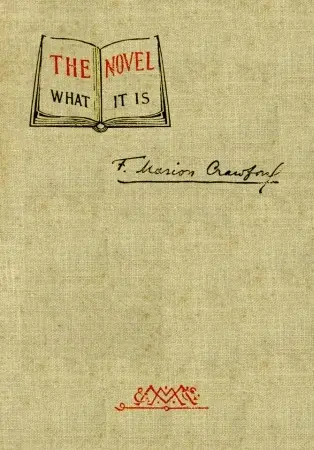
"The Novel; what it is" by F. Marion Crawford is a critical essay on the form and essence of the novel, written in the late 19th century. This book falls within the genre of literary criticism and serves as an exploration of what constitutes a novel, its purpose, and its relationship with other forms of writing. Likely composed during the late Victorian era, Crawford's work engages in a broader conversation about the evolving landscape of literature and the role of novelists in society. In this essay, Crawford defines the novel as an "intellectual artistic luxury," asserting that its primary function is to entertain and engage readers rather than preach or instruct them on moral or social issues. He critiques the trend of "purpose-novels," which attempt to impart moral lessons or address social issues, arguing that this undermines the inherent value of fiction as a means of escapism and enjoyment. Throughout the text, Crawford contrasts realism and romance in literature and advocates for a balanced approach that fosters both engaging storytelling and deep emotional resonance. The essay ultimately reflects on the anxieties and challenges faced by novelists in a rapidly modernizing world, urging them to create works that resonate with the complexities of human experience without falling into didacticism.
Introduction adapted from the source catalogue; source summaries may be automatically generated.
Free to read · English · 13,856 words · No account needed
MAKE TIME FOR A GOOD BOOK
On by default. Untick to stop anonymous reading totals. Each page counts after 10 seconds in view. How this works.
Anonymous counting is on unless you have switched it off.
Most people have a very clear conception of what a good play ought to be, and of the precise extent to which realism can be effective without being offensive. But it is strange, and it is a bad sign of the times, that persons who would not tolerate a coarse play read novels little, if at all, short of indecent. An answer suggests itself which may be comprehensive as an explanation, but is insufficient as an excuse. In our Anglo-Saxon social system the young girl is everywhere, and, if the shade of Sterne will allow me to say so, we temper the wind of our realism to the sensitive innocence of the ubiquitous shorn lamb. Once admit that the young girl is to have the freedom of our theatre, and it follows, and ought to follow, and very generally does follow, that our plays must be suited to maiden ears and eyes. It is a good thing that this should be so, but the effect is rather strange. The men who hear plays in English are not, perhaps, more moral than their contemporaries of Paris, Vienna, and Berlin. We like to believe that our women are better than those of foreign nations. We owe it to them to put more faith in them because they are our own, our dear mothers and wives and sisters and daughters, for whom, if we be men, we mean to do all that men can do. But we are all men and women nevertheless, and human, and we have the thoughts and the understanding of men and women and not of school-girls. Yet the school-girl practically decides what we are to hear at the theatre and, so far as our own language is concerned, determines to a great extent what we are to read.
But if we do not write for the young girl, who will? We have not the advantage possessed by the French of satisfying the demands of young people by translations from works in other languages. The young girl in France, as a matter of fact, reads Walter Scott, Bulwer, and Dickens, while her mother diverts her leisure with the more lively productions of Paul Bourget, Guy de Maupassant, or possibly Balzac, whom all educated Frenchmen and French-women are at least supposed to have read. The advocate of a broader license in the English fiction of the future may answer that the whole body of novels already in existence should be more than sufficient for the delectation of “the young.” Should the development of the new school, however, lead to the creation of a literature in our language, resembling, as a whole, that of the French, our novel, in its present form, would soon cease to be written, and those of the type which are already in existence would in a short time be regarded as antiquated, dull, and savouring of the Sunday-school. Youth, too, dislikes to be treated as youth. The old, who regretfully long to be young again, may find some consolation in the ardent desire of youth for mature years. Moreover, it is easier to lower the reader’s moral tone than to raise it ever so little. The ambition of all boys, and probably of very many young girls, is to read such novels as their parents do not habitually leave on the drawing-room table. Every boy wants to read “Guy Livingstone,” and most boys do, with or without their mamma’s permission, at a very early age. If we advanced so far as the French realistic point of view, that book would become a common property of boys and girls, and perhaps “Nana,” or “Les Mensonges,” would take its place in the estimation of our children,--a consummation devoutly to be prayed against. Our “books for the young” are not, on the whole, a success, unless we are willing to modify the expression, and call them books for the very young. There are not in existence, I believe, enough really interesting, and yet perfectly harmless, novels to occupy the vast amount of spare time which the young seem ready to devote to literature, and which we, the workers, seek in vain. It is not always easy to see--it is certainly not easy for us to explain--why we novelists occasionally introduce a thought, a page, or a chapter in a novel otherwise fit for a child’s ears, which may have the effect, so to say, of turning weak tea into bad whiskey. Yet most of us have done it, contemplate doing it, or at least go so far as to wish that we might allow ourselves the liberty. Perhaps, if that liberty were universally granted, we should desire it less. Perhaps a number of my colleagues will not admit that they desire it at all. I believe that in most cases it is only a desire to escape from limitations not unlike those overstepped when an author writes much in dialect. It looks as though it might be easier to write interesting books with the help of the knowledge of evil, as well as with the help of the knowledge of good; and after a certain number of years of hard work a novelist instinctively leans towards any method of lightening his labours which presents itself to his tired imagination. If he yields once, he will probably yield again and fall into the slipshod, careless ways for which the overworked man is often cruelly, if not altogether unjustly, blamed. For the public, which most of us acknowledge to be a perfectly just body in the long run, is as thoroughly unforgiving as Justice herself. “He has written himself out.” How carelessly that little phrase is often uttered! How terrible it is for any author to hear! It is indeed a solemn memento mori, the phrase of all others of which we dread the application to ourselves. For the romance of romancing soon disappears. After the production of one, two, three, or half-a-dozen novels, if the writer is really what we call “a professional,” and must go on writing as a business, he discovers how serious is the occupation in which he is engaged. Half-a-dozen books, or less, will make a reputation; ten will sustain one; twenty are in ordinary cases a career. Does any one, not an author, who reads these lines guess at the labour, the imagination, the industry, the set purpose, the courage, which are necessary to produce a score of novels of an average good quality? And if not, how can he understand the intense longing for a removal of restraint, for a little more liberty that tempts the overwrought intelligence into error? Far be it from me to appeal in any way to the public pity, for my own sake or in behalf of others. We are no more to be pitied when we break down than an old shoemaker who can no longer see the point of his bristles, and not so much as a broken-winded cab-horse that has never had any option in the choice of a career. Let this be taken as an explanation, not as an apology. To judge from the standards of some people, however, the worn-out novelist, whose works have filled the shelves of the young girl of the period, might find profitable employment if he would adopt the tenets of realism and write for the jaded taste of those who, whether already old or what is called still young, have exhausted their capacity for bread and milk and crave red pepper and stimulants.
Your reading position is saved on this browser. Take it to another device with a library code. Reading pages adapt to text, rather than matching a printed edition.
F. Marion (Francis Marion) Crawford
F. Marion (Francis Marion) Crawford

F. Marion (Francis Marion) Crawford

F. Marion (Francis Marion) Crawford
BEHIND THE BOOK
This eBook is for the use of anyone anywhere in the United States and most other parts of the world at no cost and with almost no restrictions whatsoever. You may copy it, give it away or re-use it under the terms of the Project Gutenberg License included with this eBook or online at www.gutenberg.org. If you are not located in the United States, you will have to check the laws of the country where you are located before using this eBook. Read the source licence.
The original source file, including credits and licence, is retained by this library. Request an original-format copy at no charge. Please include the book title and Project Gutenberg identifier #51010.
KEEP YOUR CURIOSITY GOING

David Patterson (Spirit) Hatch

David Patterson (Spirit) Hatch

David Patterson (Spirit) Hatch
Coulson Kernahan

Ralph Waldo Emerson

Maurice Baring