THE CLASSIC COLLECTION✦Salve Venetia, gleanings from Venetian history; vol. IICLASSIC FREE BOOKS
Salve Venetia, gleanings from Venetian history; vol. II
F. Marion (Francis Marion) Crawford
THE CLASSIC COLLECTION · 1893
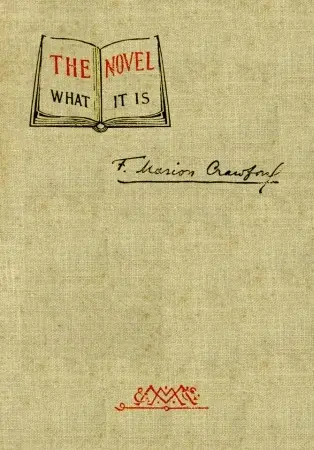
"The Novel; what it is" by F. Marion Crawford is a critical essay on the form and essence of the novel, written in the late 19th century. This book falls within the genre of literary criticism and serves as an exploration of what constitutes a novel, its purpose, and its relationship with other forms of writing. Likely composed during the late Victorian era, Crawford's work engages in a broader conversation about the evolving landscape of literature and the role of novelists in society. In this essay, Crawford defines the novel as an "intellectual artistic luxury," asserting that its primary function is to entertain and engage readers rather than preach or instruct them on moral or social issues. He critiques the trend of "purpose-novels," which attempt to impart moral lessons or address social issues, arguing that this undermines the inherent value of fiction as a means of escapism and enjoyment. Throughout the text, Crawford contrasts realism and romance in literature and advocates for a balanced approach that fosters both engaging storytelling and deep emotional resonance. The essay ultimately reflects on the anxieties and challenges faced by novelists in a rapidly modernizing world, urging them to create works that resonate with the complexities of human experience without falling into didacticism.
Introduction adapted from the source catalogue; source summaries may be automatically generated.
Free to read · English · 13,856 words · No account needed
MAKE TIME FOR A GOOD BOOK
On by default. Untick to stop anonymous reading totals. Each page counts after 10 seconds in view. How this works.
Anonymous counting is on unless you have switched it off.
Every writer who has succeeded has his own methods of creating such illusion. Some of us are found out, and some of us are not; but we all do the same thing in one way or another, consciously or unconsciously. The tricks of the art are without number, simple or elaborate, easily learned or hard to imitate, and many of us consider that we have a monopoly of certain tricks we call our own, and are unreasonably angry when a competitor makes use of them.
The means, all subservient to language, are many, but the object is always one: to make the reader realise as far as possible the writer’s conception of his story.
That word “realise” has a greater value and a wider application upon the question which I am endeavouring to treat so briefly than in ordinary conversation. To realise means to make real from one’s own standpoint, to see as vividly through the imagination what is partially imaginary as what is altogether imagined; in other words, to call up an image as coincident with the representations of fact as truth itself. Of course, in a printed book, the author has no means to attain this end excepting language, and upon the terms of language employed must depend a very large part of his success. Language is the tool with which he makes his weapons, and these in their turn may vary in manufacture and temper according to his requirements. The most powerful weapon of all is what is most commonly called truth to nature. Goethe said of his “Wilhelm Meister,” “there is nothing in it which I have not lived and nothing exactly as I lived it”; yet most people would call “Wilhelm Meister” a fantastic book. Other means of producing an impression are local colour, the use of dialects and foreign languages. Here I know I am touching upon a very delicate point, and that I risk wounding the sensibilities of many writers and attacking the individual tastes of many readers of fiction. Nevertheless, the mention of the dialect-novel raises a question which is before the literary grand jury of the world. Assuredly every man has a prime right to make use of the material at his disposal; and if some particular dialect forms a part of this stock in trade, he is as free to employ it as an African traveller, for instance, is free to introduce his own reminiscences into a novel, if he writes one. Colour alone amuses some people, chiefly children. Small boys and girls do not despise a kaleidoscope as a toy on a rainy day, and dialect without dramatic interest is colour without form or outline, and some novels in dialect are nothing more. But then, there are plenty of works of fiction written in ordinary English which have not even that one merit, and of these I do not wish to say anything. Take a really good novel, however, in which more than half the pages are filled with dialogues in a language not familiar to the English-speaking public as a whole. Is not the writer wilfully limiting his audience, if not himself? Is he not sacrificing his privilege of addressing all men, for the sake of addressing a few in terms which they especially prefer? Is he not preferring local popularity to broader and more enduring reputation? Could he not, by the skilful use of description, by a clever handling of grammar and a careful selection of words, produce an impression which should be more widely felt, though less warmly received, perhaps, in that one small public to which he appeals? Is he not, although he be a first-rate man, often tempted to lapses of literary conscience by the peculiar facilities he finds in the literary by-way he has chosen? How much of what is screaming farce in the dialect of the few, would be funny if translated into plain English for the many? Wit and humour are intellectual, and when genuine are susceptible of being translated into almost all languages; but dialect seems to me to rank with puns, and with puns of a particular local character. A practical demonstration of this is found in the fact that stories in dialect, when told and not read, are duller than any other stories, unless the teller has the power of imitating accents. Almost all limitations which a man willingly assumes afford facilities for the sake of which he assumes them.
Your reading position is saved on this browser. Take it to another device with a library code. Reading pages adapt to text, rather than matching a printed edition.
F. Marion (Francis Marion) Crawford
F. Marion (Francis Marion) Crawford

F. Marion (Francis Marion) Crawford

F. Marion (Francis Marion) Crawford
BEHIND THE BOOK
This eBook is for the use of anyone anywhere in the United States and most other parts of the world at no cost and with almost no restrictions whatsoever. You may copy it, give it away or re-use it under the terms of the Project Gutenberg License included with this eBook or online at www.gutenberg.org. If you are not located in the United States, you will have to check the laws of the country where you are located before using this eBook. Read the source licence.
The original source file, including credits and licence, is retained by this library. Request an original-format copy at no charge. Please include the book title and Project Gutenberg identifier #51010.
KEEP YOUR CURIOSITY GOING

David Patterson (Spirit) Hatch

David Patterson (Spirit) Hatch

David Patterson (Spirit) Hatch
Coulson Kernahan

Ralph Waldo Emerson

Maurice Baring