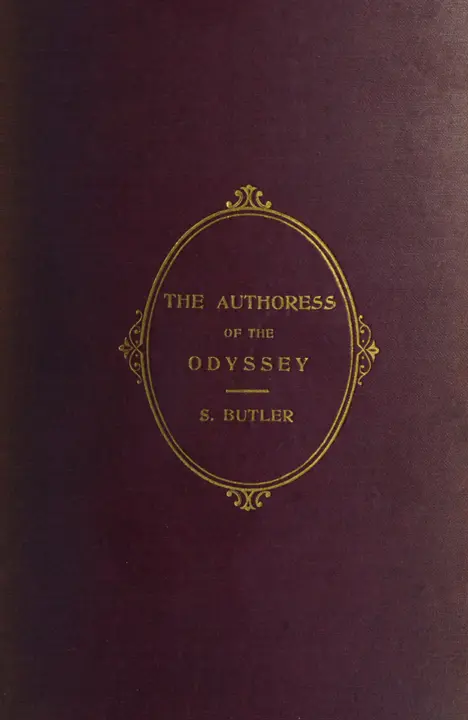
The Authoress of the Odyssey Where and when she wrote, who she was, the use she made of the Iliad, and how the poem grew under her hands
Samuel Butler
THE CLASSIC COLLECTION · 1907
"The Note-Books of Samuel Butler" by Samuel Butler is a collection of personal reflections and observations arranged and edited by Henry Festing Jones, likely written in the late 19th century. This compilation captures Butler's contemplations on a vast array of subjects, including philosophy, literature, evolution, and the complexities of life itself, reflecting the nuanced perspectives of a thinker whose work interrogated societal norms and personal identity. The opening of this work introduces readers to the origins and purpose behind Butler's note-keeping habit, revealing that he began documenting his thoughts early in life to capture fleeting insights and reflections. These notes served not only as a repository of his ideas but also as a means of shaping his literary voice by forcing him to articulate his thoughts clearly. The preface elaborates on the diverse topics covered in his notes—ranging from his childhood experiences and reflections on morality to inquiries into evolution and the nature of human existence—setting the stage for the rich tapestry of philosophical musings that follow.
Introduction adapted from the source catalogue; source summaries may be automatically generated.
Free to read · English · 142,917 words · No account needed
MAKE TIME FOR A GOOD BOOK
On by default. Untick to stop anonymous reading totals. Each page counts after 10 seconds in view. How this works.
Anonymous counting is on unless you have switched it off.
{153} Prince was my cat when I lived in Barnard’s Inn. He used to stray into Mr. Kemp’s rooms on my landing (see p. 131 ante). Mrs. Kemp’s sister brought her child to see them, and the child, playing with Prince one day, made a discovery and exclaimed:
“Oh! it’s got pins in its toes.”
Butler put this into The Way of all Flesh.
{162} Philippians i. 15–18:—
Some indeed preach Christ even of envy and strife; and some also of
good will:
The one preach Christ of contention, not sincerely, supposing to add
affliction to my bonds:
But the other of love, knowing that I am set for the defence of the
gospel.
What then? notwithstanding, every way, whether in pretence, or in truth, Christ is preached; and I therein do rejoice, yea, and will rejoice.
{176} Narcissus, “Should Riches mate with Love.”
{235} Butler gave this as a subject to Mr. E. P. Larken who made it into a short story entitled “The Priest’s Bargain,” which appeared in the Pall Mall Magazine, May, 1897.
{203} All things have I seen in the days of my vanity: there is a just man that perisheth in his righteousness, and there is a wicked man that prolongeth his life in his wickedness.
Be not righteous over much; neither make thyself over wise: why shouldest
thou destroy thyself?
Be not over much wicked, neither be thou foolish: why shouldest thou die before thy time? (Eccles. vii. 15, 16, 17).
{204} Cf. “Imaginary Worlds,” p. 233 post.
{225} “So, again, it is said that when Andromeda and Perseus had travelled but a little way from the rock where Andromeda had so long been chained, she began upbraiding him with the loss of her dragon who, on the whole, she said, had been very good to her. The only things we really hate are unfamiliar things.” Life & Habit, Chapter viii, p. 138/9.
{251} This note is one of those that appeared in the New Quarterly Review. The Hon. Mrs. Richard Grosvenor did not see it there, but a few years later I lent her my copy. She wrote to me 31 December, 1911.
“The notes are delightful. By the way I can add to one. When Mr. Butler came to tell me he was going to stay with Dr. Creighton, he told me that Alfred had decided he might go on finding the little flake of tobacco in the letter. Then he asked me if I would lend him a prayer-book as he thought the bishop’s man ought to find one in his portmanteau when he unpacked, the visit being from a Saturday to Monday. I fetched one and he said:
“‘Is it cut?’”
{261} “Ramblings in Cheapside” in Essays on Life, Art and Science.
Your reading position is saved on this browser. Take it to another device with a library code. Reading pages adapt to text, rather than matching a printed edition.
Samuel Butler
Samuel Butler
Samuel Butler
Samuel Butler
BEHIND THE BOOK
This eBook is for the use of anyone anywhere in the United States and most other parts of the world at no cost and with almost no restrictions whatsoever. You may copy it, give it away or re-use it under the terms of the Project Gutenberg License included with this eBook or online at www.gutenberg.org. If you are not located in the United States, you will have to check the laws of the country where you are located before using this eBook. Read the source licence.
The original source file, including credits and licence, is retained by this library. Request an original-format copy at no charge. Please include the book title and Project Gutenberg identifier #6173.
KEEP YOUR CURIOSITY GOING

David Patterson (Spirit) Hatch

David Patterson (Spirit) Hatch

David Patterson (Spirit) Hatch
Coulson Kernahan

Ralph Waldo Emerson

Maurice Baring