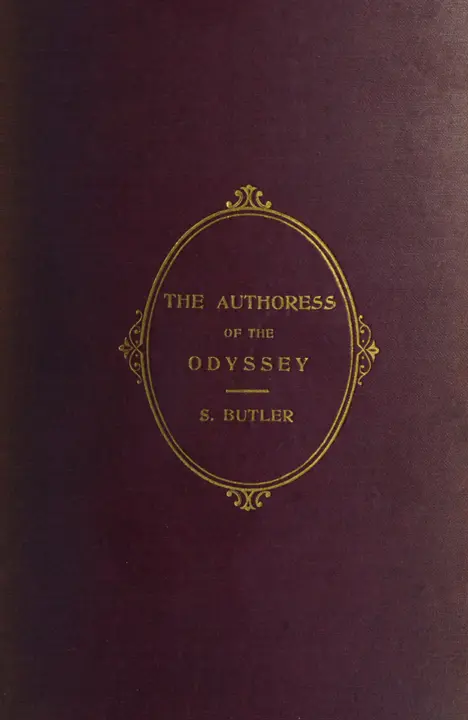
The Authoress of the Odyssey Where and when she wrote, who she was, the use she made of the Iliad, and how the poem grew under her hands
Samuel Butler
THE CLASSIC COLLECTION · 1907
"The Note-Books of Samuel Butler" by Samuel Butler is a collection of personal reflections and observations arranged and edited by Henry Festing Jones, likely written in the late 19th century. This compilation captures Butler's contemplations on a vast array of subjects, including philosophy, literature, evolution, and the complexities of life itself, reflecting the nuanced perspectives of a thinker whose work interrogated societal norms and personal identity. The opening of this work introduces readers to the origins and purpose behind Butler's note-keeping habit, revealing that he began documenting his thoughts early in life to capture fleeting insights and reflections. These notes served not only as a repository of his ideas but also as a means of shaping his literary voice by forcing him to articulate his thoughts clearly. The preface elaborates on the diverse topics covered in his notes—ranging from his childhood experiences and reflections on morality to inquiries into evolution and the nature of human existence—setting the stage for the rich tapestry of philosophical musings that follow.
Introduction adapted from the source catalogue; source summaries may be automatically generated.
Free to read · English · 142,917 words · No account needed
MAKE TIME FOR A GOOD BOOK
On by default. Untick to stop anonymous reading totals. Each page counts after 10 seconds in view. How this works.
Anonymous counting is on unless you have switched it off.
A father was telling his eldest daughter, aged about six, that she had a little sister, and was explaining to her how nice it all was. The child said it was delightful and added:
“Does Mamma know? Let’s go and tell her.”
Mr. Darwin in the Zoological Gardens
Frank Darwin told me his father was once standing near the hippopotamus cage when a little boy and girl, aged four and five, came up. The hippopotamus shut his eyes for a minute.
“That bird’s dead,” said the little girl; “come along.”
Terbourg
Gogin told me that Berg, an impulsive Swede whom he had known in Laurens’s studio in Paris and who painted very well, came to London and was taken by an artist friend [Henry Scott Tuke, A.R.A.] to the National Gallery where he became very enthusiastic about the Terbourgs. They then went for a walk and, in Kensington Gore, near one of the entrances to Hyde Park or Kensington Gardens, there was an old Irish apple-woman sitting with her feet in a basket, smoking a pipe and selling oranges.
“Arranges two a penny, sorr,” said the old woman in a general way.
And Berg, turning to her and throwing out his hands appealingly, said:
“O, madame, avez-vous vu les Terbourgs? Allez voir les Terbourgs.”
He felt that such a big note had been left out of the life of any one who
had not seen them.
At Doctors’ Commons
A woman once stopped me at the entrance to Doctors’ Commons and said:
“If you please, sir, can you tell me—is this the place that I came to
before?”
Not knowing where she had been before I could not tell her.
The Sack of Khartoum
As I was getting out of a ’bus the conductor said to me in a confidential
tone:
“I say, what does that mean? ‘Sack of Khartoum’? What does ‘Sack of Khartoum’ mean?”
“It means,” said I, “that they’ve taken Khartoum and played hell with it
all round.”
He understood that and thanked me, whereon we parted.
Missolonghi
Ballard [a fellow art-student with Butler at Heatherley’s] told me that an old governess, some twenty years since, was teaching some girls modern geography. One of them did not know the name Missolonghi. The old lady wrung her hands:
“Why, me dear,” she exclaimed, “when I was your age I could never hear the name mentioned without bursting into tears.”
I should perhaps add that Byron died there.
Memnon
Your reading position is saved on this browser. Take it to another device with a library code. Reading pages adapt to text, rather than matching a printed edition.
Samuel Butler
Samuel Butler
Samuel Butler
Samuel Butler
BEHIND THE BOOK
This eBook is for the use of anyone anywhere in the United States and most other parts of the world at no cost and with almost no restrictions whatsoever. You may copy it, give it away or re-use it under the terms of the Project Gutenberg License included with this eBook or online at www.gutenberg.org. If you are not located in the United States, you will have to check the laws of the country where you are located before using this eBook. Read the source licence.
The original source file, including credits and licence, is retained by this library. Request an original-format copy at no charge. Please include the book title and Project Gutenberg identifier #6173.
KEEP YOUR CURIOSITY GOING

David Patterson (Spirit) Hatch

David Patterson (Spirit) Hatch

David Patterson (Spirit) Hatch
Coulson Kernahan

Ralph Waldo Emerson

Maurice Baring