THE CLASSIC COLLECTION✦My diaries, being a personal narrative of events 1888-1914, Part 2 (1900-1914)CLASSIC FREE BOOKS
My diaries, being a personal narrative of events 1888-1914, Part 2 (1900-1914)
Wilfrid Scawen Blunt
THE CLASSIC COLLECTION · 1915
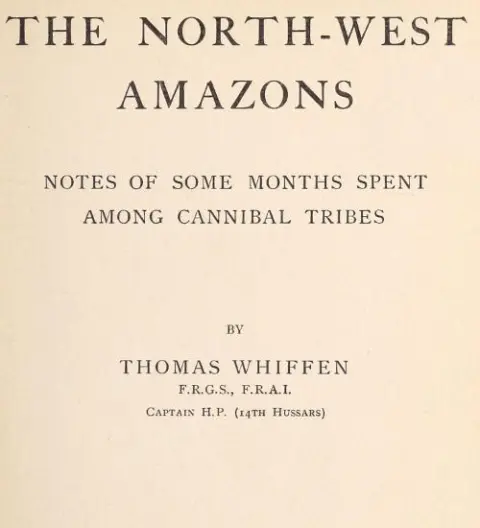
"The North-West Amazons: Notes of some months spent among cannibal tribes" by Thomas Whiffen is a historical account written in the early 20th century. The work details the author's months spent exploring the remote regions near the upper Amazon River, specifically focusing on the cannibal tribes and their cultures. Whiffen shares his observations of the tribes' customs, daily life, and interactions with nature, providing readers with an ethnographic glimpse into a largely untouched world. At the start of the narrative, Whiffen recounts his motivations for embarking on this journey following a period of unemployment due to ill health. He reflects on previous travel experiences and the influence of Dr. Alfred Russel Wallace's writings, which inspired him to explore the Amazon. Arriving in Manaos, he quickly realizes the challenges of accessing the interior and securing a reliable party, and the narrative unfolds with his detailed accounts of the difficulties faced in navigating the forest, river routes, and the dynamics with local tribes. The opening section sets the stage for an immersive exploration of the Amazonian wilderness and the indigenous peoples residing there, capturing both the allure and the difficulties of his expedition.
Introduction adapted from the source catalogue; source summaries may be automatically generated.
Free to read · English · 110,454 words · No account needed
MAKE TIME FOR A GOOD BOOK
On by default. Untick to stop anonymous reading totals. Each page counts after 10 seconds in view. How this works.
Anonymous counting is on unless you have switched it off.
Another source of confusion in writing about these peoples has been the indiscriminate use of the words nation, tribe, clan, family. To avoid possibility of mistake it may be explained at the outset that tribe is here used in the sense ruled by the new editions of both the Anthropological and the Folklore Handbooks, that is to say, “a group with a common language, code of law, some rude form of government, and capable of uniting for common action.” These tribes I would further classify into language-groups, such as the Witoto language-group, the Boro language-group, and so forth. The group name--Witoto, Boro, Andoke, or whatever the case may be--applies to all the tribes of these groups, in addition to their individual names. The variations between these tribes of a group are mainly dialectic and local, but the variance between tribes of alien groups is more than a difference of speech and custom. The Boro, for instance, are distinctly Chinese in appearance; their neighbours the Witoto resemble rather the Dyaks of Borneo.
The two groups with which we are mainly concerned, and the only two with which it is possible in this book to deal seriously in detail, are the Witoto and the Boro. They occupy roughly the lands between the Japura and the Igara Parana, and the Igara Parana and the Issa, though there are no actual boundaries. The Boro country lies north-west of the Futahi Hills, in the watersheds of the Pupuna and the Kahuanari rivers. The Boro also occupy a stretch of country north of the Japura, where that river bends south and east below its junction with the Wama, and including part of the Ira watershed. On this, the north-east border, they meet the country of the Menimehe, while on the north they touch the Karahone country. The Resigero and Nonuya districts lie between them and the Muenane. The country by the Futahi Hills west of the Igara Parana, that is to say, the basins of the Esperanza and Sabalo Yacu rivers, is very sparsely populated, and the Dukaiya country on the west of the Nonuya practically separates the Witoto and the Boro on the north-west. From the mouth of an unnamed tributary of the Japura--below the Tauauru and on the opposite bank--the Andoke country runs south of the Japura to the junction of the Kuemani, where the Japura becomes the boundary between the Andoke and the Witoto. On the west the Orahone country lies on the farther side of the Issa from the Witoto, the Issa being the dividing line from the west and south-west of the Witoto group. The name Orahone is given to all tribes indiscriminately if they elongate the lobes of their ears,[50] so the Orahone, or Long-ears, may possibly be many distinct tribes. Thus, one writer notes of the Napo tribes, the “Cotos” and the “Tutapishcos,” that they “are sometimes called ‘Orejones,’” but are not so known locally.[51] The Orahone are of a low type. To the east of the Menimehe and the Boro districts the Kuretu language-group of tribes occupy the country north and south of the Japura. To the north the Opaina, Makuna, and Tukana groups interpose between them and the Bara and Maku groups. The Maku are found from the Rio Negro to the Apaporis, and again above the Bara group north of the Arara Hills about the Kaouri river, a tributary of the Uaupes. Though the Bara group live to the north of the Apaporis they have nothing in common with the Uaupes Indians. Both their language and customs resemble more those of the Japura, and they have no intercourse with the surrounding tribes. They are a dark-skinned people, of a low type, and consequently looked down on by their lighter-skinned neighbours. The Maku, also of a low type and dark, are a very nomadic group; in fact all these peoples are wanderers, and the districts here given for their localities must be taken as merely approximate. That they were there when I was in the country is no guarantee that they will be found there now, or a few years hence. The locality of a tribe, or a language-group, is mainly dependent on the locality of its neighbours, especially of any powerful or warlike body. The tribes of the upper Issa districts are semi-civilised Colombian, those of the lower waters semi-civilised Brazilian Indians. Only in the middle district have the tribes been free, until recently, from the influence of the white man.
Your reading position is saved on this browser. Take it to another device with a library code. Reading pages adapt to text, rather than matching a printed edition.
BEHIND THE BOOK
This eBook is for the use of anyone anywhere in the United States and most other parts of the world at no cost and with almost no restrictions whatsoever. You may copy it, give it away or re-use it under the terms of the Project Gutenberg License included with this eBook or online at www.gutenberg.org. If you are not located in the United States, you will have to check the laws of the country where you are located before using this eBook. Read the source licence.
The original source file, including credits and licence, is retained by this library. Request an original-format copy at no charge. Please include the book title and Project Gutenberg identifier #55540.
KEEP YOUR CURIOSITY GOING
Wilfrid Scawen Blunt
Wilfrid Scawen Blunt

E. W. (Edgar Watson) Howe
Cécile Tormay

Moritz Busch
John L. Ransom