THE CLASSIC COLLECTION✦My diaries, being a personal narrative of events 1888-1914, Part 2 (1900-1914)CLASSIC FREE BOOKS
My diaries, being a personal narrative of events 1888-1914, Part 2 (1900-1914)
Wilfrid Scawen Blunt
THE CLASSIC COLLECTION · 1915
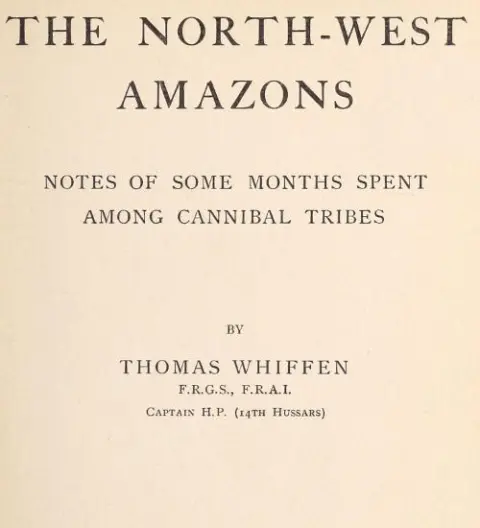
"The North-West Amazons: Notes of some months spent among cannibal tribes" by Thomas Whiffen is a historical account written in the early 20th century. The work details the author's months spent exploring the remote regions near the upper Amazon River, specifically focusing on the cannibal tribes and their cultures. Whiffen shares his observations of the tribes' customs, daily life, and interactions with nature, providing readers with an ethnographic glimpse into a largely untouched world. At the start of the narrative, Whiffen recounts his motivations for embarking on this journey following a period of unemployment due to ill health. He reflects on previous travel experiences and the influence of Dr. Alfred Russel Wallace's writings, which inspired him to explore the Amazon. Arriving in Manaos, he quickly realizes the challenges of accessing the interior and securing a reliable party, and the narrative unfolds with his detailed accounts of the difficulties faced in navigating the forest, river routes, and the dynamics with local tribes. The opening section sets the stage for an immersive exploration of the Amazonian wilderness and the indigenous peoples residing there, capturing both the allure and the difficulties of his expedition.
Introduction adapted from the source catalogue; source summaries may be automatically generated.
Free to read · English · 110,454 words · No account needed
MAKE TIME FOR A GOOD BOOK
On by default. Untick to stop anonymous reading totals. Each page counts after 10 seconds in view. How this works.
Anonymous counting is on unless you have switched it off.
[383] Humboldt, ii. 400-1; Chanoine Bernadino de Souza, Para e Amazon;
see Nery, pp. 8-9.
[384] Humboldt, pp. 88, 400.
[385] Spruce, ii. 561.
[386] Spruce wisely remarks on this point, “that the Spaniards had been for two whole years among Indians who wore their hair long,” and therefore were not likely to mistake men for women (Spruce, ii. 459).
[387] Nery, p. 6.
[388] The French traveller rejects the ἀ-, μαζός theory in favour of the ἄμα ζώνη--bound with a belt (Nery, p. 2).
[389] Wallace, p. 343.
[390] “I have myself seen that Indian women can fight.… The women pile up heaps of stones, to serve as missiles for the men” (Spruce, ii. 457-8). This, vide “stones,” is not possible in the Issa-Japura district.
[391] Where tribal differentiation of colour is so marked as among these people it is only natural that tales should be told of some mythical “white” folk.
[392] Crevaux, Voyages dans l’Amérique du Sud, p. 284.
[393] Komuine = monkey (Boro).
[394] “So high”--demonstrated with the hand.
[395] These would be her natural protectors.
[396] Rubber latex. See Depilation.
[397] To hide the unsightliness.
[398] Of the chief’s daughter.
[399] This may be a folk-tale of the monkey-people stealing Indian women for their mates. Cf. Skeat, Malay Magic, p. 185; Clifford, Studies in Brown Humanity, p. 243.
But it should not be overlooked that the Boro depile most carefully, while the Andoke medicine-man does not depile at all, and the Andoke are mortal foes of the Boro. The Karahone also are said not to depile, and on this score would be regarded by the Boro as no better than brute beasts. So this story may be a traditional account of the actual rape of a chief’s daughter by a hostile tribe, the Amazonian version of Helen and Troy.
[400] Simson, p. 168.
[401] Spruce, i. 332. im Thurn relates of the Arawak Indians that “each family is descended--their fathers knew how, but they themselves have forgotten--from its eponymous animal, bird, or plant” (im Thurn, pp. 184, 376).
[402] The general principle is well known, and is now used both by the authorities of the United States and of Great Britain. It consists in giving to the vowels in native words their Italian significance, and to the consonants that which they have in the English language.
[403] Notes and Queries on Anthropology (1912), pp. 187-96.
[404] Simson, p. 94.
[405] Tylor, p. 25.
[406] Koch-Grünberg transliterates it as ingetā, or ingétā; and gives marā for good, maringetā, marinyetā, bad; faréti, fat; faré ingetā, thin (Die Uitóto Indianer, pp. 10-11).
[407] Orton stated that the Zaparo “have no words for numbers above three, but show their fingers” (Orton, p. 170). Simson gives words for four and five as in use among those tribes, and after that manunu, meaning “many-many” (Simson, p. 179).
Your reading position is saved on this browser. Take it to another device with a library code. Reading pages adapt to text, rather than matching a printed edition.
BEHIND THE BOOK
This eBook is for the use of anyone anywhere in the United States and most other parts of the world at no cost and with almost no restrictions whatsoever. You may copy it, give it away or re-use it under the terms of the Project Gutenberg License included with this eBook or online at www.gutenberg.org. If you are not located in the United States, you will have to check the laws of the country where you are located before using this eBook. Read the source licence.
The original source file, including credits and licence, is retained by this library. Request an original-format copy at no charge. Please include the book title and Project Gutenberg identifier #55540.
KEEP YOUR CURIOSITY GOING
Wilfrid Scawen Blunt
Wilfrid Scawen Blunt

E. W. (Edgar Watson) Howe
Cécile Tormay

Moritz Busch
John L. Ransom