THE CLASSIC COLLECTION✦My diaries, being a personal narrative of events 1888-1914, Part 2 (1900-1914)CLASSIC FREE BOOKS
My diaries, being a personal narrative of events 1888-1914, Part 2 (1900-1914)
Wilfrid Scawen Blunt
THE CLASSIC COLLECTION · 1915
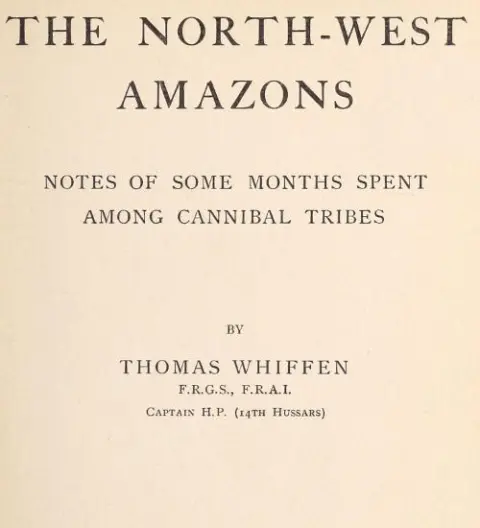
"The North-West Amazons: Notes of some months spent among cannibal tribes" by Thomas Whiffen is a historical account written in the early 20th century. The work details the author's months spent exploring the remote regions near the upper Amazon River, specifically focusing on the cannibal tribes and their cultures. Whiffen shares his observations of the tribes' customs, daily life, and interactions with nature, providing readers with an ethnographic glimpse into a largely untouched world. At the start of the narrative, Whiffen recounts his motivations for embarking on this journey following a period of unemployment due to ill health. He reflects on previous travel experiences and the influence of Dr. Alfred Russel Wallace's writings, which inspired him to explore the Amazon. Arriving in Manaos, he quickly realizes the challenges of accessing the interior and securing a reliable party, and the narrative unfolds with his detailed accounts of the difficulties faced in navigating the forest, river routes, and the dynamics with local tribes. The opening section sets the stage for an immersive exploration of the Amazonian wilderness and the indigenous peoples residing there, capturing both the allure and the difficulties of his expedition.
Introduction adapted from the source catalogue; source summaries may be automatically generated.
Free to read · English · 110,454 words · No account needed
MAKE TIME FOR A GOOD BOOK
On by default. Untick to stop anonymous reading totals. Each page counts after 10 seconds in view. How this works.
Anonymous counting is on unless you have switched it off.
[141] These blow-pipes appear to be similar to those still in use among the Orang Kuantan Malays, of which a specimen is to be seen in the British Museum. It is made of two grooved halves of a hard wood, bound with cane, and coated with “a gutta-like substance” (Skeat, Man, 1902, No. 108). This is, however, a shorter instrument than the Witoto or Boro use, the measurements given being only 5 feet 2 inches for total length, with an interior diameter of seven-sixteenths of an inch at the mouthpiece and three-eighths of an inch at the muzzle-end. The blow-pipe is found among all Malayan tribes. For distribution in the South Seas, cf. map in Skeat and Blagden’s Pagan Tribes, i. 254.
[142] Deniker states that the Miranha hunt “like the ancient Quechuas by means of nets stretched out between the trees, into which they drive, with cries and gestures, the terrified animals” (Deniker, p. 561). I have never seen or heard of such nets among them.
[143] Orton, pp. 169-70.
[144] Cf. method of poisoning adopted by natives of Torres Straits
(Torres Straits, iv. 159).
[145] Jacquinia armillaris. According to Spix and Martius babasco poison is made from the leaves and blossom of the Budleya connata (Spix and von Martius, Reise, 1820, p. 98).
[146] Simson, p. 131.
[147] Paullinia pinnata (Sapindaceae) (Spruce, ii. 523; Bates, ii. 82-3). Spruce also mentions cunambi, poison obtained from the roots of Ichthyothera cunambi (Spruce, ii. 520); and Yuca-raton, the root of Gliricidiae sp. (Spruce, ii. 455).
[148] The frame is made of timbo-titica, Heteropsis sp. (Spruce, ii.
523).
[149] Such very hard wood is procurable, and so abundant is it that even tribes like the Botucudo, who could use shell, stone, or metal, use wood in preference, and many tribes prefer their lithic axes to metal ones. The inference is obvious--these peoples are not, and never have been, metal-using races, and poisoned wood suits sufficiently their purposes for arrow-heads.
[150] Oakenfull, p. 30.
[151] Compare with customs of the Mafulu in British New Guinea (Williamson, p. 179; Fiji, Thompson, p. 35).
[152] Clough, pp. 104-5; Wallace, p. 353.
[153] Partridge, Cross River Natives, p. 59; “Upper Congo Cannibals,” J.R.A.I., xxiv. pp. 298-9.
[154] For example, Maw, p. 160.
[155] Wallace, pp. 346-7.
[156] Ratzel, ii. 138-9; Orton, pp. 171-2.
[157] See British Museum, Cambridge Museum, Munich Museum.
[158] Bates, ii. 132.
[159] I was never present at a cannibal feast. This information is based on Robuchon’s account, checked by cross-questioning the Indians with whom I came in contact.
[160] Johnson, Liberia, ii. 898.
[161] On the other hand earth-eating is prevalent among the Torres Straits people, where salt is not rare. The pregnant woman eats it to make her infant light in colour and strong and brave (Torres Straits Exped., iv. 139).
[162] Crevaux, p. 287.
[163] Bates, ii. 195.
[164] Ibid.
Your reading position is saved on this browser. Take it to another device with a library code. Reading pages adapt to text, rather than matching a printed edition.
BEHIND THE BOOK
This eBook is for the use of anyone anywhere in the United States and most other parts of the world at no cost and with almost no restrictions whatsoever. You may copy it, give it away or re-use it under the terms of the Project Gutenberg License included with this eBook or online at www.gutenberg.org. If you are not located in the United States, you will have to check the laws of the country where you are located before using this eBook. Read the source licence.
The original source file, including credits and licence, is retained by this library. Request an original-format copy at no charge. Please include the book title and Project Gutenberg identifier #55540.
KEEP YOUR CURIOSITY GOING
Wilfrid Scawen Blunt
Wilfrid Scawen Blunt

E. W. (Edgar Watson) Howe
Cécile Tormay

Moritz Busch
John L. Ransom