THE CLASSIC COLLECTION✦My diaries, being a personal narrative of events 1888-1914, Part 2 (1900-1914)CLASSIC FREE BOOKS
My diaries, being a personal narrative of events 1888-1914, Part 2 (1900-1914)
Wilfrid Scawen Blunt
THE CLASSIC COLLECTION · 1915
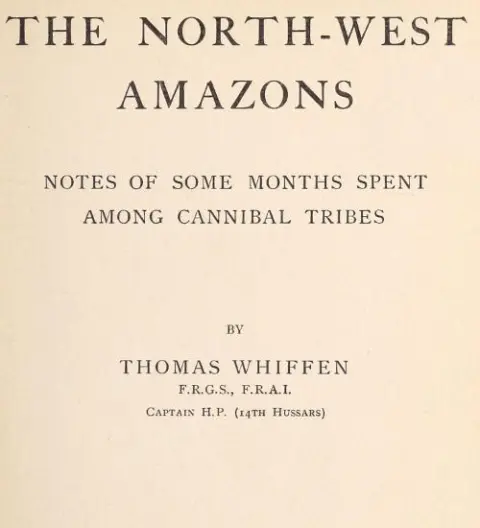
"The North-West Amazons: Notes of some months spent among cannibal tribes" by Thomas Whiffen is a historical account written in the early 20th century. The work details the author's months spent exploring the remote regions near the upper Amazon River, specifically focusing on the cannibal tribes and their cultures. Whiffen shares his observations of the tribes' customs, daily life, and interactions with nature, providing readers with an ethnographic glimpse into a largely untouched world. At the start of the narrative, Whiffen recounts his motivations for embarking on this journey following a period of unemployment due to ill health. He reflects on previous travel experiences and the influence of Dr. Alfred Russel Wallace's writings, which inspired him to explore the Amazon. Arriving in Manaos, he quickly realizes the challenges of accessing the interior and securing a reliable party, and the narrative unfolds with his detailed accounts of the difficulties faced in navigating the forest, river routes, and the dynamics with local tribes. The opening section sets the stage for an immersive exploration of the Amazonian wilderness and the indigenous peoples residing there, capturing both the allure and the difficulties of his expedition.
Introduction adapted from the source catalogue; source summaries may be automatically generated.
Free to read · English · 110,454 words · No account needed
MAKE TIME FOR A GOOD BOOK
On by default. Untick to stop anonymous reading totals. Each page counts after 10 seconds in view. How this works.
Anonymous counting is on unless you have switched it off.
[104] Tylor mentions the hammock as one of “the inventions which it seems possible to trace to their original districts,” and states that it has spread from South America and the West Indies “far and wide over the world, carrying with it its Haitian name, hamac” (op. cit. p. 175). It is interesting to note in this connection that a hammock is known as a hamaka among the Yakuna; the Tariana call it hamaka or amaka; and the Yavitero Indians call it aimaiha (Koch-Grünberg, Aruak-Sprachen Nordwestbrasiliens und der angrenzenden Gebiete, p. 65). The Baré Indians call it mi; the Baniwa bidzaha or bisali; the Siusi pieta or piete; the Katapolitani change the t to d and have pieda; the Kurutana call it makaitepa; the Uarekena say soalita (Koch-Grünberg, op. cit.); while the Pioje call hammocks jangre (Simson, p. 268). The Witoto word is kinai and the Boro gwapa.
[105] Hamilton Rice gives the distances between the meshes as the space of thumb to little finger stretch for the Witoto, palm-length for the Karahone, four fingers for the Cubbeo (p. 700). I knew the spacing differed, but never heard that it was a tribal distinction.
[106] The palm employed is, according to Bates, an Astrocaryum (Bates, ii. 209). Wallace and im Thurn mention the Mauritia flexuosa (A. R. Wallace, p. 342; im Thurn, pp. 283, 290), which, according to Spruce, “seems confined to the submaritime region” (Spruce, i. 15). He gives Bromelia karatas, ii. 520. Spix and Martius give the Tucuma palm (Astrocaryum vulgare) and others of the same genus (Spix and Martius, p. 248).
[107] “A species of Desmoncus” (A. R. Wallace, p. 336).
[108] Women make both cassava-squeezers and graters. This may be a coincidence, as I have seen men making the mats for the doorways, usually women’s work.
[109] Guilielmia speciosa.
[110] Spruce, ii. 447.
[111] Spencer and Gillen, Native Tribes of Central Australia, pp. 668-9, and Across Australia.
[112] Any hard wood may be used, but cedar makes the best canoe. Hamilton Rice says cachicama (Rice, p. 691). Spruce mentions “a heavy laurel, probably Paraturi,” used by the Tussari for making their cascos (Spruce, i. 413). Bates mentions the Itauba amarello, “the yellow variety of the stone-wood” (Bates, ii. 117). But all trees will not do, for some will not open properly when they are fired (André, pp. 241-2).
[113] Iriartea ventricosa.
[114] This is said to be the only kind of canoe used by the Auhishiri
(cf. Simson, p. 199).
[115] Viz. the Maca, the Guaharibo, and the Guahibo (Spruce, i. 477).
[116] Wallace, p. 358.
[117] For example, the Zaparo (Simson, pp. 169, 295); the Uaupes Indians
(Wallace, p. 349).
[118] Among other tribes this is not always the case. Manioc and banana cultivation with the Rucuyens is carried on by the men (Ratzel, ii. 128).
Your reading position is saved on this browser. Take it to another device with a library code. Reading pages adapt to text, rather than matching a printed edition.
BEHIND THE BOOK
This eBook is for the use of anyone anywhere in the United States and most other parts of the world at no cost and with almost no restrictions whatsoever. You may copy it, give it away or re-use it under the terms of the Project Gutenberg License included with this eBook or online at www.gutenberg.org. If you are not located in the United States, you will have to check the laws of the country where you are located before using this eBook. Read the source licence.
The original source file, including credits and licence, is retained by this library. Request an original-format copy at no charge. Please include the book title and Project Gutenberg identifier #55540.
KEEP YOUR CURIOSITY GOING
Wilfrid Scawen Blunt
Wilfrid Scawen Blunt

E. W. (Edgar Watson) Howe
Cécile Tormay

Moritz Busch
John L. Ransom