THE CLASSIC COLLECTION✦My diaries, being a personal narrative of events 1888-1914, Part 2 (1900-1914)CLASSIC FREE BOOKS
My diaries, being a personal narrative of events 1888-1914, Part 2 (1900-1914)
Wilfrid Scawen Blunt
THE CLASSIC COLLECTION · 1915
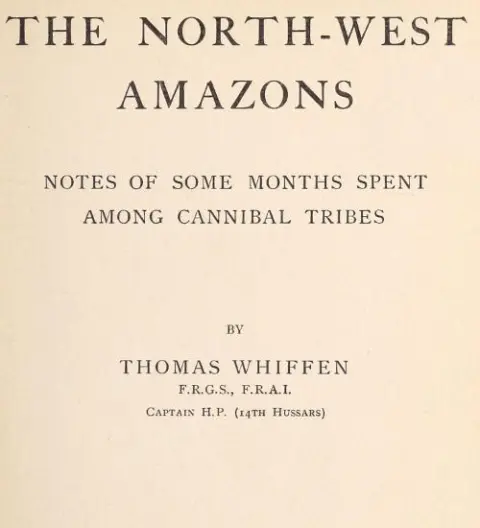
"The North-West Amazons: Notes of some months spent among cannibal tribes" by Thomas Whiffen is a historical account written in the early 20th century. The work details the author's months spent exploring the remote regions near the upper Amazon River, specifically focusing on the cannibal tribes and their cultures. Whiffen shares his observations of the tribes' customs, daily life, and interactions with nature, providing readers with an ethnographic glimpse into a largely untouched world. At the start of the narrative, Whiffen recounts his motivations for embarking on this journey following a period of unemployment due to ill health. He reflects on previous travel experiences and the influence of Dr. Alfred Russel Wallace's writings, which inspired him to explore the Amazon. Arriving in Manaos, he quickly realizes the challenges of accessing the interior and securing a reliable party, and the narrative unfolds with his detailed accounts of the difficulties faced in navigating the forest, river routes, and the dynamics with local tribes. The opening section sets the stage for an immersive exploration of the Amazonian wilderness and the indigenous peoples residing there, capturing both the allure and the difficulties of his expedition.
Introduction adapted from the source catalogue; source summaries may be automatically generated.
Free to read · English · 110,454 words · No account needed
MAKE TIME FOR A GOOD BOOK
On by default. Untick to stop anonymous reading totals. Each page counts after 10 seconds in view. How this works.
Anonymous counting is on unless you have switched it off.
This child took the women of the tribe to a beautiful plantation of manioc, far, far up a certain river, and there the precocious infant explained how to reproduce the plant with bits of the stalks.
So to this day the chief food of all the peoples is cassava.
This story is utterly different from one Spruce heard from more northern tribes at Saō Gabriel. The Barré story has it that a bird discovered to the Indians the use of the mandiocca, then a great and solitary tree. All the tribes came to procure the roots, and when none were left carried off branches; hence the varieties of mandiocca now grown.[380]
Deluge traditions are to be found among practically all the tribes. I repeatedly asked questions on this point, and invariably found, as other travellers had discovered previously elsewhere,[381] that the Indians would tell of a flood that drove their fathers in the long, long ago to seek refuge in canoes, for all the earth was under water. But though Mr. Joyce considers it “strange how this deluge myth not only pervades practically the whole of the Andean region of South America, but extends also to many regions in the northern portion of the Continent,” it must be remembered that inundations are frequent in these regions, and a great one probably occurs every few decades. It would only be strange were there no deluge myths. As Sir Everard im Thurn has so aptly put it, when “the Indian tells in his simple language the tradition of the highest flood which covered all the small world known to him, and tells how the Indians escaped it, it is not difficult to realise that the European hearer, theologically prejudiced in favour of Noah, … is apt to identify the two stories.”[382]
With the possible exception of the Eldorado fable, there is no South American legend that has excited so much interest and speculation as the story of the warrior women who in some mysterious forest fastness dwelt apart from men, cultivated masculine attributes, and destroying the male brought up the female progeny resultant from the yearly exception to their celibate rule,[383] to be women of the same stern pattern as their extraordinary selves. Some writers would make them a seventeenth century edition of the modern suffragette, rebel against the “tyranny” of man--and with certainly better reason for rebellion.[384] The story has been treated as mere Spanish romance,[385] or a mistake on the part of the invaders due to the custom of wearing the hair long among many of the tribes.[386] It has been taken to be a deliberate fabrication on the part of Pizarro to explain his failure, a temptation to which Sir Walter Raleigh himself also fell victim.[387] Be it what it may, the tale was told, the land known as the land of these women warriors, and their name of Amazons bestowed upon the great river. The tale of warrior women is, however, not confined to the forests of the Amazon. One comes therewith to the question of nomenclatory origin. The Baron de Santa-Anna Nery devotes the first ten pages of his Land of the Amazons to this discussion. It seems to be a case of where doctors disagree.[388] But at least the tale, Asiatic, African, or autochthonic, was localised here, and stories of feminine prowess in the field continued to be quoted even in the nineteenth century. Wallace himself mentions “traditions” said to be extant among the Indians themselves, of “women without husbands.”[389] This is no proof of the local existence at any time of celibate women warriors. The tradition may well exist, the only curiosity again would be if it did not. For three centuries at least the invading white man has talked of, and inquired for, a tribe of such warrior women. It takes less than this to start the most robust of folk-tales. A world agape like the Athenians of old for some new thing, some tale to vary the oft-told stories, does not require three centuries to adopt a novel romance. The question “do such things exist?” is not asked long before it ceases to be a question and becomes an assertion. The more positive the assertion the greater will be the wonder of the tale. When the wonder is sufficient it will be established as a current myth. I do not therefore deny that such a tale is told, or at least may be told, but for my own part I never heard mention of it. Spruce speaks of women assisting their men to repulse an attack on tribal head-quarters,[390] but no story of any woman fighting, or having done so at any time, was ever told me. Moreover it should not be forgotten in this connection that all weapons are strictly tabu to women.
Your reading position is saved on this browser. Take it to another device with a library code. Reading pages adapt to text, rather than matching a printed edition.
BEHIND THE BOOK
This eBook is for the use of anyone anywhere in the United States and most other parts of the world at no cost and with almost no restrictions whatsoever. You may copy it, give it away or re-use it under the terms of the Project Gutenberg License included with this eBook or online at www.gutenberg.org. If you are not located in the United States, you will have to check the laws of the country where you are located before using this eBook. Read the source licence.
The original source file, including credits and licence, is retained by this library. Request an original-format copy at no charge. Please include the book title and Project Gutenberg identifier #55540.
KEEP YOUR CURIOSITY GOING
Wilfrid Scawen Blunt
Wilfrid Scawen Blunt

E. W. (Edgar Watson) Howe
Cécile Tormay

Moritz Busch
John L. Ransom