
In the Morning
Willis Boyd Allen
THE CLASSIC COLLECTION · 1905
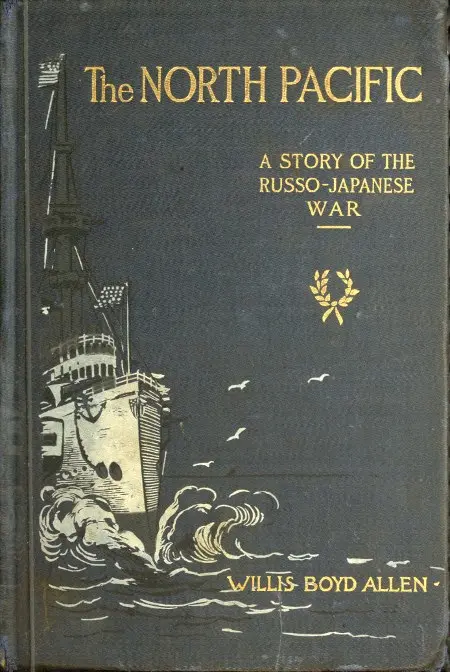
"The North Pacific: A Story of the Russo-Japanese War" by Willis Boyd Allen is a historical account written in the early 20th century. The narrative delves into the Russo-Japanese War, focusing on naval battles and the intricacies of warfare during this significant conflict between two great powers of the East and West. The story likely involves several characters, including members of the American navy and Japanese protagonists who play pivotal roles in the unfolding events. The opening of the book sets the stage with a vivid description of a battleship trial, focusing on the USS Retvizan as it undergoes rigorous testing amid the bustling activity of a shipyard. Two young Japanese men, Oto and Oshima, blend into the background as seemingly ordinary stewards but reveal alertness as they observe the battleship closely. Their keen interest hints at underlying motives related to the war. As the narrative progresses, the ship's crew, including reporter Fred Larkin, takes shape, foreshadowing future developments as the ship sets sail into the conflict-prone waters of the Pacific. The interactions between the sailors and Japanese characters signal potential themes of cultural collision and espionage amid wartime uncertainty.
Introduction adapted from the source catalogue; source summaries may be automatically generated.
Free to read · English · 69,858 words · No account needed
MAKE TIME FOR A GOOD BOOK
On by default. Untick to stop anonymous reading totals. Each page counts after 10 seconds in view. How this works.
Anonymous counting is on unless you have switched it off.
At the end of the sixth day, the Osprey was ready for sea. Her men, her stores, supplies, coal and ammunition were on board, well stowed. Rexdale drew a long breath of relief, and Paymaster Ross another, as the last account was filed that night. The commander wrote a long letter to his wife, Hallie, before retiring. She was visiting friends in the West, and he had no opportunity to see her before starting on what was doubtless to be a cruise to the other side of the world. This is a part of a naval officer's life. "Detached," from this place to that, from one ship, or one duty, to another, says the brief naval report. The officer receives his written orders, and if his heart aches a little, under his blue uniform, no one knows it but the one who receives the good-bye letter, hurriedly sent by the despatch-boat or the orderly; and he is ready for the new post.
Paymaster Ross, meanwhile, is busy with half a hundred lists and receipts and accounts. He it is who knows accurately the pay of every man on board. Look over his shoulder and read in his "Register" of current date the salaries that our National Uncle pays to his nephews for naval services:
-----------------------------+------------+----------- RANK. |ON SEA DUTY.| ON SHORE. -----------------------------+------------+----------- Admiral (George Dewey) | $13,500 | $13,500 Rear Admirals: | | First Nine | 7,500 | 6,375 Second Nine | 5,500 | 4,675 Chiefs of Bureaus | ...... | 5,500 Captains | 3,500 | 2,975 Commanders | 3,000 | 2,550 Lieutenant-Commanders | 2,500 | 2,125 Lieutenants | 1,800 | 1,530 Lieutenants, Junior Grade | 1,500 | 1,500 Ensigns | 1,400 | 1,190 -----------------------------+------------+-----------
It is to be remembered that, in addition to the amounts given in this table, all the officers mentioned (below the grade of rear-admiral) are entitled by the present laws to "ten per cent. upon the full yearly pay of their grades for each and every period of five years' service, as increase for length of service, or 'longevity pay.'" Still, thirty-five hundred dollars, even with that additional "longevity pay," does not seem a very large salary for the commander of a battle-ship at sea and perhaps under fire from day to day!
Warrant officers, namely boatswains, gunners, carpenters, sailmakers, pharmacists and warrant machinists are paid (for sea duty) from $1200 a year for the first three years after date of appointment, to $1800 after twelve years' service.
Chief petty officers, including Chief Master-at-arms, Chief Boatswain's Mate, Chief Gunner's Mate, Chief Yeoman, Hospital Steward, Bandmaster, and a few others, draw pay ranging from $50 to $70 a month. The pay of first-class petty officers, of whom there are about twenty varieties, is from $36 to $65 a month; that of second-class petty officers a trifle less; and that of third-class petty officers $30 a month.
Your reading position is saved on this browser. Take it to another device with a library code. Reading pages adapt to text, rather than matching a printed edition.
Willis Boyd Allen

Willis Boyd Allen

Willis Boyd Allen
Willis Boyd Allen
BEHIND THE BOOK
This eBook is for the use of anyone anywhere in the United States and most other parts of the world at no cost and with almost no restrictions whatsoever. You may copy it, give it away or re-use it under the terms of the Project Gutenberg License included with this eBook or online at www.gutenberg.org. If you are not located in the United States, you will have to check the laws of the country where you are located before using this eBook. Read the source licence.
The original source file, including credits and licence, is retained by this library. Request an original-format copy at no charge. Please include the book title and Project Gutenberg identifier #45413.
KEEP YOUR CURIOSITY GOING
Cécile Tormay

Moritz Busch
Coulson Kernahan
John L. Ransom

Maurice Baring
Frances Wright