
In the Morning
Willis Boyd Allen
THE CLASSIC COLLECTION · 1905
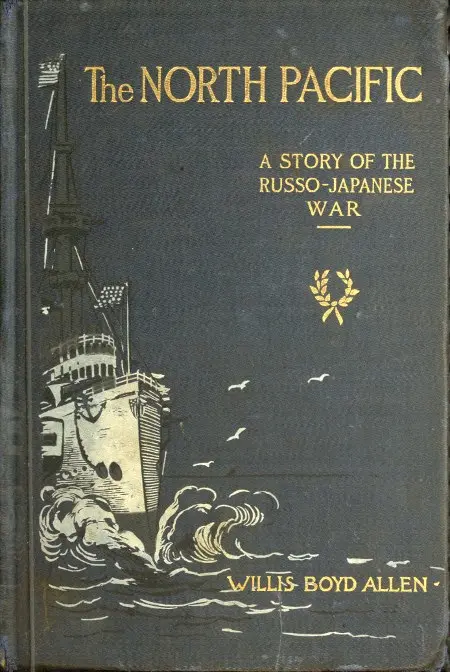
"The North Pacific: A Story of the Russo-Japanese War" by Willis Boyd Allen is a historical account written in the early 20th century. The narrative delves into the Russo-Japanese War, focusing on naval battles and the intricacies of warfare during this significant conflict between two great powers of the East and West. The story likely involves several characters, including members of the American navy and Japanese protagonists who play pivotal roles in the unfolding events. The opening of the book sets the stage with a vivid description of a battleship trial, focusing on the USS Retvizan as it undergoes rigorous testing amid the bustling activity of a shipyard. Two young Japanese men, Oto and Oshima, blend into the background as seemingly ordinary stewards but reveal alertness as they observe the battleship closely. Their keen interest hints at underlying motives related to the war. As the narrative progresses, the ship's crew, including reporter Fred Larkin, takes shape, foreshadowing future developments as the ship sets sail into the conflict-prone waters of the Pacific. The interactions between the sailors and Japanese characters signal potential themes of cultural collision and espionage amid wartime uncertainty.
Introduction adapted from the source catalogue; source summaries may be automatically generated.
Free to read · English · 69,858 words · No account needed
MAKE TIME FOR A GOOD BOOK
On by default. Untick to stop anonymous reading totals. Each page counts after 10 seconds in view. How this works.
Anonymous counting is on unless you have switched it off.
The dinner proved a great success. Larkin, of course, kept his end of the table in a shout, while young Starr was by no means too bashful to appreciate Ethelwyn's fun. "Doc." Liddon talked politics with the civilian reporter, navy-yard gossip with Mrs. Commandant, international complications with her husband, and nonsense, flavoured with dry wit, with Edith. Dobson told the story of his rescue from the hazing party at the Academy, and brought down the house as he described his position when Norman Holmes and Dave Rexdale came on the scene--standing on his head, with his tormentors pouring cold water down his trousers-leg.
Then Dave himself was called on for the tale of his boat-wreck on the lonely Desertas, near Madeira, when he and "Sandy" barely escaped with their lives.
The cabin of the Osprey was prettily decorated with ferns and flowers, and there was little to suggest warfare, the roar of cannon, the cries of the fierce combatants, in its dainty appointments. It fell about, however, that, as was natural, the conversation at length turned to the navies of the great nations, and, in comparison, that of the United States.
"Where do we stand, among the other Powers--in point of naval strength,
I mean?" asked some one.
The commandant had excused himself on the plea of important duty, and had returned to his office on the Yard. Oddly enough, it was the civilian that answered the question, before any one else could recall the figures.
"We are fifth in rank," said Larkin, helping himself to a banana. "If we carry out our present rather indefinite plans we shall be, by 1908, the third in strength, possibly the second, with only England ahead of us."
"Do you happen to remember the approximate number of large ships in the English navy?" asked Dobson.
"I'm sorry to say I do not," replied the reporter.
"I do," put in Ensign Liddon, who had had time to collect his thoughts and statistics. "England has two hundred and one, not counting gunboats, torpedo-boats, and other small craft----"
"Small! Do you call this ship small?" cried Ethelwyn indignantly.
"She'd look like a kitten beside her mother if a first-class battleship ranged alongside," laughed Liddon. "Well, I was about to add that France has ninety-six big ships, Russia fifty-nine, and Germany seventy-three. The United States has only sixty-five."
"How many has Japan?" inquired Rexdale significantly. Just behind his shoulder a pair of dark, obliquely-set eyes flashed at the question.
"Forty-four, I believe. She would have a poor show at sea against
Russia's fifty-nine."
"Oshima, there, doesn't seem to agree with you," said Dr. Cutler lightly, nodding in the direction of the steward.
Your reading position is saved on this browser. Take it to another device with a library code. Reading pages adapt to text, rather than matching a printed edition.
Willis Boyd Allen
Willis Boyd Allen

Willis Boyd Allen
Willis Boyd Allen
BEHIND THE BOOK
This eBook is for the use of anyone anywhere in the United States and most other parts of the world at no cost and with almost no restrictions whatsoever. You may copy it, give it away or re-use it under the terms of the Project Gutenberg License included with this eBook or online at www.gutenberg.org. If you are not located in the United States, you will have to check the laws of the country where you are located before using this eBook. Read the source licence.
The original source file, including credits and licence, is retained by this library. Request an original-format copy at no charge. Please include the book title and Project Gutenberg identifier #45413.
KEEP YOUR CURIOSITY GOING
Cécile Tormay

Moritz Busch
Coulson Kernahan
John L. Ransom

Maurice Baring
Frances Wright