
In the Morning
Willis Boyd Allen
THE CLASSIC COLLECTION · 1905
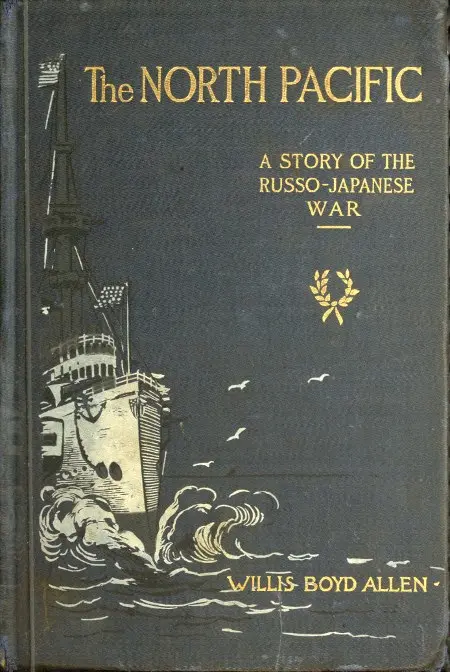
"The North Pacific: A Story of the Russo-Japanese War" by Willis Boyd Allen is a historical account written in the early 20th century. The narrative delves into the Russo-Japanese War, focusing on naval battles and the intricacies of warfare during this significant conflict between two great powers of the East and West. The story likely involves several characters, including members of the American navy and Japanese protagonists who play pivotal roles in the unfolding events. The opening of the book sets the stage with a vivid description of a battleship trial, focusing on the USS Retvizan as it undergoes rigorous testing amid the bustling activity of a shipyard. Two young Japanese men, Oto and Oshima, blend into the background as seemingly ordinary stewards but reveal alertness as they observe the battleship closely. Their keen interest hints at underlying motives related to the war. As the narrative progresses, the ship's crew, including reporter Fred Larkin, takes shape, foreshadowing future developments as the ship sets sail into the conflict-prone waters of the Pacific. The interactions between the sailors and Japanese characters signal potential themes of cultural collision and espionage amid wartime uncertainty.
Introduction adapted from the source catalogue; source summaries may be automatically generated.
Free to read · English · 69,858 words · No account needed
MAKE TIME FOR A GOOD BOOK
On by default. Untick to stop anonymous reading totals. Each page counts after 10 seconds in view. How this works.
Anonymous counting is on unless you have switched it off.
The target, towed out and anchored by a whaleboat, consisted of a triangular raft of boards supported at each corner by an empty barrel. On this was stepped a mast twelve feet high, with a small red flag at the top. Three leg-of-mutton sails, or "wings," gave the craft the appearance, at a distance, of a small catboat under sail. The Osprey now took her position--the distance and course being plotted by officers in two boats--and steamed at half-speed past the target at a distance of about sixteen hundred yards.
The gun-crews were summoned to quarters, and the firing begun with a six-pounder on the forecastle, followed by two three-pounders on the same deck.
The big four-inch gun was then loaded, the officers putting cotton in their ears to avoid injury. The first shot, weighing between thirty and forty pounds, was dropped a little to the right of the target; the second fell just beyond it and to the left.
"Fire on the top of the roll," cautioned the captain of the gun-crew, which comprised four of the best gunners on the ship.
The third shot fell short, and was duly so recorded, in a memorandum to be included in a report to the Department.
As the disappointed gunner stepped back he saw Oto, who, being a sort of privileged character, was lingering close by, shake his head slightly.
"Perhaps you think you could do better, Jap!" said the man sharply.
Oto nodded, but remained modestly silent.
"What, did you ever fire a heavy piece of ordnance?" asked Liddon, standing near to watch the practice.
Oto nodded again. "I could hit that target," he added simply, touching
his cap and turning away.
"Stop," said the officer. He stepped toward the bridge, and, saluting, said: "The Japanese yonder says he is used to firing and could hit the target, sir. Shall I let him try?"
Rexdale, who was closely noting the practice, hesitated, it being the strict rule that no one outside the gun-crew should fire. He spoke in a low tone to Staples, who laughed and said: "All right, sir. It's only one shot wasted, in any case."
"Let the boy sight the piece, and fire," ordered the commander.
Oto touched his cap and adjusted the sighting apparatus to his shoulder. His small hands fluttered a moment around the delicate machinery; then he swung the great muzzle slightly upward and to the right. The ship rose on a long swell, and just as it hung on the crest came the roar of the great gun.
An instant's pause was followed by a cheer from the men; for as the smoke drifted away, behold, there was no target to be seen!
Your reading position is saved on this browser. Take it to another device with a library code. Reading pages adapt to text, rather than matching a printed edition.
Willis Boyd Allen
Willis Boyd Allen
Willis Boyd Allen
Willis Boyd Allen
BEHIND THE BOOK
This eBook is for the use of anyone anywhere in the United States and most other parts of the world at no cost and with almost no restrictions whatsoever. You may copy it, give it away or re-use it under the terms of the Project Gutenberg License included with this eBook or online at www.gutenberg.org. If you are not located in the United States, you will have to check the laws of the country where you are located before using this eBook. Read the source licence.
The original source file, including credits and licence, is retained by this library. Request an original-format copy at no charge. Please include the book title and Project Gutenberg identifier #45413.
KEEP YOUR CURIOSITY GOING
Cécile Tormay

Moritz Busch
Coulson Kernahan
John L. Ransom

Maurice Baring
Frances Wright