In the Morning
Willis Boyd Allen
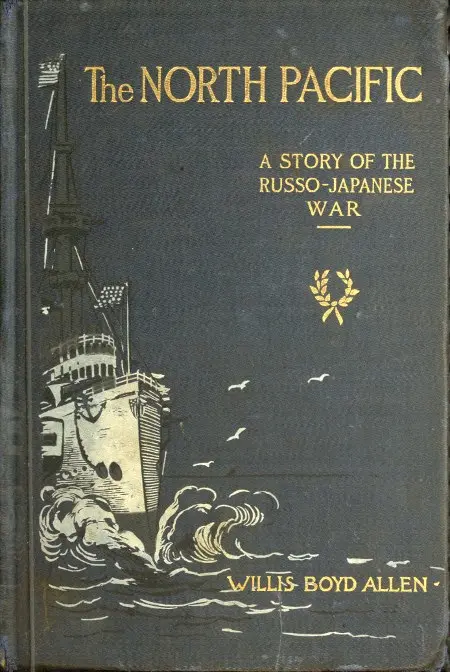
THE CLASSIC COLLECTION · 1905
"The North Pacific: A Story of the Russo-Japanese War" by Willis Boyd Allen is a historical account written in the early 20th century. The narrative delves into the Russo-Japanese War, focusing on naval battles and the intricacies of warfare during this significant conflict between two great powers of the East and West. The story likely involves several characters, including members of the American navy and Japanese protagonists who play pivotal roles in the unfolding events. The opening of the book sets the stage with a vivid description of a battleship trial, focusing on the USS Retvizan as it undergoes rigorous testing amid the bustling activity of a shipyard. Two young Japanese men, Oto and Oshima, blend into the background as seemingly ordinary stewards but reveal alertness as they observe the battleship closely. Their keen interest hints at underlying motives related to the war. As the narrative progresses, the ship's crew, including reporter Fred Larkin, takes shape, foreshadowing future developments as the ship sets sail into the conflict-prone waters of the Pacific. The interactions between the sailors and Japanese characters signal potential themes of cultural collision and espionage amid wartime uncertainty.
Introduction adapted from the source catalogue; source summaries may be automatically generated.
Free to read · English · 69,858 words · No account needed
MAKE TIME FOR A GOOD BOOK
On by default. Untick to stop anonymous reading totals. Each page counts after 10 seconds in view. How this works.
Anonymous counting is on unless you have switched it off.
"Oh, China holds a sort of suzerainty or protectorate over Korea, but practically it has governed itself. The King, or Sultan, or whatever he calls himself, has always been held sacred--to touch him with an iron weapon was sure death. Of late years foreign merchants have gained a foothold in the country, and travellers have visited it. You know Wiju, at the mouth of the Yalu, was declared an open port only last February."
"What's the religion hereabouts?"
"Mostly Confucianism. Catholic missionaries have made a tremendous struggle to introduce Christianity, and their history has been a long series of martyrdoms. Why, in 1866, there was a great massacre of native Christians, and nearly ten thousand perished."
"That finished the matter, I suppose?"
"Not much. There are supposed to be at least forty-five thousand Roman Catholic Christians in Korea to-day. Just what will become of them if the country goes to Japan, or is divided up among the big Powers, nobody knows. The Koreans, by the way, have a standing army of seventeen thousand men, trained and drilled by European officers."
With talk of this sort, and various other statistics relating to the Hermit Kingdom, time passed rapidly, and the learned young ensign was still lecturing when the train rolled into the station at Seoul.
The two officers strolled up the shady side of the main street, and soon espied some curios from which they determined to select mementos of this strange city.
"We ought to have some change," said Bob. "I've nothing but English gold. Suppose I get this shopkeeper to give me Korean money for half a dozen sovereigns?"
"All right," agreed Liddon, with a twinkle in his eye which the other did not see. "He'll be glad to have the gold, no doubt, and will cheat you a little, but that won't matter."
"How can I make him understand what I want?" queried the midshipman, standing before the Korean helplessly, with the money in his hand.
"I guess I can arrange it," said Doc. Liddon gravely. "I happen to know the word for small change in this country. Hulloa, you! Sapeke!" The ensign held out the gold as he spoke, and let it clink.
The man nodded twenty times, repeating "Sapeke! Sapeke!" and calling three or four coolies, gave them an order, despatching them in different directions. Then he gently drew out the American's watch, and pointing to the open face, held out five fingers.
"That means he'll have the change ready in five minutes, I suppose,"
said Liddon.
"Of course, just as they'd do at home. Sent round to the bank for it, probably. Let's walk on a bit, and come back here when the time's up."
Your reading position is saved on this browser. Take it to another device with a library code. Reading pages adapt to text, rather than matching a printed edition.
Willis Boyd Allen
Willis Boyd Allen
Willis Boyd Allen
Willis Boyd Allen
BEHIND THE BOOK
This eBook is for the use of anyone anywhere in the United States and most other parts of the world at no cost and with almost no restrictions whatsoever. You may copy it, give it away or re-use it under the terms of the Project Gutenberg License included with this eBook or online at www.gutenberg.org. If you are not located in the United States, you will have to check the laws of the country where you are located before using this eBook. Read the source licence.
The original source file, including credits and licence, is retained by this library. Request an original-format copy at no charge. Please include the book title and Project Gutenberg identifier #45413.
KEEP YOUR CURIOSITY GOING
Cécile Tormay

Moritz Busch
Coulson Kernahan
John L. Ransom

Maurice Baring
Frances Wright