THE CLASSIC COLLECTION✦An outlaw’s diary: the CommuneCLASSIC FREE BOOKS
An outlaw’s diary: the Commune
Cécile Tormay
THE CLASSIC COLLECTION · 1859
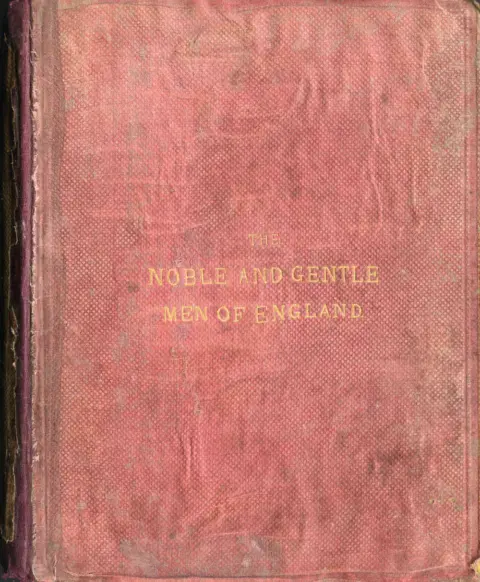
"The Noble and Gentle Men of England" by Evelyn Philip Shirley is a historical account written in the mid-19th century. The work aims to chronicle the arms and genealogies of ancient knightly and gentle families in England, arranged by their respective counties. It particularly focuses on those families that had established themselves before the 16th century, offering insights into the social structure and lineage of England's aristocracy. The opening of the text sets the stage for the author's exploration of England's noble families, outlining his methodology and the limitations he imposed on his investigation. Shirley discusses the criteria for inclusion, emphasizing the importance of direct male descent and the historical ties to the land. He acknowledges the challenges of genealogy, such as distinguishing between ancient and more recent claims to lineages. The introduction also references various sources from county histories and manuscripts, indicating a rigorous approach to documenting the legacy of aristocratic families. These early details lay a foundation for the detailed genealogies that will follow in the subsequent chapters.
Introduction adapted from the source catalogue; source summaries may be automatically generated.
Free to read · English · 64,026 words · No account needed
MAKE TIME FOR A GOOD BOOK
On by default. Untick to stop anonymous reading totals. Each page counts after 10 seconds in view. How this works.
Anonymous counting is on unless you have switched it off.
[Illustration] Sutton-upon-Trent gave name to this ancient family, the first upon record being Roland, son of Hervey, who lived in the reign of Henry III., and married Alice, daughter and coheiress of Richard de Lexington. From this match came the manor of Averham or Egram in this county, which long continued the seat and residence of the Suttons, who were represented in the days of Queen Elizabeth by Sir William Sutton, whom her Majesty coupled, not in the most complimentary manner, with three other eminent Nottinghamshire knights in the following distich:--
"Gervase the gentle,* Stanhope the stout,
Markham the lion, and Sutton the lout."
In 1646, Robert Sutton, the head of this family, was raised to the Peerage as Baron Lexington, extinct 1723, who is represented in the female line by Viscount Canterbury. The present family descend from Henry, younger brother of the first Lord Lexington.
See Thoroton's Nottinghamshire, pp. 327, 359; and Courthope's
Debrett's Baronetage, p. 195.
ARMS.--Argent, a canton sable.
Present Representative, Sir John Sutton, 3rd Baronet.
* i.e. Sir Gervase Clifton.
[Illustration] Stanhope, in the wapentake of Darlington in the bishoprick of Durham, gave name to this knightly family, of whom the first recorded ancestor is Walter de Stanhope, whose son Richard died at Stanhope, in 1338 or 1339. In the reign of Edward III. we find Sir Richard Stanhope, grandson of Walter, Mayor of Newcastle-on-Tyne. Hampton and other manors in this county came by marriage with the heiress of Maulovel about 1370; but on the death of Richard Stanhope in 1529, these estates went to his only daughter and heiress, who became the wife of John Babington. The monastery of Shelford was soon after this period granted to Sir Michael Stanhope (in the 31st of Henry VIII).
Younger Branches. 1. Stanhope of Holme-Lacy, Baronet 1807, descended from the youngest brother of the great-grandfather of the present Earl. 2. Stanhope Earl Stanhope 1718, descended from the eldest son of the second marriage of the first Earl of Chesterfield. 3. Stanhope Earl of Harrington 1742, descended from Sir John Stanhope, younger brother by the half-blood of the first Earl of Chesterfield.
See Lord Mahon's (now Earl Stanhope) Notices of the Stanhopes. 8vo., 1855; Thoroton's Nottinghamshire, 147; Surtees's Durham, ii. 46; and Brydges's Collins, iii. 407, iv. 171, and 284.
ARMS.--Quarterly ermine and gules. And so borne in the reign of Edward III., but after the match with Maulovel, who brought into the family the estate and seat of Rampton from the heiress of Longvillers, the arms of that family, viz. Sable, a bend between six cross-crosslets argent, were assumed; on losing that great estate, Sir Michael Stanhope resumed the more ancient coat in the reign of Henry VIII.
Present Representative, George Stanhope, 6th Earl of Chesterfield.
Your reading position is saved on this browser. Take it to another device with a library code. Reading pages adapt to text, rather than matching a printed edition.
BEHIND THE BOOK
This eBook is for the use of anyone anywhere in the United States and most other parts of the world at no cost and with almost no restrictions whatsoever. You may copy it, give it away or re-use it under the terms of the Project Gutenberg License included with this eBook or online at www.gutenberg.org. If you are not located in the United States, you will have to check the laws of the country where you are located before using this eBook. Read the source licence.
The original source file, including credits and licence, is retained by this library. Request an original-format copy at no charge. Please include the book title and Project Gutenberg identifier #58212.
KEEP YOUR CURIOSITY GOING
Cécile Tormay

Moritz Busch
John L. Ransom
Frances Wright
Cécile Tormay

Mabel Potter Daggett