THE CLASSIC COLLECTION✦An outlaw’s diary: the CommuneCLASSIC FREE BOOKS
An outlaw’s diary: the Commune
Cécile Tormay
THE CLASSIC COLLECTION · 1859
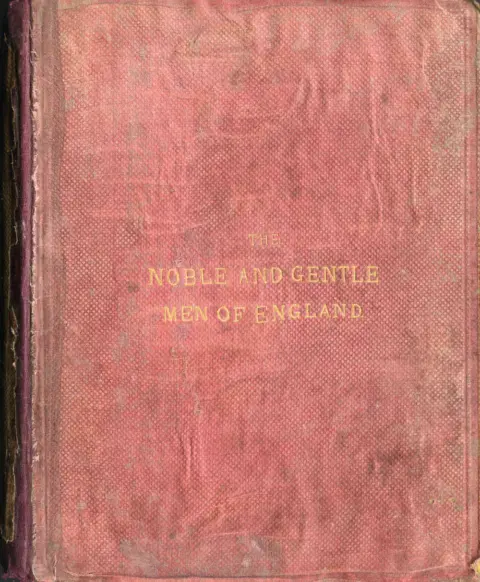
"The Noble and Gentle Men of England" by Evelyn Philip Shirley is a historical account written in the mid-19th century. The work aims to chronicle the arms and genealogies of ancient knightly and gentle families in England, arranged by their respective counties. It particularly focuses on those families that had established themselves before the 16th century, offering insights into the social structure and lineage of England's aristocracy. The opening of the text sets the stage for the author's exploration of England's noble families, outlining his methodology and the limitations he imposed on his investigation. Shirley discusses the criteria for inclusion, emphasizing the importance of direct male descent and the historical ties to the land. He acknowledges the challenges of genealogy, such as distinguishing between ancient and more recent claims to lineages. The introduction also references various sources from county histories and manuscripts, indicating a rigorous approach to documenting the legacy of aristocratic families. These early details lay a foundation for the detailed genealogies that will follow in the subsequent chapters.
Introduction adapted from the source catalogue; source summaries may be automatically generated.
Free to read · English · 64,026 words · No account needed
MAKE TIME FOR A GOOD BOOK
On by default. Untick to stop anonymous reading totals. Each page counts after 10 seconds in view. How this works.
Anonymous counting is on unless you have switched it off.
[Illustration] Originally of Northumberland, where the family were seated at an early period. The first recorded ancestor is Sir Robert de Maners, who obtained a grant of land in Berrington in 1327, and was M.P. for Northumberland in 1340. His son William Maners, of Etal, died before 1324, which estate appears to have been inherited from an heiress of Muschamp. At the end of the fifteenth century, by marriage with the heiress of the baronial family of Roos, the house of Manners came into possession of the Castle of Belvoir. In the succeeding century, a fortunate match with the heiress of Vernon of Haddon still further increased the wealth and importance of this noble family.
The royal title of Rutland, which had belonged to the house of York, was conferred upon Thomas Lord Roos in 1525 as the grandson of the lady Anne of York, sister to King Edward the Fourth.
An extinct branch was from the time of Henry VIII. for a long period of Newmanor House, in the parish of Framlington, in Durham. Another branch of the Etal family was of Cheswick, in the same county, extinct after 1633.
See Raine's North Durham, 211, 230; Nichols's Leicestershire, ii. pt. i. 67; and Brydges's Collins, i. 454.
ARMS.--Or, two bars azure; a chief quarterly azure and gules, on the 1st and 4th two fleurs-de-lis, on the 2nd and 3rd a leopard of England of the first; the chief being an augmentation granted by Henry VIII. The ancient arms, no doubt founded on those of the Muschamp family, were, Or, two bars azure, a chief gules. See the Rolls of the reign of Edward II. and Richard III.
Present Representative, Charles Cecil John Manners, sixth Duke of
Rutland.
[Illustration] This is a branch of the extinct family of the Lords Alington, of Horseheath, in Cambridgeshire, who were originally of Alington, in the same county, soon after the Conquest. The family descend from a younger son of Sir Giles Alington, and were seated at Swinhope in the reign of Queen Elizabeth.
See Clutterbuck's History of Hertfordshire, ii. 542; and Collectanea Topog. et Genealog. iv. 33-53, and note 2, p. 39. For Horseheath, see Topographer, ii. 374.
ARMS.--Sable, a bend engrailed between six billets argent.
Present Representative, George Marmaduke Alington, Esq.
+Gentle.+
[Illustration] It has been supposed, but without any evidence or authority, that this family is descended from Thorold, Sheriff of Lincolnshire in 1052, and that consequently it may claim Saxon origin. There is however no doubt that this is a family of very great antiquity, and seated at Marston as early as the reign of Henry I.
See Wotton's Baronetage, ii. 338, and iv. 250.
ARMS.--Sable, three goats salient argent.
Your reading position is saved on this browser. Take it to another device with a library code. Reading pages adapt to text, rather than matching a printed edition.
BEHIND THE BOOK
This eBook is for the use of anyone anywhere in the United States and most other parts of the world at no cost and with almost no restrictions whatsoever. You may copy it, give it away or re-use it under the terms of the Project Gutenberg License included with this eBook or online at www.gutenberg.org. If you are not located in the United States, you will have to check the laws of the country where you are located before using this eBook. Read the source licence.
The original source file, including credits and licence, is retained by this library. Request an original-format copy at no charge. Please include the book title and Project Gutenberg identifier #58212.
KEEP YOUR CURIOSITY GOING
Cécile Tormay

Moritz Busch
John L. Ransom
Frances Wright
Cécile Tormay

Mabel Potter Daggett