THE CLASSIC COLLECTION✦An outlaw’s diary: the CommuneCLASSIC FREE BOOKS
An outlaw’s diary: the Commune
Cécile Tormay
THE CLASSIC COLLECTION · 1859
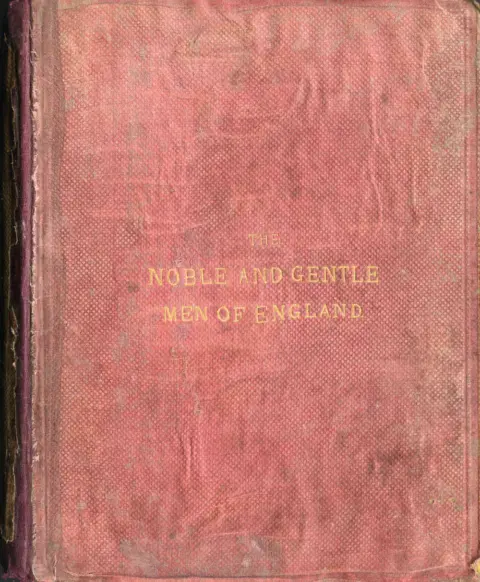
"The Noble and Gentle Men of England" by Evelyn Philip Shirley is a historical account written in the mid-19th century. The work aims to chronicle the arms and genealogies of ancient knightly and gentle families in England, arranged by their respective counties. It particularly focuses on those families that had established themselves before the 16th century, offering insights into the social structure and lineage of England's aristocracy. The opening of the text sets the stage for the author's exploration of England's noble families, outlining his methodology and the limitations he imposed on his investigation. Shirley discusses the criteria for inclusion, emphasizing the importance of direct male descent and the historical ties to the land. He acknowledges the challenges of genealogy, such as distinguishing between ancient and more recent claims to lineages. The introduction also references various sources from county histories and manuscripts, indicating a rigorous approach to documenting the legacy of aristocratic families. These early details lay a foundation for the detailed genealogies that will follow in the subsequent chapters.
Introduction adapted from the source catalogue; source summaries may be automatically generated.
Free to read · English · 64,026 words · No account needed
MAKE TIME FOR A GOOD BOOK
On by default. Untick to stop anonymous reading totals. Each page counts after 10 seconds in view. How this works.
Anonymous counting is on unless you have switched it off.
ARMS.--Lozengy ermine and sable, a canton gules.
Present Representative, John Wilson Patten, Esq. M.P. for North
Lancashire.
+Knightly.+
[Illustration] "One of the ancientest families in the whole shire," wrote Burton in 1622; descended from Ralph Turvile, a benefactor to the abbey of Leicester in 1297. The principal seat was at Normanton Turvile, in this county, where the elder line of the family became extinct in 1776. Aston Flamvile, also in Leicestershire, was the residence of the immediate ancestors of this younger branch. It was sold early in the eighteenth century, and Husband's Bosworth inherited, by the will of Maria-Alathea Fortescue, in 1763.
See Nichols's Leicestershire, under Normanton Turvile, iv. pt. 2. 1004; under Aston Flamvile, ii. pt. 2. 465; under Husband's Bosworth, iv. pt. 2. 451
ARMS.--Gules, three chevronels vair. This coat was borne by Sir Richard Turvile, de co. Warw. in the reign of Edward II., and Sir Nicholas Turvil, at the same period, bore the same coat reduced to two chevrons. (Rolls of the date.)
Present Representative, Francis Charles Turvile, Esq.
[Illustration] This ancient family was certainly seated at Quorndon two descents before the reign of Edward I. In that of Henry VI. Thomas, second son of John Farnham and Margaret Billington, living in 1393, founded a junior branch denominated of "The Nether-Hall." He was the ancestor of the present family, who also descend in the female line from the elder branch, denominated "of Quorndon," by the marriage of the coheiress in 1703 with Benjamin Farnham, of the Nether-Hall.
See Nichols's History of Leicestershire, vol. iii. pt. i. p. 103.
ARMS.--Quarterly or and azure, in the first and second quarter a
crescent interchanged.
Sir Robert de Farnham, of the county of Stafford, bore in the reign of Edward II. Quarterly argent and azure, four crescents counterchanged. (Roll.)
Present Representative, Edward Basil Farnham, Esq. late M.P. for
North Leicestershire.
[Illustration] Lewis de Brienne, who died in 1283, married Agnes, Viscountess de Beaumont, who died in 1300: their children took the name of Beaumont, and from hence this noble family is supposed to be descended. Coleorton came from the heiress of Maureward in the fifteenth century, but Grace-dieu, also in this county, was the older seat. The representative of the elder line of the family was created Viscount Beaumont in Ireland in 1622, extinct 1702, when Coleorton went to the ancestors of the present Baronet, descended from the third son of Nicholas Beaumont, of Coleorton, who died in 1585.
See Nicholas Leicestershire, iii. pt. 2. 743; Wotton's Baronetage, iii. 230; Erdeswick's Staffordshire, ed. 1844, 396; and Hornby's Tract on Dugdale's Baronage.
Your reading position is saved on this browser. Take it to another device with a library code. Reading pages adapt to text, rather than matching a printed edition.
BEHIND THE BOOK
This eBook is for the use of anyone anywhere in the United States and most other parts of the world at no cost and with almost no restrictions whatsoever. You may copy it, give it away or re-use it under the terms of the Project Gutenberg License included with this eBook or online at www.gutenberg.org. If you are not located in the United States, you will have to check the laws of the country where you are located before using this eBook. Read the source licence.
The original source file, including credits and licence, is retained by this library. Request an original-format copy at no charge. Please include the book title and Project Gutenberg identifier #58212.
KEEP YOUR CURIOSITY GOING
Cécile Tormay

Moritz Busch
John L. Ransom
Frances Wright
Cécile Tormay

Mabel Potter Daggett