THE CLASSIC COLLECTION✦An outlaw’s diary: the CommuneCLASSIC FREE BOOKS
An outlaw’s diary: the Commune
Cécile Tormay
THE CLASSIC COLLECTION · 1859
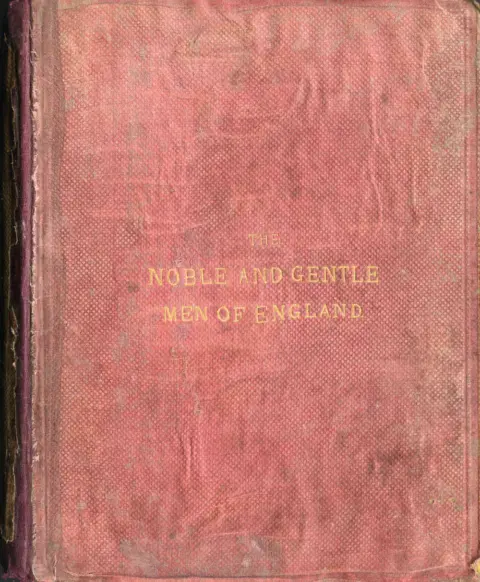
"The Noble and Gentle Men of England" by Evelyn Philip Shirley is a historical account written in the mid-19th century. The work aims to chronicle the arms and genealogies of ancient knightly and gentle families in England, arranged by their respective counties. It particularly focuses on those families that had established themselves before the 16th century, offering insights into the social structure and lineage of England's aristocracy. The opening of the text sets the stage for the author's exploration of England's noble families, outlining his methodology and the limitations he imposed on his investigation. Shirley discusses the criteria for inclusion, emphasizing the importance of direct male descent and the historical ties to the land. He acknowledges the challenges of genealogy, such as distinguishing between ancient and more recent claims to lineages. The introduction also references various sources from county histories and manuscripts, indicating a rigorous approach to documenting the legacy of aristocratic families. These early details lay a foundation for the detailed genealogies that will follow in the subsequent chapters.
Introduction adapted from the source catalogue; source summaries may be automatically generated.
Free to read · English · 64,026 words · No account needed
MAKE TIME FOR A GOOD BOOK
On by default. Untick to stop anonymous reading totals. Each page counts after 10 seconds in view. How this works.
Anonymous counting is on unless you have switched it off.
Sizergh, in the parish of Helsington, appears to have belonged to the Stricklands in the reign of Edward I. Sir Walter de Strickland had licence to empark there in the ninth of Edward III. During the civil wars of the seventeenth century the head of this house was loyal, while Walter, son of Sir William Strickland, of Boynton, Baronet 1641, was one of Cromwell's pretended House of Peers. The Stricklands of Boynton are supposed to be a younger branch of the house of Sizergh. The Stricklands called Standish, of Standish, in the county of Lancaster, represent the elder line, the present Mr. Standish being the eldest son of the late Thomas Strickland, of Sizergh, Esq.
See Burn's Westmorland, vol. i. p. 87; and Whitaker's Richmondshire,
vol. ii. p. 333.
ARMS.--Sable, three escallops within a border engrailed argent. The present coat, but without the border, was borne by Walter de Strykelande, in the reign of Richard II. Another coat, used in the reign of Edward II. was Argent, two bars and a quarter gules. (Rolls.) The Stricklands of Boynton bear, Gules, a chevron or between three crosses patée argent, on a canton ermine a stag's head erased sable.
Present Representative, Walter Strickland, Esq.
[Illustration] Michael le Fleming, living in the reign of William the Conqueror, is the ancestor of this ancient family, originally seated in Cumberland and at Gleston, in Furness, in Lancashire. Isabel, daughter of Sir John de Lancastre, living in the sixth of Henry VI., having married Sir Thomas le Fleming, of Coniston, Knight, seated the Flemings at Rydal, ever since the residence of the family.
See Burn's Westmorland, vol. i. p. 150; and Wotton's Baronetage,
vol. iv. p. 105.
ARMS.--Gules, fretty argent. The present coat, called "The arms of Hoddleston," with a label vert, was borne by John Fleming de Westmerland in the reign of Edward III. (Roll.) A more ancient coat, according to Wotton, was a Fleur-de-lis, within a roundell.
Present Representative, Sir Michael le Fleming, 7th Baronet.
+Gentle.+
[Illustration] In the thirty-eighth year of the reign of Edward III., William de Wybergh, of Saint Bee's, in Cumberland, became possessed of the manor of Clifton, in marriage with Elianor, only daughter of Gilbert D'Engayne, whose family had held it from the time of Henry II. It has ever since continued the seat and residence of their descendants. In Cromwell's days the Wyberghs had the honour to be considered delinquents; and in the succeeding century, in 1715, the head of the house was taken prisoner in consequence of his allegiance to the house of Hanover.
Younger Branch. Lawson of Brayton, Baronet 1831.
See Burn's Westmorland, vol. i. p. 417.
Your reading position is saved on this browser. Take it to another device with a library code. Reading pages adapt to text, rather than matching a printed edition.
BEHIND THE BOOK
This eBook is for the use of anyone anywhere in the United States and most other parts of the world at no cost and with almost no restrictions whatsoever. You may copy it, give it away or re-use it under the terms of the Project Gutenberg License included with this eBook or online at www.gutenberg.org. If you are not located in the United States, you will have to check the laws of the country where you are located before using this eBook. Read the source licence.
The original source file, including credits and licence, is retained by this library. Request an original-format copy at no charge. Please include the book title and Project Gutenberg identifier #58212.
KEEP YOUR CURIOSITY GOING
Cécile Tormay

Moritz Busch
John L. Ransom
Frances Wright
Cécile Tormay

Mabel Potter Daggett