THE CLASSIC COLLECTION✦An outlaw’s diary: the CommuneCLASSIC FREE BOOKS
An outlaw’s diary: the Commune
Cécile Tormay
THE CLASSIC COLLECTION · 1859
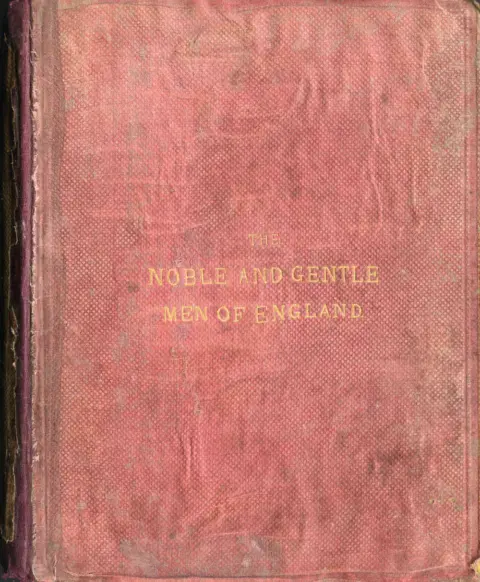
"The Noble and Gentle Men of England" by Evelyn Philip Shirley is a historical account written in the mid-19th century. The work aims to chronicle the arms and genealogies of ancient knightly and gentle families in England, arranged by their respective counties. It particularly focuses on those families that had established themselves before the 16th century, offering insights into the social structure and lineage of England's aristocracy. The opening of the text sets the stage for the author's exploration of England's noble families, outlining his methodology and the limitations he imposed on his investigation. Shirley discusses the criteria for inclusion, emphasizing the importance of direct male descent and the historical ties to the land. He acknowledges the challenges of genealogy, such as distinguishing between ancient and more recent claims to lineages. The introduction also references various sources from county histories and manuscripts, indicating a rigorous approach to documenting the legacy of aristocratic families. These early details lay a foundation for the detailed genealogies that will follow in the subsequent chapters.
Introduction adapted from the source catalogue; source summaries may be automatically generated.
Free to read · English · 64,026 words · No account needed
MAKE TIME FOR A GOOD BOOK
On by default. Untick to stop anonymous reading totals. Each page counts after 10 seconds in view. How this works.
Anonymous counting is on unless you have switched it off.
[Illustration] The name is derived from Throcmorton, in the parish of Fladbury, in the county of Worcester, where John de Trockemerton, the supposed ancestor of this family, was living about the year 1200. From this John descended, after many generations, another "John Throkmerton," who was, according the Leland, "the first setter up of his name to any worship in Throkmerton village, the which was at that tyme neither of his inheritance or purchase, but as a thing taken of the Sete of Wircester in farme, bycause he bore the name of the lordeship and village. This John was Under-Treasurer of England about the tyme of Henry V.;" and married Elianor, daughter and coheir of Guido de la Spine, and thus became possessed of Coughton, in the parish of Hadley, in this county, which has continued the principal seat of the family, of whom the most remarkable was Sir Nicholas Throckmorton, ambassador in France, in the reign of Queen Elizabeth, who died in 1570.
Younger Branches (now extinct), were the Throckmortons of Stoughton and Ellington, in Huntingdonshire, [for the latter see Camden's Visitation of that county in 1613, printed by the Camden Society in 1849, p. 123;] and the Carews of Bedington, in Surrey, Baronet 1714, extinct 1764; descended in the male line from Sir Nicholas, younger son of Sir Nicholas Throckmorton, and Anne, daughter of Sir Nicholas Carew, Knt.; see Wotton's Baronetage, vol. ii. pi 351, and vol. iv. p. 159; Dugdale's Warwickshire, vol. ii. pp. 749 and 819; Nash's Worcestershire, vol. i. p. 452; Leland's Itinerary, vol. iv. p. 16; and for the poetical life of Sir Nicholas Throckmorton, see Peck's Memoirs of Milton.
ARMS.--Gules, on a chevron argent three bars gemelles sable.
Present Representative, Sir Nicholas William Throckmorton, 9th
Baronet.
[Illustration] The descent of this family from the ancient house of Sheldon, of Sheldon, in this county, is a matter of doubt, but admitted by Dugdale to be not improbable. It appears to be proved that the Sheldons are descended from John Sheldon, of Abberton, in Worcestershire, in the reign of Henry IV. Nash, in his History of that county, carries the pedigree two descents higher, viz., to Richard Sheldon of Rowley, in the county of Stafford, whose grandson John was of the same place in the fourth of Edward IV. The manor of Beoly, in Worcestershire, was purchased of Richard Neville Lord Latimer by William Sheldon in the same reign, and continued till the destruction of the mansion-house by fire in the Civil Wars of the seventeenth century, the principal seat of the family, who were connected with Warwickshire by the marriage of William Sheldon, Esq. with Mary, daughter and coheir of William Willington, of Barcheston, Esq., in the reign of Henry VIII. It was this William Sheldon who purchased the manor of Weston, in the parish of Long-Compton, in this county, and here his son Ralph built "a very fair house" in the reign of Queen Elizabeth; but these estates have both, within the memory of man, passed from this ancient family, who still possess considerable properly at Brailes, purchased by William Sheldon in the first of Edward VI.
Your reading position is saved on this browser. Take it to another device with a library code. Reading pages adapt to text, rather than matching a printed edition.
BEHIND THE BOOK
This eBook is for the use of anyone anywhere in the United States and most other parts of the world at no cost and with almost no restrictions whatsoever. You may copy it, give it away or re-use it under the terms of the Project Gutenberg License included with this eBook or online at www.gutenberg.org. If you are not located in the United States, you will have to check the laws of the country where you are located before using this eBook. Read the source licence.
The original source file, including credits and licence, is retained by this library. Request an original-format copy at no charge. Please include the book title and Project Gutenberg identifier #58212.
KEEP YOUR CURIOSITY GOING
Cécile Tormay

Moritz Busch
John L. Ransom
Frances Wright
Cécile Tormay

Mabel Potter Daggett