THE CLASSIC COLLECTION✦An outlaw’s diary: the CommuneCLASSIC FREE BOOKS
An outlaw’s diary: the Commune
Cécile Tormay
THE CLASSIC COLLECTION · 1859
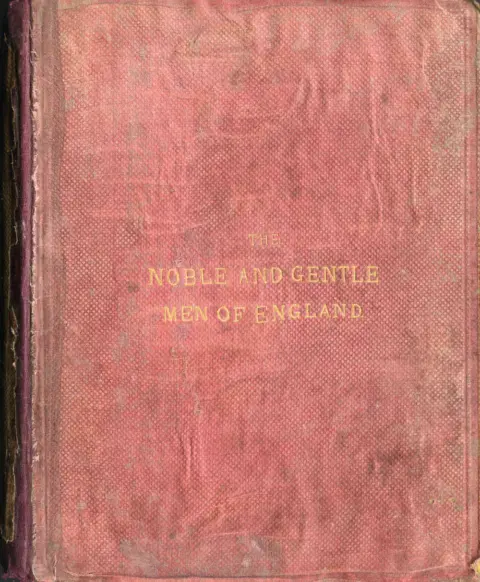
"The Noble and Gentle Men of England" by Evelyn Philip Shirley is a historical account written in the mid-19th century. The work aims to chronicle the arms and genealogies of ancient knightly and gentle families in England, arranged by their respective counties. It particularly focuses on those families that had established themselves before the 16th century, offering insights into the social structure and lineage of England's aristocracy. The opening of the text sets the stage for the author's exploration of England's noble families, outlining his methodology and the limitations he imposed on his investigation. Shirley discusses the criteria for inclusion, emphasizing the importance of direct male descent and the historical ties to the land. He acknowledges the challenges of genealogy, such as distinguishing between ancient and more recent claims to lineages. The introduction also references various sources from county histories and manuscripts, indicating a rigorous approach to documenting the legacy of aristocratic families. These early details lay a foundation for the detailed genealogies that will follow in the subsequent chapters.
Introduction adapted from the source catalogue; source summaries may be automatically generated.
Free to read · English · 64,026 words · No account needed
MAKE TIME FOR A GOOD BOOK
On by default. Untick to stop anonymous reading totals. Each page counts after 10 seconds in view. How this works.
Anonymous counting is on unless you have switched it off.
[Illustration] "The noble race of Sneyds, of great worship and account,"* appear to be denominated from Snead, a hamlet in the parish of Tunstall, in this county, where they were seated as early as the reign of Henry III. By marriage with the heiress of Tunstall they had other lands in that parish, and for two descents were called Snead alias Tunstall. Bradwell, the former seat of this family, was purchased in the reign of Henry IV. The fine old house at Keel, lately taken down and now rebuilt, was erected by Ralph Sneyd, Esq. in 1581. During the Usurpation, the Sneyds being on the loyal side, Keel house narrowly escaped destruction, and many of the ancient evidences were plundered and lost at that time.
Younger Branches. Sneyd of Ashcombe, and of Loxley in this county, descended from the second son of William Sneyd, of Keel, who died in 1694: and the Sneyds of Ireland, descended from Wettenhall, Archdeacon of Kilmore, younger brother of the ancestor of the preceding branches.
See Erdeswick, pp. 20, 25; Leland's Itinerary in Coll. Topog. et Genealog. iii. 342; Gent. Mag. vol. lxxi. p. 28; and Ward's History of the Borough of Stoke-upon-Trent.
ARMS.--Argent, a scythe, the blade in chief, the sned and handle in bend sinister sable, on the fess point a fleur-de-lis of the second. This fleur-de-lis is said to have been assumed by Richard de Tunstall, alias Sneyd, after the battle of Poictiers.
Present Representative, Ralph Sneyd, Esq.
* King's Vale Royal, b. ii. p. 77, who would derive them from
Cheshire.
[Illustration] In the reign of Henry III., Robert Whitgreave, the ancestor of this family, was seated at Burton near Stafford. Bridgeford, in the vicinity of Whitgreave, from whence the name is derived, and early in the seventeenth century Moseley, successively became the residence of the Whitgreaves, and at the latter place Thomas Whitgreave, Esq. had the honour to shelter his sovereign Charles II. after the battle of Worcester.
See Erdeswick, pp. 137, 185, 348.
ARMS.--Azure, on a cross quarterly pierced or four chevrons gules. This coat, founded on the arms of Stafford, was granted by Humphry Earl of Stafford to Robert Whitgrave in the 20th of Henry VI. See the grant in Camden's Remains, ed. 1657, p. 221. An augmentation has been lately added, On a chief argent, a rose gules within a wreath of oak proper.
Present Representative, George Thomas Whitgreave, Esq.
Your reading position is saved on this browser. Take it to another device with a library code. Reading pages adapt to text, rather than matching a printed edition.
BEHIND THE BOOK
This eBook is for the use of anyone anywhere in the United States and most other parts of the world at no cost and with almost no restrictions whatsoever. You may copy it, give it away or re-use it under the terms of the Project Gutenberg License included with this eBook or online at www.gutenberg.org. If you are not located in the United States, you will have to check the laws of the country where you are located before using this eBook. Read the source licence.
The original source file, including credits and licence, is retained by this library. Request an original-format copy at no charge. Please include the book title and Project Gutenberg identifier #58212.
KEEP YOUR CURIOSITY GOING
Cécile Tormay

Moritz Busch
John L. Ransom
Frances Wright
Cécile Tormay

Mabel Potter Daggett