THE CLASSIC COLLECTION✦The Shield of LoveCLASSIC FREE BOOKS
The Shield of Love
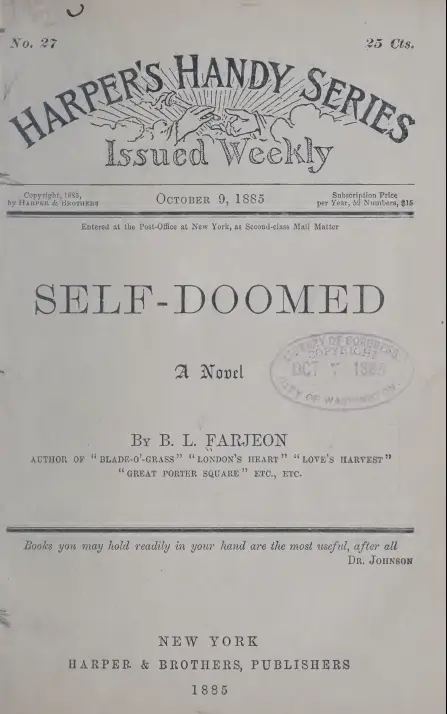
B. L. (Benjamin Leopold) Farjeon
THE CLASSIC COLLECTION · 1885
"The Nine of Hearts: A Novel" by B. L. Farjeon is a fiction work written in the late 19th century. The story revolves around Edward Layton, who stands trial for the murder of his wife, Agnes Layton, raising suspicions and intrigue as the courtroom drama unfolds. The narrative explores themes of love, betrayal, and the complexities of human relationships, particularly in the context of a troubled marriage. At the start of the novel, the courtroom is abuzz with tension as Edward Layton is on trial for the alleged murder of his wife, found dead from poisonous narcotics. His choice to represent himself rather than be defended by his counsel raises questions about his state of mind and the circumstances surrounding the incident. Witnesses provide testimony that paints a complicated picture of Edward’s relationships, revealing the discord between him and Agnes, heightened by revelations of previous engagements and motives tied to inheritance. This opening sets the stage for a gripping legal drama marked by emotional conflict and moral ambiguity.
Introduction adapted from the source catalogue; source summaries may be automatically generated.
Free to read · English · 45,690 words · No account needed
MAKE TIME FOR A GOOD BOOK
On by default. Untick to stop anonymous reading totals. Each page counts after 10 seconds in view. How this works.
Anonymous counting is on unless you have switched it off.
"Not personally," replied the lawyer; "only from report and hearsay. He is an Englishman, and must be an amazingly shrewd fellow; and that he is in earnest is partly proved by this cable, in which no words are spared to make his meaning clear."
While he was speaking to his friend, the lawyer was busily engaged writing upon a blank telegraph form, which was enclosed in the envelope delivered by the messenger.
"What will you do in the matter?" asked Dr. Daincourt.
"Here is my reply," said the lawyer, and he read it aloud:
"From Mr. Bainbridge, Q.C., Harley Street, London, to Archibald Laing, Box 1236, P. 0., Pittsburg, U. S.
"'Your cable received. I undertake the commission, and will use every effort to establish Layton's innocence, in which I firmly believe. There is a mystery in the matter, and I will do my best to get at the heart of it. I will write to you as you desire.'"
He touched the bell and the servant appeared.
"Give this to the telegraph boy," he said, "and pay his cab fare to the telegraph office, in order that there shall be no delay."
When the servant had departed, the lawyer rose from his chair and paced the room slowly in deep thought, and it was during the intervals in his reflections that the conversation between him and Dr. Daincourt was carried on.
"Is it not very strange," said the lawyer, "that I am advised in this cable message to seek information from the one juryman who pronounced Layton innocent, and whose address I have not obtained?"
"Yes, it is, indeed," replied Dr. Daincourt, "very strange."
"Of course I shall find him; there will not be the least difficulty in that respect. Tell me, doctor. It was proved at the trial that Mrs. Layton's death was caused by an overdose of morphia, taken in the form of effervescing lozenges. It was established that she was occasionally in the habit of taking one of these lozenges at night to produce sleep, and her maid swore that her mistress never took more than one, being aware of the danger of an overdose. The usual mode of administering these noxious opiates is by placing one in the mouth and allowing it to dissolve; but they will dissolve in water, and the medical evidence proved that at least eight or ten of the poisonous lozenges must have been administered in this way, in one dose, to the unfortunate lady. The glass from which the liquid was drunk was round, not by her bedside, but on the mantle-shelf, which is at some distance from the bed. It is a natural inference, if the unfortunate woman had administered the dose to herself, that the glass would have been found on the table by her bedside. It was not so found, and the maid declares that her mistress was too weak to get out of bed and return to it unaided. These facts, if they be facts, circumstantially prove that the cause of death lay outside the actions of the invalid herself. The maid states that when she left her mistress the bottle containing about a dozen lozenges was on the table by her mistress's bedside, and also a glass, and a decanter of water; and that when she visited her mistress at between six and seven o'clock in the morning there were no lozenges left in the bottle, and the glass from which they were supposed to be taken, dissolved in water, was on the mantle-shelf. Now, in my view, this circumstance is in favor of the prisoner."
Your reading position is saved on this browser. Take it to another device with a library code. Reading pages adapt to text, rather than matching a printed edition.
B. L. (Benjamin Leopold) Farjeon
B. L. (Benjamin Leopold) Farjeon
B. L. (Benjamin Leopold) Farjeon
B. L. (Benjamin Leopold) Farjeon
BEHIND THE BOOK
This eBook is for the use of anyone anywhere in the United States and most other parts of the world at no cost and with almost no restrictions whatsoever. You may copy it, give it away or re-use it under the terms of the Project Gutenberg License included with this eBook or online at www.gutenberg.org. If you are not located in the United States, you will have to check the laws of the country where you are located before using this eBook. Read the source licence.
The original source file, including credits and licence, is retained by this library. Request an original-format copy at no charge. Please include the book title and Project Gutenberg identifier #53085.
KEEP YOUR CURIOSITY GOING
Coulson Kernahan

Maurice Baring
Frances Wright
Cécile Tormay

Frederic Jesup Stimson

W. H. P. (William Henry Pope) Jarvis